
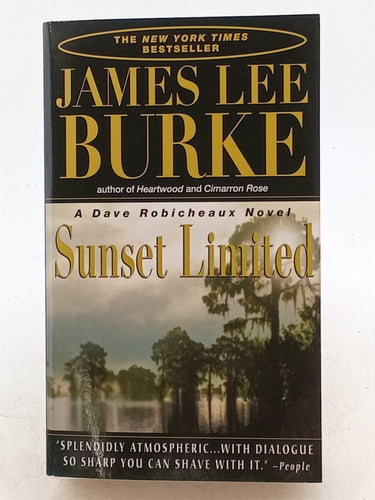
Sunset Limited by James Lee Burke
One of the best novels of the year from one of the very best writers at work today.--Rocky Mountain News The townspeople of New Iberia, Louisiana, didn't crucify Megan Flynn's father. They just didn't catch whoever pinned him to a barn wall with sixteen-penny nails. Decades later, Megan, now a world-famous photojournalist, has come back to the bayou, looking for cop Dave Robicheaux. It was Dave who found the body of labor leader Jack Flynn. The sight changed the boy, shaped him as a man. And after forty years, Robicheaux is still haunted by the bizarre unsolved slaying. Now Megan's return has stirred up the ghosts of the long-buried past, igniting a storm of violence that will rip apart lives of blacks and whites in this bayou country. And for a good cop with bad memories, hard desire, and chilling nightmares, the time has come to uncover the truth. Editorial Reviews Review Splendidly atmospheric...with dialogue so sharp you can shave with it.--People One of the best novels of the year from one of the very best writers at work today.--Rocky Mountain News Engrossing...a vivid, violent fable...James Lee Burke outshines himself in Sunset Limited.--Daily News (N.Y.) America's best novelist.--The Denver Post Top-drawer work...James Lee Burke just keeps getting better...Burke writes of the bayous, their people and their violence with electrical luminescence. The dialogue crackles like heat lightning and the story races from conflict to conflict. Robicheaux, a modern-day tragic hero, continues to grow as one of crime fiction's major figures.--San Antonio Express-News Burke's dialogue sounds true as a tape recording; his writing about action is strong and economical. . . . Burke is a prose stylist to be reckoned with.--Los Angeles Times Book Review Burke flies miles above most contemporary crime novelists.--The Orlando Sentinel Among writers in the genre, only Tony Hillerman's novels about the Navajo tribal police match Burke's ability to write evocatively about the natural world. . . . It's hard to imagine readers not bolting it down like a steaming plate of crawfish etouffee.--Entertainment Weekly Burke writes prose that has a pronounced streak of poetry in it.--The New York Times James Lee Burke isn't simply a crime writer--he's the Graham Greene of the bayou.--New York Daily News If you haven't already discovered Burke's novels, find one!--Chicago Tribune James Lee Burke can write some of the best scenes of violence in American literature. He can also toss out a metaphor or a brief descriptive phrase that can stop a reader cold.--The Washington Post Book World It has become apparent that not since Raymond Chandler has anyone so thoroughly reinvented the crime and mystery genre as James Lee Burke.--Jim Harrison, author of Legends of the Fall If you haven't read Burke, get going.--Playboy Nobody working in the genre holds us more compellingly than Mr. Burke, or with such style and ferocity. He stands all but alone in the invention of character.--The New Yorker One of our most compelling novelists.--New York Newsday Few writers in america can evoke a region as well as Burke.--The Philadelphia Inquirer Robicheaux is a detective to be reckoned with, more interesting than Spenser, more complex and satisfying than Travis McGee . . . James Lee Burke is a writer to be remembered.--USA Today Burke writes prose as moody and memory-laden as his region.--Time Burke tells a story in a style all his own; language that's alive, electric; he's a master at setting mood, laying in atmosphere, all with quirky, raunchy dialog that's a delight.--Elmore Leonard It's hard to deny the powerful impact of Mr. Burke's hard-boiled poetics.--The Wall Street Journal From the Inside Flap aked with sin, Dave Robicheaux is dueling with killers, ghosts, and a woman's revenge.... The townspeople of New Iberia, Louisiana, didn't crucify Megan Flynn's father. They just didn't catch whoever pinned him to a barn wall with sixteen-penny nails. Decades later, Megan, now a world-famous photojournalist, has come back to the bayou, looking for cop Dave Robicheaux. It was Dave who found the body of labor leader Jack Flynn. The sight changed the boy, shaped him as a man. And after forty years, Robicheaux is still haunted by the bizarre unsolved slaying. Now Megan's return has stirred up the ghosts of the long-buried past, igniting a storm of violence that will rip apart lives of blacks and whites in this bayou county. And for a good cop with bad memories, hard desires, and chilling nightmares, the time has come to uncover the truth. From the Back Cover In a land soaked with sin, Dave Robicheaux is dueling with killers, ghosts, and a woman's revenge.... The townspeople of New Iberia, Louisiana, didn't crucify Megan Flynn's father. They just didn't catch whoever pinned him to a barn wall with sixteen-penny nails. Decades later, Megan, now a world-famous photojournalist, has come back to the bayou, looking for cop Dave Robicheaux. It was Dave who found the body of labor leader Jack Flynn. The sight changed the boy, shaped him as a man. And after forty years, Robicheaux is still haunted by the bizarre unsolved slaying. Now Megan's return has stirred up the ghosts of the long-buried past, igniting a storm of violence that will rip apart lives of blacks and whites in this bayou county. And for a good cop with bad memories, hard desires, and chilling nightmares, the time has come to uncover the truth. About the Author James Lee Burke is the author of sixteen previous books, including the New York Times bestsellers Cimarron Rose, Cadillac Jukebox, Burning Angel, and Dixie City Jam. He lives with his wife in Missoula, Montana, and New Iberia, Louisiana. Excerpt. Reprinted by permission. All rights reserved. The jailer, Alex Guidry, lived outside of town on a ten-acre horse farm devoid of trees or shade. The sun's heat pooled in the tin roofs of his outbuildings, and grit and desiccated manure blew out of his horse lots. His oblong 1960s red-brick house, its central-air-conditioning units roaring outside a back window twenty-four hours a day, looked like a utilitarian fortress constructed for no other purpose than to repel the elements. His family had worked for a sugar mill down toward New Orleans, and his wife's father used to sell Negro burial insurance, but I knew little else about him. He was one of those aging, well-preserved men with whom you associate a golf photo on the local sports page, membership in a self-congratulatory civic club, a charitable drive that is of no consequence. Or was there something else, a vague and ugly story years back? I couldn't remember. Sunday afternoon I parked my pickup truck by his stable and walked past a chain-link dog pen to the riding ring. The dog pen exploded with the barking of two German shepherds who caromed off the fencing, their teeth bared, their paws skittering the feces that lay baked on the hot concrete pad. Alex Guidry cantered a black gelding in a circle, his booted calves fitted with English spurs. The gelding's neck and sides were iridescent with sweat. Guidry sawed the bit back in the gelding's mouth. What is it? he said. I'm Dave Robicheaux. I called earlier. He wore tan riding pants and a form-fitting white polo shirt. He dismounted and wiped the sweat off his face with a towel and threw it to a black man who had come out of the stable to take the horse. You want to know if this guy Broussard was in the detention chair? The answer is no, he said. He says you've put other inmates in there. For days. Then he's lying. You have a detention chair, though, don't you? For inmates who are out of control, who don't respond to Isolation. You gag them? No. I rubbed the back of my neck and looked at the dog pen. The water bowl was turned over and flies boiled in the door of the small doghouse that gave the only relief from the sun. You've got a lot of room here. You can't let your dogs run? I said. I tried to smile. Anything else, Mr. Robicheaux? Yeah. Nothing better happen to Cool Breeze while he's in your custody. I'll keep that in mind, sir. Close the gate on your way out, please. I got back in my truck and drove down the shell road toward the cattle guard. A half dozen Red Angus grazed in Guidry's pasture, while snowy egrets perched on their backs. Then I remembered. It was ten or eleven years back, and Alex Guidry had been charged with shooting a neighbor's dog. Guidry had claimed the dog had attacked one of his calves and eaten its entrails, but the neighbor told another story, that Guidry had baited a steel trap for the animal and had killed it out of sheer meanness. I looked into the rearview mirror and saw him watching me from the end of the shell drive, his legs slightly spread, a leather riding crop hanging from his wrist. Monday morning I returned to work at the Iberia Parish Sheriff's Department and took my mail out of my pigeonhole and tapped on the sheriff's office. He tilted back in his swivel chair and smiled when he saw me. His jowls were flecked with tiny blue and red veins that looked like fresh ink on a map when his temper flared. He had shaved too close and there was a piece of bloody tissue paper stuck in the cleft in his chin. Unconsciously he kept stuffing his shirt down over his paunch into his gunbelt. You mind if I come back to work a week early? I asked. This have anything to do with Cool Breeze Broussard's complaint to the Justice Department? I went out to Alex Guidry's place yesterday. How'd we end up with a guy like that as our jailer? It's not a job people line up for, the sheriff said. He scratched his forehead. You've got an FBI agent in your office right now, some gal named Adrien Glazier. You know her? Nope. How'd she know I was going to be here? She called your house first. Your wife told her. Anyway, I'm glad you're back. I want this bullshit at the jail cleared up. We just got a very weird case that was thrown in our face from St. Mary Parish. He opened a manila folder and put on his glasses and peered down at the fax sheets in his fingers. This is the story he told me. Three months ago, under a moon haloed with a rain ring and sky filled with dust blowing out of the sugarcane fields, a seventeen-year-old black girl named Sunshine Labiche claimed two white boys forced her car off a dirt road into a ditch. They dragged her from behind the wheel, walked her by each arm into a cane field, then took turns raping and sodomizing her. The next morning she identified both boys from a book of mug shots. They were brothers, from St. Mary Parish, but four months earlier they had been arrested for a convenience store holdup in New Iberia and had been released for lack of evidence. This time they should have gone down. They didn't. Both had alibis, and the girl admitted she had been smoking rock with her boyfriend before she was raped. She dropped the charges. Late Saturday afternoon an unmarked car came to the farmhouse of the two brothers over in St. Mary Parish. The father, who was bedridden in the front room, watched the visitors, unbeknown to them, through a crack in the blinds. The driver of the car wore a green uniform, like sheriff's deputies in Iberia Parish, and sunglasses and stayed behind the wheel, while a second man, in civilian clothes and a Panama hat, went to the gallery and explained to the two brothers they only had to clear up a couple of questions in New Iberia, then they would be driven back home. It ain't gonna take five minutes. We know you boys didn't have to come all the way over to Iberia Parish just to change your luck, he said. The brothers were not cuffed; in fact, they were allowed to take a twelve-pack of beer with them to drink in the back seat. A half hour later, just at sunset, a student from USL, who was camped out in the Atchafalaya swamp, looked through the flooded willow and gum trees that surrounded his houseboat and saw a car stop on the levee. Two older men and two boys got out. One of the older men wore a uniform. They all held cans of beer in their hands; all of them urinated off the levee into the cattails. Then the two boys, dressed in jeans and Clorox-stained print shirts with the sleeves cut off at the armpits, realized something was wrong. They turned and stared stupidly at their companions, who had stepped backward up the levee and were now holding pistols in their hands. The boys tried to argue, holding their palms outward, as though they were pushing back an invisible adversary. Their arms were olive with suntan, scrolled with reformatory tattoos, their hair spiked in points with butch wax. The man in uniform raised his gun and shouted an unintelligible order at them, motioning at the ground. When the boys did not respond, the second armed man, who wore a Panama hat, turned them toward the water with his hand, almost gently, inserted his shoe against the calf of one, then the other, pushing them to their knees, as though he were arranging manikins in a show window. Then he rejoined the man in uniform up the bank. One of the boys kept looking back fearfully over his shoulder. The other was weeping uncontrollably, his chin tilted upward, his arms stiff at his sides, his eyes tightly shut. The men with guns were silhouetted against a molten red sun that had sunk across the top of the levee. Just as a flock of ducks flapped across the sun, the gunmen clasped their weapons with both hands and started shooting. But because of the fading light, or perhaps the nature of their deed, their aim was bad. Both victims tried to rise from their knees, their bodies convulsing simultaneously from the impact of the rounds. The witness said, Their guns just kept popping. It looked like somebody was blowing chunks out of a watermelon. After it was over, smoke drifted out over the water and the shooter in the Panama hat took close-up flash pictures with a Polaroid camera. The witness used a pair of binoculars. He says the guy in the green uniform had our department patch on his sleeve, the sheriff said. White rogue cops avenging the rape of a black girl? Look, get that FBI agent out of here, will you? He looked at the question in my face. She's got a broom up her ass. He rubbed his fingers across his mouth. Did I say that? I'm going to go back to the laundry business. A bad day used to be washing somebody's golf socks, he said. I looked through my office window at the FBI agent named Adrien Glazier. She sat with her legs crossed, her back to me, in a powder-blue suit and white blouse, writing on a legal pad. Her handwriting was filled with severe slants and slashes, with points in the letters that reminded me of incisor teeth. When I opened the door she looked at me with ice-blue eyes that could have been taken out of a Viking's face. I visited William Broussard last night. He seems to think you're going to get him out of the parish prison, she said. Cool Breeze? He knows better than that. Does he? I waited. Her hair was ash-blond, wispy and broken on the ends, her face big-boned and adversarial. She was one of those you instinctively know have a carefully nursed reservoir of anger they draw upon as needed, in the same way others make use of daily prayer. My stare broke. Sorry. Is that a question? I said. You don't have any business indicating to this man you can make deals for him, she said. I sat down behind my desk and glanced out the window, wishing I could escape back into the coolness of the morning, the streets that were sprinkled with rain, the palm fronds lifting and clattering in the wind. I picked up a stray paper clip and dropped it in my desk drawer and closed the drawer. Her eyes never left my face or relented in their accusation. What if the prosecutor's office does cut him loose? What's it to you? I said. You're interfering in a federal investigation. Evidently you have a reputation for it. I think the truth is you want his cojones in a vise. You'll arrange some slack for him after he rats out some guys you can't make a case against. She uncrossed her legs and leaned forward. She cocked her elbow on my desk and let one finger droop forward at my face. Megan Flynn is an opportunistic bitch. What she didn't get on her back, she got through posing as the Joan of Arc of oppressed people. You let her and her brother jerk your pud, then you're dumber than the people in my office say you are, she said. This has to be a put-on. She pulled a manila folder out from under her legal pad and dropped it on my desk blotter. Those photos are of a guy named Swede Boxleiter. They were taken in the yard at the Colorado state pen in Canon City. What they don't show is the murder he committed in broad daylight with a camera following him around the yard. That's how good he is, she said. His head and face were like those of a misshaped Marxist intellectual, the yellow hair close-cropped on the scalp, the forehead and brainpan too large, the cheeks tapering away to a mouth that was so small it looked obscene. He wore granny glasses on a chiseled nose, and a rotted and torn weight lifter's shirt on a torso that rippled with cartilage. The shots had been taken from an upper story or guard tower with a zoom lens. They showed him moving through the clusters of convicts in the yard, faces turning toward him the way bait fish reflect light when a barracuda swims toward their perimeter. A fat man was leaning against the far wall, one hand squeezed on his scrotum, while he told a story to a half circle of his fellow inmates. His lips were twisted with a word he was forming, purple from a lollypop he had been eating. The man named Swede Boxleiter passed an inmate who held a tape-wrapped ribbon of silver behind his back. After Swede Boxleiter had walked by, the man whose palm seemed to have caught the sun like a heliograph now had his hands stuffed in his pockets. The second-to-last photo showed a crowd at the wall like early men gathered on the rim of a pit to witness the death throes and communal roasting of an impaled mammoth. Then the yard was empty, except for the fat man, the gash across his windpipe bubbling with saliva and blood, the tape-wrapped shank discarded in the red soup on his chest. Boxleiter is buddies with Cisco Flynn. They were in the same state home in Denver. Maybe you'll get to meet him. He got out three days ago, she said. Ms. Glazier, I'd like to-- It's Special Agent Glazier. Right. I'd like to talk with you, but . . . Look, why not let us take care of our own problems? What a laugh. She stood up and gazed down at me. Here it is. Hong Kong is going to become the property of Mainland China soon. There're some people we want to put out of business before we have to deal with Beijing to get at them. Got the big picture? Not really. You know how it is out here in the provinces, swatting mosquitoes, arresting people for stealing hog manure, that sort of thing. She laughed to herself and dropped her card on my desk, then walked out of my office and left the door open as though she would not touch anything in our department unless it was absolutely necessary. At noon I drove down the dirt road by the bayou toward my dock and bait shop. Through the oak trees that lined the shoulder I could see the wide gallery and purple-streaked tin roof of my house up the slope. It had rained again during the morning, and the cypress planks in the walls were stained the color of dark tea, the hanging baskets of impatiens blowing strings of water in the wind. My adopted daughter Alafair, whom I had pulled from a submerged plane wreck out on the salt when she was a little girl, sat in her pirogue on the far side of the bayou, fly-casting a popping bug into the shallows. I walked down on the dock and leaned against the railing. I could smell the salty odor of humus and schooled-up fish and trapped water out in the swamp. Alafair's skin was bladed with the shadows of a willow tree, her hair tied up on her head with a blue bandanna, her hair so black it seemed to fill with lights when she brushed it. She had been born in a primitive village in El Salvador, her family the target of death squads because they had sold a case of Pepsi-Cola to the rebels. Now she was almost sixteen, her Spanish and early childhood all but forgotten. But sometimes at night she cried out in her sleep and would have to be shaken from dreams filled with the marching boots of soldiers, peasants with their thumbs wired together behind them, the dry ratcheting sound of a bolt being pulled back on an automatic weapon. Wrong time of day and too much rain, I said. Oh, yeah? she said. She lifted the fly rod into the air, whipping the popping bug over her head, then laying it on the edge of the lily pads. She flicked her wrist so the bug popped audibly in the water, then a goggle-eye perch rose like a green-and-gold bubble out of the silt and broke the surface, its dorsal fin hard and spiked and shiny in the sunlight, the hook and feathered balsa-wood lure protruding from the side of its mouth. Alafair held the fly rod up as it quivered and arched toward the water, retrieving the line with her left hand, guiding the goggle-eye between the islands of floating hyacinths, until she could lift it wet and flopping into the bottom of the pirogue. Not bad, I said. You had another week off. Why'd you go back to work? she said. Long story. See you inside. No, wait, she said, and set her rod down in the pirogue and paddled across the bayou to the concrete boat ramp. She stepped out into the water with a stringer of catfish and perch wrapped around her wrist, and climbed the wood steps onto the dock. In the last two years all the baby fat had melted off her body, and her face and figure had taken on the appearance of a mature woman's. When she worked with me in the bait shop, most of our male customers made a point of focusing their attention everywhere in the room except on Alafair. A lady named Ms. Flynn was here. Bootsie told me what happened to her father. You found him, Dave? she said. My dad and I did. He was crucified? It happened a long time ago, Alf. The people who did it never got caught? That's sickening. Maybe they took their own fall down the road. They all do, one way or another. It's not enough. Her face seemed heated, pinched, as though by an old memory. You want some help cleaning those fish? I asked. Her eyes looked at me again, then cleared. What would you do if I said yeah? she asked. She swung the stringer so it touched the end of my polished loafer. Megan wants me to get her inside the jail to take pictures? I said to Bootsie in the kitchen. She seems to think you're a pretty influential guy, she replied. Bootsie was bent over the sink, scrubbing the burnt grease off a stove tray, her strong arms swollen with her work; her polo shirt had pulled up over her jeans, exposing the soft taper of her hips. She had the most beautiful hair I had ever seen in a woman. It was the color of honey, with caramel swirls in it, and its thickness and the way she wore it up on her head seemed to make the skin of her face even more pink and lovely. Is there anything else I can arrange? An audience with the Pope? I said. She turned from the drainboard and dried her hands on a towel. That woman's after something else. I just don't know what it is, she said. The Flynns are complicated people. They have a way of finding war zones to play in. Don't let her take you over the hurdles, Streak. I hit her on the rump with the palm of my hand. She wadded up the dish towel and threw it past my head. We ate lunch on the redwood table under the mimosa tree in the back yard. Beyond the duck pond at the back of our property my neighbor's sugarcane was tall and green and marbled with the shadows of clouds. The bamboo and periwinkles that grew along our coulee rippled in the wind, and I could smell rain and electricity in the south. What's in that brown envelope you brought home? Bootsie asked. Pictures of a mainline sociopath in the Colorado pen. Why bring them home? I've seen the guy. I'm sure of it. But I can't remember where. Around here? No. Somewhere else. The top of his head looks like a yellow cake but he has no jaws. An obnoxious FBI agent told me he's pals with Cisco Flynn. A head like a yellow cake? A mainline con? Friends with Cisco Flynn? Yeah. Wonderful. That night I dreamed of the man named Swede Boxleiter. He was crouched on his haunches in the darkened exercise yard of a prison, smoking a cigarette, his granny glasses glinting in the humid glow of lights on the guard towers. The predawn hours were cool and filled with the smells of sage, water coursing over boulders in a canyon riverbed, pine needles layered on the forest floor. A wet, red dust hung in the air, and the moon seemed to rise through it, above the mountain's rim, like ivory skeined with dyed thread. But the man named Swede Boxleiter was not one to concern himself with the details of the alpine environment he found himself in. The measure of his life and himself was the reflection he saw in the eyes of others, the fear that twitched in their faces, the unbearable tension he could create in a cell or at a dining table simply by not speaking. He didn't need a punk or prune-o or the narcissistic pleasure of clanking iron in the yard or even masturbation for release from the energies that, unsatiated, could cause him to wake in the middle of the night and sit in a square of moonlight as though he were on an airless plateau that echoed with the cries of animals. Sometimes he smiled to himself and fantasized about telling the prison psychologist what he really felt inside, the pleasure that climbed through the tendons in his arm when he clasped a shank that had been ground from a piece of angle iron on an emery wheel in the shop, the intimacy of that last moment when he looked into the eyes of the hit. The dam that seemed to break in his loins was like water splitting the bottom of a paper bag. But prison shrinks were not people you confided in, at least if you were put together like Swede Boxleiter and ever wanted to make the street again. In my dream he rose from his crouched position, reached up and touched the moon, as though to despoil it, but instead wiped away the red skein from one corner with his fingertip and exposed a brilliant white cup of light. I sat up in bed, the window fan spinning its shadows on my skin, and remembered where I had seen him. Early the next morning I went to the city library on East Main Street and dug out the old Life magazine in which Megan's photos of a black rapist's death inside a storm drain had launched her career. Opposite the full-page shot of the black man reaching out futilely for the sunlight was the group photo of five uniformed cops staring down at his body. In the foreground was Swede Boxleiter, holding a Red Delicious apple with a white divot bitten out of it, his smile a thin worm of private pleasure stitched across his face. But I wasn't going to take on the Flynns' problems, I told myself, or worry about a genetic misfit in the Colorado pen. I was still telling myself that late that night when Mout' Broussard, New Iberia's legendary shoeshine man and Cool Breeze's father, called the bait shop and told me his son had just escaped from the parish prison.
Publication Details
Title:
Author(s):
Illustrator:
Binding: Paperback
Published by: Island Books: , 1999
Edition:
ISBN: 9780440223986 | 0440223989
416 pages.
Book Condition: Very Good
products.product.pickup_availability.unavailable
Product information

New Zealand Delivery
Shipping Options
Shipping options are shown at checkout and will vary depending on the delivery address and weight of the books.
We endeavour to ship the following day after your order is made and to have pick up orders available the same day. We ship Monday-Friday. Any orders made on a Friday afternoon will be sent the following Monday. We are unable to deliver on Saturday and Sunday.
Pick Up is Available in NZ:
Warehouse Pick Up Hours
- Monday - Friday: 9am-5pm
- 35 Nathan Terrace, Shannon NZ
Please make sure we have confirmed your order is ready for pickup and bring your confirmation email with you.
Rates
-
New Zealand Standard Shipping - $6.00
- New Zealand Standard Rural Shipping - $10.00
- Free Nationwide Standard Shipping on all Orders $75+
Please allow up to 5 working days for your order to arrive within New Zealand before contacting us about a late delivery. We use NZ Post and the tracking details will be emailed to you as soon as they become available. There may be some courier delays that are out of our control.
International Delivery
We currently ship to Australia and a range of international locations including: Belgium, Canada, China, Switzerland, Czechia, Germany, Denmark, Spain, Finland, France, United Kingdom, United States, Hong Kong SAR, Thailand, Philippines, Ireland, Israel, Italy, Japan, South Korea, Malaysia, Netherlands, Norway, Poland, Portugal, Sweden & Singapore. If your country is not listed, we may not be able to ship to you, or may only offer a quoting shipping option, please contact us if you are unsure.
International orders normally arrive within 2-4 weeks of shipping. Please note that these orders need to pass through the customs office in your country before it will be released for final delivery, which can occasionally cause additional delays. Once an order leaves our warehouse, carrier shipping delays may occur due to factors outside our control. We, unfortunately, can’t control how quickly an order arrives once it has left our warehouse. Contacting the carrier is the best way to get more insight into your package’s location and estimated delivery date.
- Global Standard 1 Book Rate: $37 + $10 for every extra book up to 20kg
- Australia Standard 1 Book Rate: $14 + $4 for every extra book
Any parcels with a combined weight of over 20kg will not process automatically on the website and you will need to contact us for a quote.
Payment Options
On checkout you can either opt to pay by credit card (Visa, Mastercard or American Express), Google Pay, Apple Pay, Shop Pay & Union Pay. Paypal, Afterpay and Bank Deposit.
Transactions are processed immediately and in most cases your order will be shipped the next working day. We do not deliver weekends sorry.
If you do need to contact us about an order please do so here.
You can also check your order by logging in.
Contact Details
- Trade Name: Book Express Ltd
- Phone Number: (+64) 22 852 6879
- Email: sales@bookexpress.co.nz
- Address: 35 Nathan Terrace, Shannon, 4821, New Zealand.
- GST Number: 103320957 - We are registered for GST in New Zealand
- NZBN: 9429031911290
We have a 30-day return policy, which means you have 30 days after receiving your item to request a return.
To be eligible for a return, your item must be in the same condition that you received it, unworn or unread.
To start a return, you can contact us at sales@bookexpress.co.nz. Please note that returns will need to be sent to the following address: 35 Nathan Terrace, Shannon, New Zealand 4821.
If your return is for a quality or incorrect item, the cost of return will be on us, and will refund your cost. If it is for a change of mind, the return will be at your cost.
You can always contact us for any return question at sales@bookexpress.co.nz.
Damages and issues
Please inspect your order upon reception and contact us immediately if the item is defective, damaged or if you receive the wrong item, so that we can evaluate the issue and make it right.
Exceptions / non-returnable items
Certain types of items cannot be returned, like perishable goods (such as food, flowers, or plants), custom products (such as special orders or personalised items), and personal care goods (such as beauty products). Although we don't currently sell anything like this. Please get in touch if you have questions or concerns about your specific item.
Unfortunately, we cannot accept returns on gift cards.
Exchanges
The fastest way to ensure you get what you want is to return the item you have, and once the return is accepted, make a separate purchase for the new item.
European Union 14 day cooling off period
Notwithstanding the above, if the merchandise is being shipped into the European Union, you have the right to cancel or return your order within 14 days, for any reason and without a justification. As above, your item must be in the same condition that you received it, unworn or unused, with tags, and in its original packaging. You’ll also need the receipt or proof of purchase.
Refunds
We will notify you once we’ve received and inspected your return, and let you know if the refund was approved or not. If approved, you’ll be automatically refunded on your original payment method within 10 business days. Please remember it can take some time for your bank or credit card company to process and post the refund too.
If more than 15 business days have passed since we’ve approved your return, please contact us at sales@bookexpress.co.nz.