
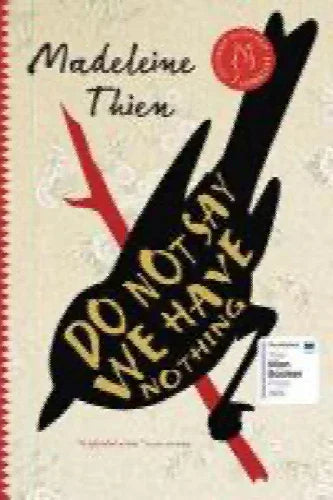
Do Not Say We Have Nothing by Madeleine Thien
Winner of the 2016 Scotiabank Giller Prize and the Governor General's Literary Award for Fiction, shortlisted for the Man Booker Prize, and longlisted for the 2017 Andrew Carnegie Medal for Excellence in Fiction, this extraordinary novel tells the story of three musicians in China before, during and after the Tiananmen Square protests of 1989. Madeleine Thien's new novel is breathtaking in scope and ambition even as it is hauntingly intimate. With the ease and skill of a master storyteller, Thien takes us inside an extended family in China, showing us the lives of two successive generations--those who lived through Mao's Cultural Revolution in the mid-twentieth century; and the children of the survivors, who became the students protesting in Tiananmen Square in 1989, in one of the most important political moments of the past century. With exquisite writing sharpened by a surprising vein of wit and sly humour, Thien has crafted unforgettable characters who are by turns flinty and headstrong, dreamy and tender, foolish and wise. At the centre of this epic tale, as capacious and mysterious as life itself, are enigmatic Sparrow, a genius composer who wishes desperately to create music yet can find truth only in silence; his mother and aunt, Big Mother Knife and Swirl, survivors with captivating singing voices and an unbreakable bond; Sparrow's ethereal cousin Zhuli, daughter of Swirl and storyteller Wen the Dreamer, who as a child witnesses the denunciation of her parents and as a young woman becomes the target of denunciations herself; and headstrong, talented Kai, best friend of Sparrow and Zhuli, and a determinedly successful musician who is a virtuoso at masking his true self until the day he can hide no longer. Here, too, is Kai's daughter, the ever-questioning mathematician Marie, who pieces together the tale of her fractured family in present-day Vancouver, seeking a fragile meaning in the layers of their collective story. With maturity and sophistication, humour and beauty, a huge heart and impressive understanding, Thien has crafted a novel that is at once beautifully intimate and grandly political, rooted in the details of daily life inside China, yet transcendent in its universality. Editorial Reviews Review #1 NATIONAL BESTSELLER SHORTLISTED FOR THE CANADIAN AUTHORS ASSOCIATION AWARD FOR FICTION SHORTLISTED FOR THE RATHBONES FOLIO PRIZE SHORTLISTED FOR THE BAILEYS WOMEN'S PRIZE FOR FICTION WINNER OF THE SCOTIABANK GILLER PRIZE WINNER OF THE GOVERNOR GENERAL'S LITERARY AWARD FINALIST FOR THE MAN BOOKER PRIZE LONGLISTED FOR THE ANDREW CARNEGIE MEDAL FOR EXCELLENCE IN FICTION Madeleine Thien's Do Not Say We Have Nothing is an elegant, nuanced and perfectly realized novel that, fugue-like, presents the lives of individuals, collectives, and generations caught in the complexities of history. Tracing the intertwined lives of two families, moving from Revolutionary China to Canada, this ambitious work explores the persistence of past and the power of art, raising meaningful questions for our times. --Governor General's Award jury citation Do Not Say We Have Nothing by Madeleine Thien entranced the jurors with its detailed, layered, complex drama of classical musicians and their loved ones trying to survive two monstrous insults to their humanity: Mao Zedong's Cultural Revolution in mid-twentieth century China and the Tiananmen Square massacre of protestors in Beijing in 1989. Do Not Say We Have Nothing addresses some of the timeless questions of literature: who do we love, and how do the love of art, of others and ourselves sustain us individually and collectively in the face of genocide? A beautiful homage to music and to the human spirit, Do Not Say We Have Nothing is both sad and uplifting in its dramatization of human loss and resilience in China and in Canada. --Scotiabank Giller Prize jury citation A beautiful, sorrowful work. The book impresses in many senses. . . . Seductive . . . The larger saga unfurls like silk--and proves similarly resistant to knots, a testament to Ms. Thien's storytelling skills. . . . Virtuoso. --The New York Times Thien is a novelist through and through. --The Globe and Mail With compassion and meticulous precision, Madeleine Thien explores ordinary lives shaped by extraordinary political events. Like a beautiful and complex piece of music, the narration unfolds in layers, returning again and again to the central themes of family, memory and loss. Thien is a serious and gifted writer. --Ma Jian, author of Beijing Coma The tragedy and absurdity of modern China never felt so alive as in Madeleine Thien's Do Not Say We Have Nothing. Thien writes of an extended family of musical prodigies whose loves and ambitions are thwarted at every turn. The meticulous research that went into this novel about real-life events makes it so utterly believable that your heart aches. Thien's writing is as lyrical as works of Bach and Shostakovich that inspire her musician characters, but her tour de force is the last movement of this symphonic novel in which the 1989 massacre at Tiananmen Square unfolds at a thrilling, fortissimo pace. --Barbara Demick, author of Nothing to Envy This is a resplendent, epic masterpiece of a novel that brings to light a dark period of Chinese history through wit, humour and nuanced storytelling. The characters linger long after the last page. --Alice Pung, author of Unpolished Gem Intelligent, powerful and moving. This is Madeleine Thien's magnum opus. --Tan Twan Eng, author of The Garden of Evening Mists Imagination, Nabokov says, is a form of memory. Do Not Say We Have Nothing is a perfect example of how a writer's imagination keeps alive the memory of a country's and its people's past when the country itself tries to erase the history. With insight and compassion, Madeleine Thien presents a compelling tale of China of twentieth century. --Yiyun Li, author of The Vagrants [S]killfully and elliptically told. . . . A colourful cast of characters comes to life. . . . Do Not Say We Have Nothing . . . show[s] Thien at the height of her abilities. . . . With unflinching clarity, Thien examines the strange, frightening psychology of mass violence in this period and how countless lives were lost as a result. It falls to music, art and literature to salvage fleeting moments of beauty from the ruins of history, the lives of the dead. --National Post It's rare to encounter a new literary novel with the sweep and scope of Do Not Say We Have Nothing. It's no exaggeration to say the reading experience is reminiscent of some of the great Russians: Dostoevsky, Pasternak, Solzhenitsyn. . . . There's a mastery of storytelling here and the book is engaging on every page. --The Vancouver Sun [A] gorgeous intergenerational saga. . . . Should any doubt remain, Do Not Say We Have Nothing will cement Madeleine Thien as one of Canada's most talented novelists. . . . [T]horoughly researched but without the burden of trivia, both riveting and lyrical. --The Globe and Mail To say Thien's characters come to life is an approximation: they are at once so whole and so open that a reader can step into the book seamlessly, watching, shifting as the pages turn. The affinity reaches so deeply that we celebrate their hopes and mourn their losses; a death leaves me crying in my kitchen. . . . [T]hien's descriptions manage to have at once the lightness of the perfect, obvious observation, and the heft of time and place. . . . My copy is dog-eared through with lines that ring and hold. . . . The novel floats by like a dream of words, a piece of the story, in solidarity with its dreamers. --Montreal Review of Books Madeleine Thien . . . strives mightily to decant the tragedy of revolutionary-cum-communist China into a literary epic. . . . That such a diffuse tale should prove shattering serves as testament to Thien's formidable storytelling skills. The vortex of ideological terror that sweeps up the characters, the harrowing experiences a cruel and pitiless regime foists upon them, and even the potent yet witty prose conveying all this drama sear themselves into your consciousness. . . . Do Not Say We Have Nothing . . . will enthrall just about any reader. --Toronto Star [T]hien delivers in spades. She has clearly done years of historical research into the turbulent timelines of twentieth-century China. . . . Thien's plots are always complicated, but the challenges of untangling them is part of the pleasure. . . . [S]he is creating a memorial for the millions of lives lost, disappeared, shriveled or wasted during not just the years of Mao's reign but back to the famine of 1910 and forward to the dashed hopes of Tiananmen in 1989. That is some accomplishment. --Literary Review of Canada [M]adeleine Thien's sensitive, effective exploration of how the Cultural Revolution still reverberates in the lives of those who experienced it, as well as their descendants. . . . [T]hien's polished prose immerses the reader into the lives of classically trained musicians in the Shanghai Conservatory of Music. . . . [A] story of love and hope. . . . Thien writes with empathy, even for those who cannot forgive themselves. --Winnipeg Free Press Do Not Say We Have Nothing is a serious accomplishment. . . . [A] sprawling work, composed of fragmented narratives, and crammed with indelible characters, horrific events and compelling ideas. . . . [T]hien manages to keep her material firmly in control. . . . This book calls to mind Dai Sijie's magical Balzac and the Little Chinese Seamstress in the way literature and music help characters endure exile and re-education. . . . The sound of music is this novel's most powerful force. --Maclean's Bold, beautiful and profoundly affecting, Do Not Say We Have Nothing celebrates the indestructibility of the individual, and both declares and illustrates the transcendent power of art. An exceptional novel. --James Scudamore, author of The Amnesia Clinic and Heliopolis Writing about history in dazzlingly original and lyrical fictional form has been the stock-in-trade of the forty-one-year-old Vancouver-born Thien, and has made her one of Canada's most critically acclaimed writers. . . . Revolving around two families of musicians living through the often horrifying ructions of twentieth-century China, from the Cultural Revolution to the iconic events of 1989 in Tiananmen Square, the book is both a salutary reminder of Thien's many strengths and a stunning next-level statement. --The Gazette Elegiac and complex. . . . The novel is a gripping page-turner, an instant history of China in the twentieth century. --The Sun Times About the Author Madeleine Thien is the author of the story collection Simple Recipes, which was a finalist for the Commonwealth Writers' Prize, a Kiriyama Pacific Prize Notable Book, and won the BC Book Prize for Fiction; the novel Certainty, which won the Amazon.ca First Novel Award; and the novel Dogs at the Perimeter, which was shortlisted for Berlin's 2014 International Literature Award and won the Frankfurt Book Fair's 2015 Liberaturpreis. Her novels and stories have been translated into twenty-five languages, and her essays have appeared in Granta, The Guardian, the Financial Times, Five Dials, Brick and Al Jazeera. Her story The Wedding Cake was shortlisted for the prestigious 2015 Sunday Times EFG Short Story Award. The daughter of Malaysian-Chinese immigrants to Canada, she lives in Montreal. Excerpt. ® Reprinted by permission. All rights reserved. On the 16th of December, 1990, Ma came home in a taxi with a new daughter who wore no coat, only a thick scarf, a woollen sweater, blue jeans and canvas shoes. I had never met a Chinese girl before, that is, one who, like my father, came from real mainland China. A pair of grey mittens dangled from a string around her neck and swayed in nervous rhythm against her legs. The fringed ends of her blue scarf fell one in front and one behind, like a scholar. The rain was falling hard, and she walked with her head down, holding a medium-sized suitcase that appeared to be empty. She was pale and her hair had the gleam of the sea. Casually I opened the door and widened my eyes as if I was not expecting visitors. Girl, Ma said. Take the suitcase. Hurry up. Ai-ming stepped inside and paused on the edge of the doormat. When I reached for the suitcase, my hand accidentally touched hers, but she didn't draw back. Instead, her other hand reached out and lightly covered mine. She gazed right at me, with such openness and curiosity that, out of shyness, I closed my eyes. Ai-ming, Ma was saying. Let me introduce you. This is my Girl. I pulled away and opened my eyes again. Ma, taking off her coat, glanced first at me and then at the room. The brown sofa with its three camel-coloured stripes had seen better days, but I had spruced it up with all the flowery pillows and stuffed animals from my bed. I had also turned on the television in order to give this room the appearance of liveliness. Ma nodded vigorously at me. Girl, greet your aunt. Really, it's okay if you call me Ai-ming. Please. I really, mmm, prefer it. To placate them both, I said, Hello. Just as I suspected, the suitcase was very light. With my free hand, I moved to take Ai-ming's coat, remembering too late she didn't have one. My arm wavered in the air like a question mark. She reached out, grasped my hand and firmly shook it. She had a question in her eyes. Her hair, pinned back on one side, fell loosely on the other, so that she seemed forever in profile, about to turn towards me. Without letting go of my hand, she manoeuvred her shoes noiselessly off her feet, first one then the other. Pinpoints of rain glimmered on her scarf. Our lives had contracted to such a degree that I could not remember the last time a stranger had entered our home; Ai-ming's presence made everything unfamiliar, as if the walls were crowding a few inches nearer to see her. The previous night, we had, at last, tidied Ba's papers and notebooks, putting them into boxes and stacking the boxes under the kitchen table. Now I found the table's surface deceitfully bare. I freed my hand, saying I would put the suitcase in her bedroom. Ma showed her around the apartment. I retreated to the sofa and pretended to watch the Weather Channel, which predicted rain for the rest of the week, the rest of 1990, the rest of the century, and even the remainder of all time. Their two voices ran one after the other like cable cars, interrupted now and then by silence. The intensity in the apartment crept inside me, and I had the sensation that the floor was made of paper, that there were words written everywhere I couldn't read, and one unthinking gesture could crumple this whole place down.
Publication Details
Title:
Author(s):
Illustrator:
Binding: Hardcover
Published by: Knopf Canada: , 2016
Edition:
ISBN: 9780345810427 | 0345810422
480 pages.
Book Condition: Very Good
products.product.pickup_availability.unavailable
Product information
New Zealand Delivery
Shipping Options
Shipping options are shown at checkout and will vary depending on the delivery address and weight of the books.
We endeavour to ship the following day after your order is made and to have pick up orders available the same day. We ship Monday-Friday. Any orders made on a Friday afternoon will be sent the following Monday. We are unable to deliver on Saturday and Sunday.
Pick Up is Available in NZ:
Warehouse Pick Up Hours
- Monday - Friday: 9am-5pm
- 35 Nathan Terrace, Shannon NZ
Please make sure we have confirmed your order is ready for pickup and bring your confirmation email with you.
Rates
-
New Zealand Standard Shipping - $6.00
- New Zealand Standard Rural Shipping - $10.00
- Free Nationwide Standard Shipping on all Orders $75+
Please allow up to 5 working days for your order to arrive within New Zealand before contacting us about a late delivery. We use NZ Post and the tracking details will be emailed to you as soon as they become available. There may be some courier delays that are out of our control.
International Delivery
We currently ship to Australia and a range of international locations including: Belgium, Canada, China, Switzerland, Czechia, Germany, Denmark, Spain, Finland, France, United Kingdom, United States, Hong Kong SAR, Thailand, Philippines, Ireland, Israel, Italy, Japan, South Korea, Malaysia, Netherlands, Norway, Poland, Portugal, Sweden & Singapore. If your country is not listed, we may not be able to ship to you, or may only offer a quoting shipping option, please contact us if you are unsure.
International orders normally arrive within 2-4 weeks of shipping. Please note that these orders need to pass through the customs office in your country before it will be released for final delivery, which can occasionally cause additional delays. Once an order leaves our warehouse, carrier shipping delays may occur due to factors outside our control. We, unfortunately, can’t control how quickly an order arrives once it has left our warehouse. Contacting the carrier is the best way to get more insight into your package’s location and estimated delivery date.
- Global Standard 1 Book Rate: $37 + $10 for every extra book up to 20kg
- Australia Standard 1 Book Rate: $14 + $4 for every extra book
Any parcels with a combined weight of over 20kg will not process automatically on the website and you will need to contact us for a quote.
Payment Options
On checkout you can either opt to pay by credit card (Visa, Mastercard or American Express), Google Pay, Apple Pay, Shop Pay & Union Pay. Paypal, Afterpay and Bank Deposit.
Transactions are processed immediately and in most cases your order will be shipped the next working day. We do not deliver weekends sorry.
If you do need to contact us about an order please do so here.
You can also check your order by logging in.
Contact Details
- Trade Name: Book Express Ltd
- Phone Number: (+64) 22 852 6879
- Email: sales@bookexpress.co.nz
- Address: 35 Nathan Terrace, Shannon, 4821, New Zealand.
- GST Number: 103320957 - We are registered for GST in New Zealand
- NZBN: 9429031911290
We have a 30-day return policy, which means you have 30 days after receiving your item to request a return.
To be eligible for a return, your item must be in the same condition that you received it, unworn or unread.
To start a return, you can contact us at sales@bookexpress.co.nz. Please note that returns will need to be sent to the following address: 35 Nathan Terrace, Shannon, New Zealand 4821.
If your return is for a quality or incorrect item, the cost of return will be on us, and will refund your cost. If it is for a change of mind, the return will be at your cost.
You can always contact us for any return question at sales@bookexpress.co.nz.
Damages and issues
Please inspect your order upon reception and contact us immediately if the item is defective, damaged or if you receive the wrong item, so that we can evaluate the issue and make it right.
Exceptions / non-returnable items
Certain types of items cannot be returned, like perishable goods (such as food, flowers, or plants), custom products (such as special orders or personalised items), and personal care goods (such as beauty products). Although we don't currently sell anything like this. Please get in touch if you have questions or concerns about your specific item.
Unfortunately, we cannot accept returns on gift cards.
Exchanges
The fastest way to ensure you get what you want is to return the item you have, and once the return is accepted, make a separate purchase for the new item.
European Union 14 day cooling off period
Notwithstanding the above, if the merchandise is being shipped into the European Union, you have the right to cancel or return your order within 14 days, for any reason and without a justification. As above, your item must be in the same condition that you received it, unworn or unused, with tags, and in its original packaging. You’ll also need the receipt or proof of purchase.
Refunds
We will notify you once we’ve received and inspected your return, and let you know if the refund was approved or not. If approved, you’ll be automatically refunded on your original payment method within 10 business days. Please remember it can take some time for your bank or credit card company to process and post the refund too.
If more than 15 business days have passed since we’ve approved your return, please contact us at sales@bookexpress.co.nz.