
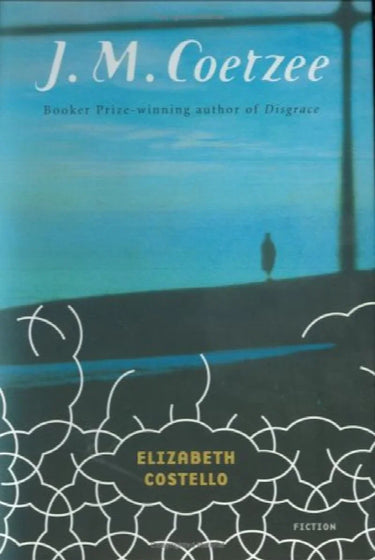
Elizabeth Costello by J. M. Coetzee
The life of aging Australian novelist Elizabeth Costello is revealed through a series of eight formal addresses that include an award-acceptance speech at a New England liberal arts college, a lecture on evil in Amsterdam, and a sexually charged reading by poet Robert Duncan. 50,000 first printing. Editorial Reviews For South African writer J.M. Coetzee, winner of two Booker Prizes and the 2003 Nobel Prize for Literature, the world of receiving literary awards and giving speeches must be such a commonplace that he has put the circuit at the center of his book, Elizabeth Costello. As the work opens, in fact, the eponymous Elizabeth, a fictional novelist, is in Williamstown, Pennsylvania, to receive the Stowe Award. For her speech at the Williamstown's Altona College she chooses the tired topic, What Is Realism? and quickly loses her audience in her unfocused discussion of Kafka. From there, readers follow her to a cruise ship where she is virtually imprisoned as a celebrity lecturer to the ship's guests. Next, she is off to Appleton College where she delivers the annual Gates Lecture. Later, she will even attend a graduation speech. Coetzee has made this project difficult for himself. Occasional writing--writing that includes graduation speeches, acceptance speeches, or even academic lectures--is a less than auspicious form around which to build a long work of fiction. A powerful central character engaged in a challenging stage of life might sustain such a work. Yet, at the start, Coetzee declares that Elizabeth is old and tired, and her best book, The House on Eccles Street is long in her past. Elizabeth Costello lacks a progressive plot and offers little development over the course of each new performance at the lectern. Readers are given Elizabeth fully formed with only brief glimpses of her past sexual dalliances and literary efforts. In the end, Elizabeth Costello seems undecided about its own direction. When Elizabeth is brought to a final reckoning at the gates of the afterlife, she begins to suspect that she is actually in hell, or at least purgatory: a purgatory of clichés. Perhaps Coetzee's Elizabeth Costello, which can be read as an extended critique of clichéd writing, is a portrait of this purgatory. While some readers may find Coetzee's philosophical prose sustenance enough on the journey, some will turn back at the gate. --Patrick O'Kelley From Publishers Weekly Even more uncompromising than usual, this latest novel by Coetzee (his first since 1999's Booker Prize-winning Disgrace) blurs the bounds of fiction and nonfiction while furthering the author's exploration of urgent moral and aesthetic questions. Elizabeth Costello, a fictional aging Australian novelist who gained fame for a Ulysses-inspired novel in the 1960s, reveals the workings of her still-formidable mind in a series of formal addresses she either attends or delivers herself (an award acceptance speech, a lecture on a cruise ship, a graduation speech). This ingenious structure allows Coetzee to circle around his protagonist, revealing her preoccupations and contradictions her relationships with her son, John, an academic, and her sister, Blanche, a missionary in Africa; her deep, almost fanatical concern with animal rights; her conflicted views on reason and realism; her grapplings with the human problems of sex and spirituality. The specters of the Holocaust and colonialism, of Greek mythology and Christian morality, and of Franz Kafka and the absurd haunt the novel, as Coetzee deftly weaves the intense contemplation of abstractions with the everyday life of an all-too-human body and mind. The struggle for self-expression comes to a wrenching climax when Elizabeth faces a final reckoning and finds herself at a loss for words. This is a novel of weighty ideas, concerned with what it means to be human and with the difficult and seductive task of making meaning. It is a resounding achievement by Coetzee and one that will linger with the reader long after its reverberating conclusion. Copyright 2003 Reed Business Information, Inc. From Publishers Weekly Even more uncompromising than usual, this latest novel by Coetzee (his first since 1999's Booker Prize-winning Disgrace) blurs the bounds of fiction and nonfiction while furthering the author's exploration of urgent moral and aesthetic questions. Elizabeth Costello, a fictional aging Australian novelist who gained fame for a Ulysses-inspired novel in the 1960s, reveals the workings of her still-formidable mind in a series of formal addresses she either attends or delivers herself (an award acceptance speech, a lecture on a cruise ship, a graduation speech). This ingenious structure allows Coetzee to circle around his protagonist, revealing her preoccupations and contradictions her relationships with her son, John, an academic, and her sister, Blanche, a missionary in Africa; her deep, almost fanatical concern with animal rights; her conflicted views on reason and realism; her grapplings with the human problems of sex and spirituality. The specters of the Holocaust and colonialism, of Greek mythology and Christian morality, and of Franz Kafka and the absurd haunt the novel, as Coetzee deftly weaves the intense contemplation of abstractions with the everyday life of an all-too-human body and mind. The struggle for self-expression comes to a wrenching climax when Elizabeth faces a final reckoning and finds herself at a loss for words. This is a novel of weighty ideas, concerned with what it means to be human and with the difficult and seductive task of making meaning. It is a resounding achievement by Coetzee and one that will linger with the reader long after its reverberating conclusion. Copyright 2003 Reed Business Information, Inc. From Booklist Although it's billed as a novel masquerading as a biography, some readers may speculate that Coetzee's newest is a biography posing as a novel, or even lectures formed into fiction (six portions were previously published separately). The format is instantly intriguing. Elizabeth Costello is a near-elderly Australian novelist who remains best known for an early work in which she appropriates James Joyce's Ulysses character, Molly Bloom. Coetzee tackles problems of writing, literature, philosophy, and family through eight lessons, most of which center on a lengthy formal address. In Realism, Costello travels to Pennsylvania with her son to receive an award; Coetzee slyly enumerates conventions of realistic storytelling even as he guides Costello through interview, debate, and a lecture in which she declares, The word-mirror is broken, irreparably. In The Novel in Africa, Costello lectures on a cruise ship with an old acquaintance, Emmanuel Egudu, a Nigerian expatriate novelist. Egudu's talk takes center stage, even as Costello demands to know why there is no African novel worth speaking of. In later lessons, Costello speaks passionately about animal rights; hears her sister, a nun, deride the humanities; and gives a speech she is not sure she believes, claiming writers who explore evil may not survive uncontaminated. Coetzee may be exploding the genre, but Elizabeth Costello has real novelistic force. Our pleasure is watching this fascinating woman wrestle with intellectual issues as if they are life-and-death matters--and being convinced, in the end, that they are. Keir Graff Copyright © American Library Association. All rights reserved About the Author Born in Cape Town, South Africa, on February 9, 1940, John Michael Coetzee studied first at Cape Town and later at the University of Texas at Austin, where he earned a Ph.D. degree in literature. In 1972 he returned to South Africa and joined the faculty of the University of Cape Town. His works of fiction include Dusklands, Waiting for the Barbarians, which won South Africa???s highest literary honor, the Central News Agency Literary Award, and the Life and Times of Michael K., for which Coetzee was awarded his first Booker Prize in 1983. He has also published a memoir, Boyhood: Scenes From a Provincial Life, and several essays collections. He has won many other literary prizes including the Lannan Award for Fiction, the Jerusalem Prize and The Irish Times International Fiction Prize. In 1999 he again won Britain???s prestigious Booker Prize for Disgrace, becoming the first author to win the award twice in its 31-year history. In 2003, Coetzee was awarded the Nobel Prize in Literature.
Publication Details
Title:
Author(s):
Illustrator:
Binding: Hardcover
Published by: The Viking Press: , 2003
Edition:
ISBN: 9780670031306 | 0670031305
240 pages.
Book Condition: As New
products.product.pickup_availability.unavailable
Product information
New Zealand Delivery
Shipping Options
Shipping options are shown at checkout and will vary depending on the delivery address and weight of the books.
We endeavour to ship the following day after your order is made and to have pick up orders available the same day. We ship Monday-Friday. Any orders made on a Friday afternoon will be sent the following Monday. We are unable to deliver on Saturday and Sunday.
Pick Up is Available in NZ:
Warehouse Pick Up Hours
- Monday - Friday: 9am-5pm
- 35 Nathan Terrace, Shannon NZ
Please make sure we have confirmed your order is ready for pickup and bring your confirmation email with you.
Rates
-
New Zealand Standard Shipping - $6.00
- New Zealand Standard Rural Shipping - $10.00
- Free Nationwide Standard Shipping on all Orders $75+
Please allow up to 5 working days for your order to arrive within New Zealand before contacting us about a late delivery. We use NZ Post and the tracking details will be emailed to you as soon as they become available. There may be some courier delays that are out of our control.
International Delivery
We currently ship to Australia and a range of international locations including: Belgium, Canada, China, Switzerland, Czechia, Germany, Denmark, Spain, Finland, France, United Kingdom, United States, Hong Kong SAR, Thailand, Philippines, Ireland, Israel, Italy, Japan, South Korea, Malaysia, Netherlands, Norway, Poland, Portugal, Sweden & Singapore. If your country is not listed, we may not be able to ship to you, or may only offer a quoting shipping option, please contact us if you are unsure.
International orders normally arrive within 2-4 weeks of shipping. Please note that these orders need to pass through the customs office in your country before it will be released for final delivery, which can occasionally cause additional delays. Once an order leaves our warehouse, carrier shipping delays may occur due to factors outside our control. We, unfortunately, can’t control how quickly an order arrives once it has left our warehouse. Contacting the carrier is the best way to get more insight into your package’s location and estimated delivery date.
- Global Standard 1 Book Rate: $37 + $10 for every extra book up to 20kg
- Australia Standard 1 Book Rate: $14 + $4 for every extra book
Any parcels with a combined weight of over 20kg will not process automatically on the website and you will need to contact us for a quote.
Payment Options
On checkout you can either opt to pay by credit card (Visa, Mastercard or American Express), Google Pay, Apple Pay, Shop Pay & Union Pay. Paypal, Afterpay and Bank Deposit.
Transactions are processed immediately and in most cases your order will be shipped the next working day. We do not deliver weekends sorry.
If you do need to contact us about an order please do so here.
You can also check your order by logging in.
Contact Details
- Trade Name: Book Express Ltd
- Phone Number: (+64) 22 852 6879
- Email: sales@bookexpress.co.nz
- Address: 35 Nathan Terrace, Shannon, 4821, New Zealand.
- GST Number: 103320957 - We are registered for GST in New Zealand
- NZBN: 9429031911290
We have a 30-day return policy, which means you have 30 days after receiving your item to request a return.
To be eligible for a return, your item must be in the same condition that you received it, unworn or unread.
To start a return, you can contact us at sales@bookexpress.co.nz. Please note that returns will need to be sent to the following address: 35 Nathan Terrace, Shannon, New Zealand 4821.
If your return is for a quality or incorrect item, the cost of return will be on us, and will refund your cost. If it is for a change of mind, the return will be at your cost.
You can always contact us for any return question at sales@bookexpress.co.nz.
Damages and issues
Please inspect your order upon reception and contact us immediately if the item is defective, damaged or if you receive the wrong item, so that we can evaluate the issue and make it right.
Exceptions / non-returnable items
Certain types of items cannot be returned, like perishable goods (such as food, flowers, or plants), custom products (such as special orders or personalised items), and personal care goods (such as beauty products). Although we don't currently sell anything like this. Please get in touch if you have questions or concerns about your specific item.
Unfortunately, we cannot accept returns on gift cards.
Exchanges
The fastest way to ensure you get what you want is to return the item you have, and once the return is accepted, make a separate purchase for the new item.
European Union 14 day cooling off period
Notwithstanding the above, if the merchandise is being shipped into the European Union, you have the right to cancel or return your order within 14 days, for any reason and without a justification. As above, your item must be in the same condition that you received it, unworn or unused, with tags, and in its original packaging. You’ll also need the receipt or proof of purchase.
Refunds
We will notify you once we’ve received and inspected your return, and let you know if the refund was approved or not. If approved, you’ll be automatically refunded on your original payment method within 10 business days. Please remember it can take some time for your bank or credit card company to process and post the refund too.
If more than 15 business days have passed since we’ve approved your return, please contact us at sales@bookexpress.co.nz.