
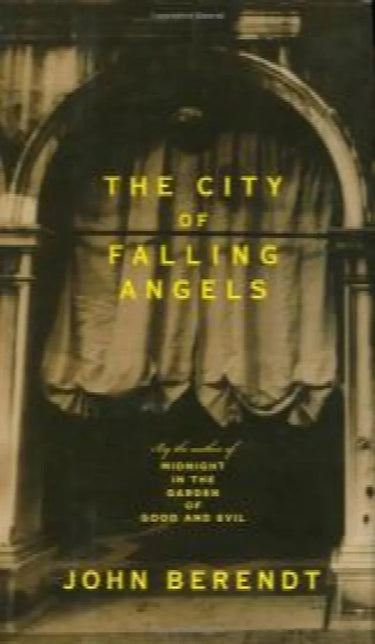
The City of Falling Angels by John Berendt
Traces the aftermath of the 1996 Venice opera house fire, an event that devastated Venetian society and was investigated by the author, who through interviews with such locals as a suicidal poet, a surrealist painter, and a master glassblower learned about the region's rich cultural history. By the author of Midnight in the Garden of Good and Evil. 700,000 first printing. Editorial Reviews Amazon.com Review Past Midnight: John Berendt on the Mysteries of Venice Just as John Berendt's first book, Midnight in the Garden of Good and Evil, was settling into its remarkable four-year run on The New York Times bestseller list, he discovered a new city whose local mysteries and traditions were more than a match for Savannah, whose hothouse eccentricities he had celebrated in the first book. The new city was Venice, and he spent much of the last decade wandering through its canals and palazzos, seeking to understand a place that any native will tell you is easy to visit but hard to know. For travelers to Venice, whether by armchair or vaporetto, he has selected his 10 (actually 11) Books to Read on Venice. And he took the time to answer a few of our questions about his charming new book, The City of Falling Angels: Amazon.com: The lush, cloistered southern city of Savannah was the locale of Midnight in the Garden of Good and Evil. Venice, the setting for The City of Falling Angels, is vastly different. Was it the difference itself that drew you to Venice? John Berendt: Savannah and Venice actually have quite a lot in common. Both are uniquely beautiful. Both are isolated geographically, culturally, and emotionally from the world outside. Venice sits in the middle of a lagoon; Savannah is surrounded by marshes, piney woods, and the ocean. Venetians think of themselves as Venetian first, Italian second; Savannahians rarely even venture forth as far as Atlanta or Charleston. So both cities offer a writer a rich context in which to set a story, and the stories provide readers a means of escape from their own environment into another world. Amazon.com: I enjoyed your rather declarative author's note: that this is a work of nonfiction, and that you used everyone's real names. In your previous book you did use pseudonyms for some characters and you explained that you took a few small liberties in the service of the larger truth of the story. Why the change this time? Berendt: When I wrote Midnight I thought I would do a few people the favor of changing their names for the sake of privacy. But when the book came out, several of the pseudonymous characters told me they wished I'd used their real names instead. So this time, no pseudonyms. As for the storytelling liberties I took in writing Midnight, they were minor and did not change the story, but my mention of it in the author's note caused some confusion, with the result that Midnight is sometimes referred to now as a novel, which it most certainly is not. Neither is The City of Falling Angels. In fact, I dispensed with the liberties this time and made it as close to the truth as I could get it. Amazon.com: In The City of Falling Angels, a number of fascinating people serve as guides to the city, each with a different idea of the true nature of Venice. Who was your favorite? Berendt: I don't have a favorite, but Count Girolamo Marcello is certainly a memorable, highly quotable commentator. Everyone in Venice is acting, he told me. Everyone plays a role, and the role changes. The key to understanding Venetians is rhythm, the rhythm of the lagoon, the water, the tides, the waves. It's like breathing. High water, high pressure: tense. Low water, low pressure: relaxed. The tide changes every six hours. I nodded that I understood. How do you see a bridge? he went on. Pardon me? I asked, A bridge? Do you see a bridge as an obstacle--as just another set of steps to climb to get from one side of a canal to the other? We Venetians do not see bridges as obstacles. To us, bridges are transitions. We go over them very slowly. They are part of the rhythm. They are the links between two parts of a theater, like changes in scenery. Our role changes as we go over bridges. We cross from one reality ... to another reality. From one street ... to another street. From one setting ... to another setting. Once I had absorbed that notion, Count Marcello continued: Sunlight on a canal is reflected up through a window onto the ceiling, then from the ceiling onto a vase, and from the vase onto a glass. Which is the real sunlight? Which is the real reflection? What is true? What is not true? The answer is not so simple, because the truth can change. I can change. You can change. That is the Venice effect. I was not terribly surprised when he later told me, Venetians never tell the truth. We mean precisely the opposite of what we say. Amazon.com: Now that you know Venice well enough to be a guide yourself, what would you say to a visitor looking for insight into the character of the city? Berendt: Tourists generally shuffle along, on narrow streets so crowded as to be nearly impassable, between the major sights of St. Mark's Square, the Rialto Bridge, and the Accademia Museum. All you have to do is to step off these heavily traveled alleyways, and in a few moments you will find yourself in quiet, much emptier surroundings. This is more like the real Venice. Another thing to do is to go into the wine bars where Venetians stand around drinking and talking. They will very likely be speaking the Venetian dialect, so you won't be able to understand them, but you will get a sampling of the true Venetian ambiance enlivened by the pronounced sing-song rhythm of the language. I'd also suggest stopping someone in the street and asking for directions. Almost invariably, you will be rewarded with a genial smile and the instructions, Sempre diritto, meaning Straight ahead. This will only leave you more confused, because when you attempt to follow a straight line, you will be confronted by more twists and turns and forks in the road than you thought possible, given the instructions. This is part of what Count Marcello described as the Venice effect. From Publishers Weekly It's taken Berendt 10 years follow up his long-running bestseller, Midnight in the Garden of Good and Evil. In lieu of Savannah, he offers us Venice, another port city full of eccentric citizens and with a long, colorful history. Like the first book, this one has a trial at the its center: Berendt moves to Venice in 1997, just three days after the city's famed Fenice opera house burns down during a restoration. The Venetian chattering classes, among whom Berendt finds a home, want to know whether it was an accident or arson. Initially, Berendt investigates, but is soon distracted by the city's charming denizens. Early on, he's warned, Everyone in Venice is acting, which sets the stage for fascinating portraits: a master glassblower creating an homage to the fire in vases, an outspoken surrealist painter, a tenacious prosecutor and others. As the infamous Italian bureaucracy drags out the investigation, Berendt spends more time schmoozing with the expatriate community in long discussions about its role in preserving local art, culture and architecture. By the time the Fenice is rebuilt and reopens, Berendt has delivered an intriguing mosaic of modern life in Venice, which makes for first-rate travel writing, albeit one that lacks a compelling core story to keep one reading into the night. Copyright ® Reed Business Information, a division of Reed Elsevier Inc. All rights reserved. From Publishers Weekly It's taken Berendt 10 years follow up his long-running bestseller, Midnight in the Garden of Good and Evil. In lieu of Savannah, he offers us Venice, another port city full of eccentric citizens and with a long, colorful history. Like the first book, this one has a trial at the its center: Berendt moves to Venice in 1997, just three days after the city's famed Fenice opera house burns down during a restoration. The Venetian chattering classes, among whom Berendt finds a home, want to know whether it was an accident or arson. Initially, Berendt investigates, but is soon distracted by the city's charming denizens. Early on, he's warned, Everyone in Venice is acting, which sets the stage for fascinating portraits: a master glassblower creating an homage to the fire in vases, an outspoken surrealist painter, a tenacious prosecutor and others. As the infamous Italian bureaucracy drags out the investigation, Berendt spends more time schmoozing with the expatriate community in long discussions about its role in preserving local art, culture and architecture. By the time the Fenice is rebuilt and reopens, Berendt has delivered an intriguing mosaic of modern life in Venice, which makes for first-rate travel writing, albeit one that lacks a compelling core story to keep one reading into the night. Copyright ® Reed Business Information, a division of Reed Elsevier Inc. All rights reserved. From The New Yorker In his first book since the success of Midnight in the Garden of Good and Evil, more than a decade ago, Berendt follows the same formula: he explores a mysterious, derelict city (this time, Venice), ingratiates himself with its leading eccentrics, and tells their stories. Berendt has a talent for letting characters sketch themselves. This book is less sensational than its predecessor, and the whodunit at the center, the burning of the opera house La Fenice, is really far less interesting than the smaller machinations and intrigues that Berendt finds along the way. The seduction and swindling of Olga Rudge, Ezra Pound's mistress, by the director of the Peggy Guggenheim Collection, is enthralling; whether an electrician intentionally left a blowtorch burning is not. Berendt is happiest among the city's witty sophisticates and latter-day Milly Theales, and though his story forces him to include a few ordinary Venetians, he does so, it seems, reluctantly. Copyright ® 2005 The New Yorker From Bookmarks Magazine Midnight in the Garden of Good and Evil became such a cultural landmark that itÂ's no wonder John Berendt waited 12 years to write a follow-up. BerendtÂ's second book doesnÂ't steer very far from his first in tone and style: he seems to have changed only the names and places. ThereÂ's also less resolution in Falling Angels, which led to the love-it-or-hate-it reviews. Still, it entertains. Berendt has a keen eye for detail and an uncanny ability to insinuate himself into the upper reaches of society, where he pulls back the veneer of gentility and dishes out delicious tales of greed, hate, envy, and conniving. But despite his considerable skills, Berendt doesnÂ't bring Venice to life as he did Savannah, and his harshest critics found Falling Angels formulaic and disjointed. Copyright © 2004 Phillips & Nelson Media, Inc. From Booklist The author's phenomenally best-selling Midnight in the Garden of Good and Evil (1994), which, for a record-breaking four years, remained on the New York Times best-seller list, drew tourists in droves to the lovely city of Savannah, Georgia. Will his thoroughly engaging new book do the same for the tourist trade to Venice, Italy? In 1996, Berendt planned an extended, off-season stay in Venice. Just three days prior to his arrival, Venice's world-famous opera house burned to the ground. He uses the official investigation into the disaster and the construction of a new opera house as a paradigm of civic and social life in this enigmatic city whose importance to the world -(other than as a tourist destination) has long vanished, and he uses the personal stories of the wide variety of individuals with whom he became acquainted during the course of his stay not only to enrich but also to personalize his account. This is journalism at its most accomplished; it is creative nonfiction as enveloping and heart embracing as good fiction. Brad Hooper Copyright © American Library Association. All rights reserved From Bookmarks Magazine Midnight in the Garden of Good and Evil became such a cultural landmark that itÂ's no wonder John Berendt waited 12 years to write a follow-up. BerendtÂ's second book doesnÂ't steer very far from his first in tone and style: he seems to have changed only the names and places. ThereÂ's also less resolution in Falling Angels, which led to the love-it-or-hate-it reviews. Still, it entertains. Berendt has a keen eye for detail and an uncanny ability to insinuate himself into the upper reaches of society, where he pulls back the veneer of gentility and dishes out delicious tales of greed, hate, envy, and conniving. But despite his considerable skills, Berendt doesnÂ't bring Venice to life as he did Savannah, and his harshest critics found Falling Angels formulaic and disjointed. Copyright © 2004 Phillips & Nelson Media, Inc. From Booklist The author's phenomenally best-selling Midnight in the Garden of Good and Evil (1994), which, for a record-breaking four years, remained on the New York Times best-seller list, drew tourists in droves to the lovely city of Savannah, Georgia. Will his thoroughly engaging new book do the same for the tourist trade to Venice, Italy? In 1996, Berendt planned an extended, off-season stay in Venice. Just three days prior to his arrival, Venice's world-famous opera house burned to the ground. He uses the official investigation into the disaster and the construction of a new opera house as a paradigm of civic and social life in this enigmatic city whose importance to the world -(other than as a tourist destination) has long vanished, and he uses the personal stories of the wide variety of individuals with whom he became acquainted during the course of his stay not only to enrich but also to personalize his account. This is journalism at its most accomplished; it is creative nonfiction as enveloping and heart embracing as good fiction. Brad Hooper Copyright © American Library Association. All rights reserved From Booklist The author's phenomenally best-selling Midnight in the Garden of Good and Evil (1994), which, for a record-breaking four years, remained on the New York Times best-seller list, drew tourists in droves to the lovely city of Savannah, Georgia. Will his thoroughly engaging new book do the same for the tourist trade to Venice, Italy? In 1996, Berendt planned an extended, off-season stay in Venice. Just three days prior to his arrival, Venice's world-famous opera house burned to the ground. He uses the official investigation into the disaster and the construction of a new opera house as a paradigm of civic and social life in this enigmatic city whose importance to the world -(other than as a tourist destination) has long vanished, and he uses the personal stories of the wide variety of individuals with whom he became acquainted during the course of his stay not only to enrich but also to personalize his account. This is journalism at its most accomplished; it is creative nonfiction as enveloping and heart embracing as good fiction. Brad Hooper Copyright © American Library Association. All rights reserved Review Berendt does great justice to an exalted city that has rightly fascinated...many...throughout the world. -- Kirkus Reviews, starred review, August 1, 2005 Having read Angels, I cannot stop haunting travel websites in search of cheap fares to Italy. Angels is that good. -- Deirdre Donahue, USA Today, September 27, 2005 About the Author John Berendt was born in New York in 1939 and graduated from Harvard University in 1961. While at Harvard, he was on the editorial board of the Harvard Lampoon. From 1961 to 1969, he was an associate editor at Esquire and later wrote for David Frost and Dick Cavett. Berendt served as editor of New York magazine from 1977 to 1979 and wrote a monthly column for Esquire from 1982 to 1994. Berendt's first book, Midnight in the Garden of Good and Evil, was published in 1994 to great acclaim and was nominated for the Pulitzer Prize.
Publication Details
Title:
Author(s):
Illustrator:
Binding: Hardcover
Published by: The Penguin Press: , 2005
Edition:
ISBN: 9781594200588 | 1594200580
414 pages.
Book Condition: Very Good
products.product.pickup_availability.unavailable
Product information
New Zealand Delivery
Shipping Options
Shipping options are shown at checkout and will vary depending on the delivery address and weight of the books.
We endeavour to ship the following day after your order is made and to have pick up orders available the same day. We ship Monday-Friday. Any orders made on a Friday afternoon will be sent the following Monday. We are unable to deliver on Saturday and Sunday.
Pick Up is Available in NZ:
Warehouse Pick Up Hours
- Monday - Friday: 9am-5pm
- 35 Nathan Terrace, Shannon NZ
Please make sure we have confirmed your order is ready for pickup and bring your confirmation email with you.
Rates
-
New Zealand Standard Shipping - $6.00
- New Zealand Standard Rural Shipping - $10.00
- Free Nationwide Standard Shipping on all Orders $75+
Please allow up to 5 working days for your order to arrive within New Zealand before contacting us about a late delivery. We use NZ Post and the tracking details will be emailed to you as soon as they become available. There may be some courier delays that are out of our control.
International Delivery
We currently ship to Australia and a range of international locations including: Belgium, Canada, China, Switzerland, Czechia, Germany, Denmark, Spain, Finland, France, United Kingdom, United States, Hong Kong SAR, Thailand, Philippines, Ireland, Israel, Italy, Japan, South Korea, Malaysia, Netherlands, Norway, Poland, Portugal, Sweden & Singapore. If your country is not listed, we may not be able to ship to you, or may only offer a quoting shipping option, please contact us if you are unsure.
International orders normally arrive within 2-4 weeks of shipping. Please note that these orders need to pass through the customs office in your country before it will be released for final delivery, which can occasionally cause additional delays. Once an order leaves our warehouse, carrier shipping delays may occur due to factors outside our control. We, unfortunately, can’t control how quickly an order arrives once it has left our warehouse. Contacting the carrier is the best way to get more insight into your package’s location and estimated delivery date.
- Global Standard 1 Book Rate: $37 + $10 for every extra book up to 20kg
- Australia Standard 1 Book Rate: $14 + $4 for every extra book
Any parcels with a combined weight of over 20kg will not process automatically on the website and you will need to contact us for a quote.
Payment Options
On checkout you can either opt to pay by credit card (Visa, Mastercard or American Express), Google Pay, Apple Pay, Shop Pay & Union Pay. Paypal, Afterpay and Bank Deposit.
Transactions are processed immediately and in most cases your order will be shipped the next working day. We do not deliver weekends sorry.
If you do need to contact us about an order please do so here.
You can also check your order by logging in.
Contact Details
- Trade Name: Book Express Ltd
- Phone Number: (+64) 22 852 6879
- Email: sales@bookexpress.co.nz
- Address: 35 Nathan Terrace, Shannon, 4821, New Zealand.
- GST Number: 103320957 - We are registered for GST in New Zealand
- NZBN: 9429031911290
We have a 30-day return policy, which means you have 30 days after receiving your item to request a return.
To be eligible for a return, your item must be in the same condition that you received it, unworn or unread.
To start a return, you can contact us at sales@bookexpress.co.nz. Please note that returns will need to be sent to the following address: 35 Nathan Terrace, Shannon, New Zealand 4821.
If your return is for a quality or incorrect item, the cost of return will be on us, and will refund your cost. If it is for a change of mind, the return will be at your cost.
You can always contact us for any return question at sales@bookexpress.co.nz.
Damages and issues
Please inspect your order upon reception and contact us immediately if the item is defective, damaged or if you receive the wrong item, so that we can evaluate the issue and make it right.
Exceptions / non-returnable items
Certain types of items cannot be returned, like perishable goods (such as food, flowers, or plants), custom products (such as special orders or personalised items), and personal care goods (such as beauty products). Although we don't currently sell anything like this. Please get in touch if you have questions or concerns about your specific item.
Unfortunately, we cannot accept returns on gift cards.
Exchanges
The fastest way to ensure you get what you want is to return the item you have, and once the return is accepted, make a separate purchase for the new item.
European Union 14 day cooling off period
Notwithstanding the above, if the merchandise is being shipped into the European Union, you have the right to cancel or return your order within 14 days, for any reason and without a justification. As above, your item must be in the same condition that you received it, unworn or unused, with tags, and in its original packaging. You’ll also need the receipt or proof of purchase.
Refunds
We will notify you once we’ve received and inspected your return, and let you know if the refund was approved or not. If approved, you’ll be automatically refunded on your original payment method within 10 business days. Please remember it can take some time for your bank or credit card company to process and post the refund too.
If more than 15 business days have passed since we’ve approved your return, please contact us at sales@bookexpress.co.nz.