
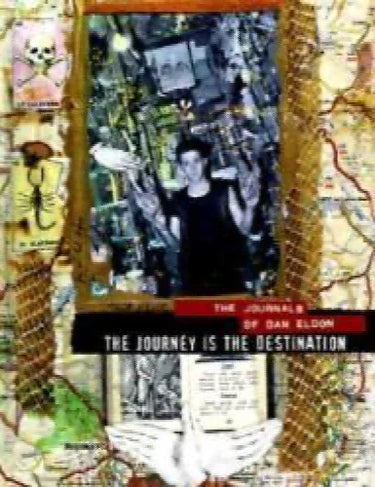
The Journey is the Destination: The Journals of Dan Eldon by Dan Eldon,Kathy Eldon
By the time he was twenty-two, Dan Eldon had led a relief mission across Africa; worked as a graphic designer in New York; studied (intermittently) at four colleges; traveled through Europe, Africa, Japan, and the US; founded a charity for Mozambiquan refugees; directed a film; written a book; started up his own photography business; and become a photojournalist for Reuters news agency, covering the famine and civil war in Somalia. There, in 1993, he was killed in an eruption of mob violence while on assignment. In a world of rules and regularity, Eldon was a renegade, a risk-taker, and an adventurer. But, despite all his travels, he knew that the interior landscape is the only one truly worth exploring, and this is the journey he dedicated himself to recording. His is no ordinary journal; it is an astonishing seventeen-volume collage of photos, drawings, words, maps, clippings, paint, scraps, shards, and trash that reveals his strange and vivid life. The Journey is the Destination offers a selection of pages from these extraordinary journals, at once the vision of an artist in his prime and the unrestrained outpourings of a young man just beginning to live. Editorial Reviews Amazon.com Review Dan Eldon, who was only 22 when he was chased down and killed by an angry mob in Somalia, was one of the youngest photographic stringers in Africa. But his journalistic work, which had appeared in Time and Newsweek, showed only a small part of his talent. Eldon excelled as an artist in his collages, which combined his photographs of Africa with paint, pastiche, pop culture images, advertising, and official documents. The Journey Is the Destination collects pages from the 17 scrapbooks that held his art. Chronicling his work from age 14 through his death at 22, this volume is startling not only in the intensity and thoughtfulness of the pages, but also in the fact that someone so young could have this kind of artistic depth and insight. From Library Journal Photojournalists who risk their lives while on assignment in dangerous circumstances are often unsung heroes. In 1993, Dan Eldon was a 22-year-old Reuters photographer covering the severe famine and strife in Somalia when he was brutally murdered by an enraged mob. In a painful tribute to her son, freelance journalist Kathy Eldon has assembled and prefaced a somewhat offbeat, scrapbook-type publication containing collages, sketches, photographs, and written ruminations culled from her son's 17 journals. Born in England and raised in Kenya, Eldon comes through as an exuberant, passionate, handsome youth who was troubled by the world's violence and deprivations. He appears to have possessed a fearless spirit, and women were attracted to him. With Eldon prominently featured in an upcoming Turner-produced TV documentary on journalists at risk and with an exhibition of his work opening in New York, this book could attract a wider-than-expected audience and is recommended for general collections.?Joan Levin, MLS, Chicago Copyright 1997 Reed Business Information, Inc. Review This book has been written up almost everywhere, around the world, in local newspapers, and international publications. Here are a few of the reviews, each reflecting on the profundity of Dan Eldon's story. By Peter Canby Dan Eldon was only twenty-two when, at the height of conflict in Somalia, he and three other journalists were chased down by a mob enraged at a United Nations helicopter attack and stoned to death. The year was 1993. Eldon was among the first to document the famine in Somalia; he had risen rapidly through the ranks of war photographers, with spreads in Time, Newsweek, and Stern. But, as The Journey Is the Destination: The Journals of Dan Eldon shows, he was an artist as well. The son of an English father and an American mother, he grew up in Nairobi, where he became fascinated by the mixture of European and African cultures and learned to speak fluent Swahili. At fifteen, he began recording his life in a series of eclectic, exuberantly collaged journals, which incorporate everything from his own drawings and paintings to stamps, matchbook covers, photographs of his friends, and self-portraits. By the time Eldon died, he had compiled seventeen journals, the last of which -- according to his mother, Kathy, who edited the published selection -- consisted, uncharacteristically, of his Somalia photographs mounted on plain white paper. Eldon was a popular figure in Somalia, but he'd become depressed by seeing the Africa he loved crumbling around him. In one of his journals he quotes Plato: Only the dead have seen the end of war. Lest the Picture Fade By Joshua Hammer For Kathy Eldon the trip was the climax of a four-year obsession. On a blazingly hot day, last September, Eldon, her daughter, Amy, a television crew and 40 Somali bodyguards rode through the streets of Mogadishu to the rubble of a large cinder-block house. Here, on July 12, 1993, a U.N. helicopter fired missiles into a group of suspected aides to warlord Mohammed Farah Aidid, killing 80 people. Minutes after the attack, Kathy's son, Dan Eldon, 22, and three other foreign jounalists were cornered by an angry mob and stoned and beaten to death. Now, as mother and daughter approached the killing site to film a documentary, another hostile crowd gathered. They were screaming 'Get these foreigners out, we don't want to remember that horrible day', says Kathy Eldon, 51. We piled back into the vehicles and left in a hurry. She was both shaken and strangely elated by the experience. There was a curious sense of joy that we'd been there and seen where he died, she says. Kathy Eldon has not grieved quietly. Over the past four years, she has traveled across three continents--and repeatedly relived her son's horrifying end--in a quest to commemorate his brief, eventful life. She has found an eager audience. Last month Chronicle Books published The Journey is the Destination: The Journals of Dan Eldon, a collection of vibrant collages created by Dan from the age of 13 until his death. The book has already sold nearly 30,000 copies, and a second printing is being planned. Meanwhile, former Columbia Pictures president Lisa Henson and Oliver Stone's former partner Janet Yang are developing a feature movie about the last three years of Dan Eldon's life. Next September Amy Eldon, 23, will appear in a Turner Broadcasting documentary about Dan's career called Dying to Tell the Story. Thousands of teenagers have participated in a Nairobi program founded in 1993 by Dan's father, Michael, called The Depot--Dan Eldon Place of Tomorrow, a sort of Outward Bound-on-the-savanna that teaches leadership skills. Eldon's story, a mix of doomed innocence, gonzo adventure and Third World exoticism, seems tailored for cinematic mythmaking. Son of a British father and an Amencan mother, now divorced, Eldon grew up in Kenya. His charismatic energy and precocious visual talent led him, at 20, to the office of Jonathan Clayton, then Reuters' Nairobi bureau chief. He was another affluent white African kid who announced, 'I'm a photographer,' like they all do, Clayton remembers. But he had a wonderful eye for color and composition, and he was willing to learn. Eldon hooked up with the Reuters wire service as a freelancer, then got his big break after the December 1992 U.S. intervention in Somalia. Eldon captured vivid images of clan gunmen, starving children, Cobra helicopter gunships and bikini clad American soldiers in Mogadishu. Those pictures ran prominently in U.S. newspapers and magazines, including NEWSWEEK. Kathy Eldon was at home in Santa Monica, Calif., when she received the news of her son's murder. I sank to the floor and said, 'Somebody help me. Help me', she remembers. After his violent death, Dan might well have faded into obscurity, but his family was determined not to let that happen. Michael Eldon, a Nairobi businessman, raised funds in Kenya and abroad to launch The Depot. Kathy, an aspiring film producer, began making the rounds of Hollywood film studios and publishers, often bringing along Dan's 17 bound journals. Playful pastiches of newspaper headlines, airline tickets, passport stamps, African coins, maps, condom packages, surrealistic drawings and photographs of teenage nymphets, wildlife and Masai warriors, the journals reflect both a life of white African privilege and a boundless curiosity about the world. The Eldons' crusade hasn't won over everybody. A few of Eldon's colleagues and friends admit to feeling queasy about the relentless celebration of his short life. The Dan Eldon I knew would have been embarrassed by it, says one Africa-based correspondent who worked closely with him. It's over the top. Some are also bothered by the disparity between the tributes lavished on Eldon and the scant attention paid to the three journalists who died alongside him: German photographer Hansi Krauss of the Associated Press and Kenyans Hos Maina and Anthony Macharia of Reuters. Kathy Eldon finds such criticism unfair. Dan had a spirit of adventure and awareness of the world that we're trying to communicate to people, she says. The art on display in The Journey is the Destination makes a promising--and poignant--beginning. Pages Ripped from Life By Liesl Schillinger Just as a botanist presses flowers in a book to trap the color they held when they still lived, The Journey Is the Destination holds a life compressed in its pages. That life vibrates with vivid hues and breathing texture; it is a collage of dewy girlfriends and Masai tribesmen, of wildebeest and decrepit Land Rovers, of photos, ironic news clippings and journal entries, all of them transformed by paint, ink, hair, beads, coins and blood into a talismanic journal of an artist's youth. That artist is Dan Eldon, a dashing young Reuters photographer who was born in London, raised in Kenya, and killed in Somalia at the age of 22, when an angry crowd stoned him to death after a United Nations bombing raid. The book has been drawn from the 17 visual journals Eldon made between 1984, the year he turned 14, and 1993, the year he died; and its pages were selected by his mother, Kathy, not to mourn his death but to celebrate his exuberant, concentrated life. At 22, an age when most of his contemporaries were frolicking in their last summer of freedom, the pause between college graduation and the yoke of the first job, Dan Eldon had been drawn by his conscience to go to Somalia, to document the famine, war and lawlessness that prevailed there in 1992 and 1993. He was hardly a hardened newsman; he was a free-spirited boy with a hungry eye for beauty. But in Somalia, he would notice a pretty girl, wrapped in a colorful cloth, only to see later that both her hands and feet had been severed by shrapnel. Someone had tossed a grenade in the market. The depravity of impersonal deaths came as a shock to him. This was my first experience with war, he wrote in a book he self-published. Before Somalia, I had only seen two dead bodies in my life. I have now seen hundreds, tossed into ditches like sacks. The worst things I could not photograph. Only the last few pages of his journals acknowledge the stark brutality of Somalia; the others preserve a rare adolescence in which imaginative horseplay jostled with exuberant idealism. For young people who doubt that a life grander than MTV and the mall can be achieved in this age, Eldon's journals prove otherwise. And for kids, and adults, who long for a role model in their own image, an untarnished face that represents possibility, not pompousness, Eldon stands tall. The Journals focus a spyglass on Eldon's life, showing him exploring the Great Rift Valley with his Kenyan friend Lengai Croze, photographing his sister Amy and her lissome friends in absurdist scenarios, and raising money to pay for a heart operation for a sick Kenyan girl. They chronicle his trips to Japan, Russia, America and Europe (during which he acquired a variety of lurid call-girl matchbooks), and his brief stints at a few colleges. They also highlight the relief expedition he initiated to help Mozambiquan refugees in Malawi, an adventure for which he raised $17,000 and mobilized an international team of 12 dazzlingly attractive young people, turning the mission into an orgy of youthful philanthropy. Using two rugged cars--a Land Rover that had been nicknamed Deziree after a voluptuous Italian girlfriend, and another called Arabella--Team Deziree embarked on the mission of helping refugees while recording in detail with the eyes of a child, any beauty (of the flesh or otherwise), horror, irony, traces of utopia or Hell. It was, he writes, the Search for clean water in a swamp. Everywhere Eldon's insights, sometimes dark, sometimes irreverent, sometimes just plain funny, scrawl across the page. He got the agony, she got the remedy, he writes across a two-page pastiche of paint-washed savannah, guinea fowl feathers and crinkled photos of iconic youths. Excised photos of cheetah, a... The power of Dan Eldon's art is a dazzling testament to the way in which he lived his life. . . Jan Sardi, screenwriter, Shine Wild with sex and death, the collection resembles the illuminations of a young Blake. British Esquire About the Author Dan Eldon was born in London in 1970 and raised in Nairobi, Kenya. His photographs of Somalia's brutal famine, published in newspapers worldwide, helped trigger the world's conscience. Eldon was stoned to death by a Somali mob reacting against a UN bombing Kathy Eldon is co-producing both a feature film about her son's life and a documentary about journalists who put their lives at risk to tell a story. She lives in Los Angeles. About the Author Dan Eldon was born in London in 1970 and raised in Nairobi, Kenya. His photographs of Somalia's brutal famine, published in newspapers worldwide, helped trigger the world's conscience. Eldon was stoned to death by a Somali mob reacting against a UN bombing Kathy Eldon is co-producing both a feature film about her son's life and a documentary about journalists who put their lives at risk to tell a story. She lives in Los Angeles.
Publication Details
Title:
Author(s):
Illustrator:
Binding: Hardcover
Published by: Chronicle Books: , 1997
Edition:
ISBN: 9780811815864 | 0811815862
224 pages.
Book Condition: Good
Spine chipped and faded.
products.product.pickup_availability.unavailable
Product information
New Zealand Delivery
Shipping Options
Shipping options are shown at checkout and will vary depending on the delivery address and weight of the books.
We endeavour to ship the following day after your order is made and to have pick up orders available the same day. We ship Monday-Friday. Any orders made on a Friday afternoon will be sent the following Monday. We are unable to deliver on Saturday and Sunday.
Pick Up is Available in NZ:
Warehouse Pick Up Hours
- Monday - Friday: 9am-5pm
- 35 Nathan Terrace, Shannon NZ
Please make sure we have confirmed your order is ready for pickup and bring your confirmation email with you.
Rates
-
New Zealand Standard Shipping - $6.00
- New Zealand Standard Rural Shipping - $10.00
- Free Nationwide Standard Shipping on all Orders $75+
Please allow up to 5 working days for your order to arrive within New Zealand before contacting us about a late delivery. We use NZ Post and the tracking details will be emailed to you as soon as they become available. There may be some courier delays that are out of our control.
International Delivery
We currently ship to Australia and a range of international locations including: Belgium, Canada, China, Switzerland, Czechia, Germany, Denmark, Spain, Finland, France, United Kingdom, United States, Hong Kong SAR, Thailand, Philippines, Ireland, Israel, Italy, Japan, South Korea, Malaysia, Netherlands, Norway, Poland, Portugal, Sweden & Singapore. If your country is not listed, we may not be able to ship to you, or may only offer a quoting shipping option, please contact us if you are unsure.
International orders normally arrive within 2-4 weeks of shipping. Please note that these orders need to pass through the customs office in your country before it will be released for final delivery, which can occasionally cause additional delays. Once an order leaves our warehouse, carrier shipping delays may occur due to factors outside our control. We, unfortunately, can’t control how quickly an order arrives once it has left our warehouse. Contacting the carrier is the best way to get more insight into your package’s location and estimated delivery date.
- Global Standard 1 Book Rate: $37 + $10 for every extra book up to 20kg
- Australia Standard 1 Book Rate: $14 + $4 for every extra book
Any parcels with a combined weight of over 20kg will not process automatically on the website and you will need to contact us for a quote.
Payment Options
On checkout you can either opt to pay by credit card (Visa, Mastercard or American Express), Google Pay, Apple Pay, Shop Pay & Union Pay. Paypal, Afterpay and Bank Deposit.
Transactions are processed immediately and in most cases your order will be shipped the next working day. We do not deliver weekends sorry.
If you do need to contact us about an order please do so here.
You can also check your order by logging in.
Contact Details
- Trade Name: Book Express Ltd
- Phone Number: (+64) 22 852 6879
- Email: sales@bookexpress.co.nz
- Address: 35 Nathan Terrace, Shannon, 4821, New Zealand.
- GST Number: 103320957 - We are registered for GST in New Zealand
- NZBN: 9429031911290
We have a 30-day return policy, which means you have 30 days after receiving your item to request a return.
To be eligible for a return, your item must be in the same condition that you received it, unworn or unread.
To start a return, you can contact us at sales@bookexpress.co.nz. Please note that returns will need to be sent to the following address: 35 Nathan Terrace, Shannon, New Zealand 4821.
If your return is for a quality or incorrect item, the cost of return will be on us, and will refund your cost. If it is for a change of mind, the return will be at your cost.
You can always contact us for any return question at sales@bookexpress.co.nz.
Damages and issues
Please inspect your order upon reception and contact us immediately if the item is defective, damaged or if you receive the wrong item, so that we can evaluate the issue and make it right.
Exceptions / non-returnable items
Certain types of items cannot be returned, like perishable goods (such as food, flowers, or plants), custom products (such as special orders or personalised items), and personal care goods (such as beauty products). Although we don't currently sell anything like this. Please get in touch if you have questions or concerns about your specific item.
Unfortunately, we cannot accept returns on gift cards.
Exchanges
The fastest way to ensure you get what you want is to return the item you have, and once the return is accepted, make a separate purchase for the new item.
European Union 14 day cooling off period
Notwithstanding the above, if the merchandise is being shipped into the European Union, you have the right to cancel or return your order within 14 days, for any reason and without a justification. As above, your item must be in the same condition that you received it, unworn or unused, with tags, and in its original packaging. You’ll also need the receipt or proof of purchase.
Refunds
We will notify you once we’ve received and inspected your return, and let you know if the refund was approved or not. If approved, you’ll be automatically refunded on your original payment method within 10 business days. Please remember it can take some time for your bank or credit card company to process and post the refund too.
If more than 15 business days have passed since we’ve approved your return, please contact us at sales@bookexpress.co.nz.