
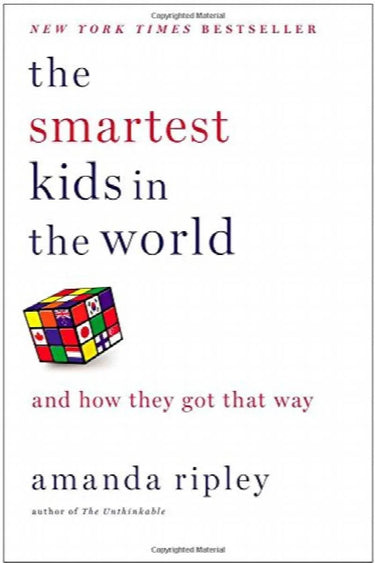
The Smartest Kids in the World: And How They Got That Way by Amanda Ripley
Through the compelling stories of three American teenagers living abroad and attending the world's top-notch public high schools, an investigative reporter explains how these systems cultivate the smartest kids on the planet. How Do Other Countries Create Smarter Kids? In a handful of nations, virtually all children are learning to make complex arguments and solve problems they've never seen before. They are learning to think, in other words, and to thrive in the modern economy. What is it like to be a child in the world's new education superpowers? In a global quest to find answers for our own children, author and Time magazine journalist Amanda Ripley follows three Americans embed­ded in these countries for one year. Kim, fifteen, raises $10,000 so she can move from Oklahoma to Finland; Eric, eighteen, exchanges a high-achieving Minnesota suburb for a booming city in South Korea; and Tom, seventeen, leaves a historic Pennsylvania village for Poland. Through these young informants, Ripley meets battle-scarred reformers, sleep-deprived zombie students, and a teacher who earns $4 million a year. Their stories, along with groundbreaking research into learning in other cultures, reveal a pattern of startling transformation: none of these countries had many smart kids a few decades ago. Things had changed. Teaching had become more rigorous; parents had focused on things that mattered; and children had bought into the promise of education. A journalistic tour de force, The Smartest Kids in the World is a book about building resilience in a new world-as told by the young Americans who have the most at stake. Editorial Reviews Review [Ripley] gets well beneath the glossy surfaces of these foreign cultures and manages to make our own culture look newly strange...The question is whether the startling perspective provided by this masterly book can also generate the will to make changes. ? New York Times Book Review Compelling . . . What is Poland doing right? And what is America doing wrong? Amanda Ripley, an American journalist, seeks to answer such questions in The Smartest Kids in the World, her fine new book about the schools that are working around the globe ....Ms. Ripley packs a startling amount of insight in this slim book. ? The Economist [T]he most illuminating reporting I have ever seen on the differences between schools in America and abroad. ? Jay Mathews, education columnist, The Washington Post [The Smartest Kids in the World is] a riveting new book....Ripley's policy recommendations are sensible and strong....The American school reform debate has been desperately in need of such no-nonsense advice, which firmly puts matters of intellect back at the center of education where they belong. ? The Daily Beast The Smartest Kids in the World should be on the back-to-school reading list of every parent, educator and policymaker interested in understanding why students in other countries outperform U.S. students on international tests. -- US News & World Report Gripping....Ripley's characters are fascinating, her writing style is accessible, and her observations are fresh....If you're interested in how to improve public schools, read Ripley's book today. -- The Huffington Post In riveting prose...this timely and inspiring book offers many insights into how to improve America's mediocre school system. -- Publishers Weekly, starred review If you care about education, you must read this book. By recounting what three intrepid kids learned from the rest of the world, it shows what we can learn about how to fix our schools. Ripley's delightful storytelling has produced insights that are both useful and inspiring. -- Walter Isaacson, author of Steve Jobs and Benjamin Franklin This book gives me hope that we can create education systems of equity and rigor-if we heed the lessons from top performing countries and focus more on preparing teachers than on punishing them. -- Randi Weingarten, President, American Federation of Teachers This is a no-nonsense, no-excuses book about how we can improve outcomes for all kids, from the poorest to the wealthiest. It avoids platitudes and ideology and relies instead on the experiences of students. -- Joel Klein, CEO, Amplify, and former chancellor, New York Department of Education Amanda Ripley observes with rare objectivity and depth. She finds a real and complex world 'over there'-schools with flaws of their own but also real and tangible lessons about how to do better by our kids. The Smartest Kids in the World gave me more insights, as a parent and as an educator, than just about anything else I've read in a while. -- Doug Lemov, author of Teach Like a Champion Such an important book! Amanda Ripley lights the path to engaging our next generation to meet a different bar. She makes an enormous contribution to the national and global discussion about what must be done to give all our children the education they need to invent the future. -- Wendy Kopp, founder and chair, Teach For America, and CEO, Teach For All The Smartest Kids in the World is a must read for anyone concerned about the state of American public education. By drawing on experiences, successes, and failures in education systems in the highest-performing countries across the globe, Amanda Ripley lays out a course for what we must do to dramatically improve our nation's schools. -- Michelle Rhee, Founder and CEO of StudentsFirst Fascinating....Ripley's voice is engaging, and Smartest Kids is impeccably researched and packed with interesting interviews and anecdotes....The book ends on a positive note....while the issues are complex, we certainly get the message that we can improve our educational system for our kids. ? Washington Independent Review of Books Ripley's stirring investigation debunks many tenets of current education reform. -- BookPage In lively, accessible prose....Ripley's book looks at the data from a new perspective. Those stunned parents and teachers in New York State and elsewhere would do well to read this book first if they are inclined to blame their children's/students' poor results on a new test. -- OECD Education Today Blog Ripley's evaluation of education in a changing world is revealing and thought-provoking. ? Rocky Mountain Telegram A good read . . . . If you want to understand what goes on in other countries' education systems, read [The Smartest Kids in the World]. ? Coshocton Tribune [Ripley] is a compelling storyteller who deftly plaits humorous anecdotes and hard data to whip you in the face with her findings. -- Kristen Levithan ? Brain, Child Magazine About the Author Amanda Ripleyis a literary journalist whose stories on human behavior and public policy have appeared in Time, The Atlantic, and Slate and helped Time win two National Magazine Awards.To discuss her work, she has appeared on ABC, NBC, CNN, FOX News, and NPR. Ripley's first book, The Unthinkable, was published in fifteen countries and turned into a PBS documentary. Excerpt. ® Reprinted by permission. All rights reserved. The Smartest Kids in the World prologue the mystery Heat Map: In a handful of countries scattered across the world, virtually all kids are learning to think critically in math, reading, and science. For most of my career at Time and other magazines, I worked hard to avoid education stories. If my editors asked me to write about schools or tests, I countered with an idea about terrorism, plane crashes, or a pandemic flu. That usually worked. I didn't say so out loud, but education stories seemed, well, kind of soft. The articles tended to be headlined in chalkboard font and festooned with pencil doodles. They were brimming with good intentions but not much evidence. The people quoted were mostly adults; the kids just turned up in the photos, smiling and silent. Then, an editor asked me to write about a controversial new leader of Washington, D.C.'s public schools. I didn't know much about Michelle Rhee, except that she wore stiletto heels and tended to say crap a lot in interviews. So, I figured it would be a good story, even if it meant slipping into the fog of education. But something unexpected happened in the fog. I spent months talking to kids, parents, and teachers, as well as people who have been creatively researching education in new ways. Pretty soon I realized that Rhee was interesting, but she was not the biggest mystery in the room. The real mystery was this: Why were some kids learning so much-and others so very little? Education was suddenly awash in data; we knew more than ever about what was happening-or failing to happen-from one neighborhood or classroom to the next. And it didn't add up. Everywhere I went I saw nonsensical ups and downs in what kids knew: in rich neighborhoods and poor, white neighborhoods and black, public schools and private. The national data revealed the same peaks and valleys, like a sprawling, nauseating roller coaster. The dips and turns could be explained in part by the usual narratives of money, race, or ethnicity. But not entirely. Something else was going on, too. Over the next few years, as I wrote more stories about education, I kept stumbling over this mystery. At Kimball Elementary School in Washington, D.C., I saw fifth graders literally begging their teacher to let them solve a long division problem on the chalkboard. If they got the answer right, they would pump their fists and whisper-shout, Yes! This was a neighborhood where someone got murdered just about every week, a place with 18 percent unemployment. In other places, I saw kids bored out of their young minds, kids who looked up when a stranger like me walked into the room, watching to see if I would, please God, create some sort of distraction to save them from another hour of nothingness. For a while, I told myself that this was the variation you'd expect from one neighborhood to the next, from one principal or teacher to another. Some kids got lucky, I supposed, but most of the differences that mattered had to do with money and privilege. Then one day I saw this chart, and it blew my mind. The United States might have remained basically flat over time, but that was the exception, it turned out. Look at Finland! It had rocketed from the bottom of the world to the top, without pausing for breath. And what was going on in Norway, right next door, which seemed to be slip sliding into the abyss, despite having virtually no child poverty? And there was Canada, careening up from mediocrity to the heights of Japan. If education was a function of culture, could culture change that dramatically-that fast?
Publication Details
Title:
Author(s):
Illustrator:
Binding: Hardcover
Published by: Simon & Schuster: , 2013
Edition:
ISBN: 9781451654424 | 1451654421
320 pages.
Book Condition: Very Good
products.product.pickup_availability.unavailable
Product information
New Zealand Delivery
Shipping Options
Shipping options are shown at checkout and will vary depending on the delivery address and weight of the books.
We endeavour to ship the following day after your order is made and to have pick up orders available the same day. We ship Monday-Friday. Any orders made on a Friday afternoon will be sent the following Monday. We are unable to deliver on Saturday and Sunday.
Pick Up is Available in NZ:
Warehouse Pick Up Hours
- Monday - Friday: 9am-5pm
- 35 Nathan Terrace, Shannon NZ
Please make sure we have confirmed your order is ready for pickup and bring your confirmation email with you.
Rates
-
New Zealand Standard Shipping - $6.00
- New Zealand Standard Rural Shipping - $10.00
- Free Nationwide Standard Shipping on all Orders $75+
Please allow up to 5 working days for your order to arrive within New Zealand before contacting us about a late delivery. We use NZ Post and the tracking details will be emailed to you as soon as they become available. There may be some courier delays that are out of our control.
International Delivery
We currently ship to Australia and a range of international locations including: Belgium, Canada, China, Switzerland, Czechia, Germany, Denmark, Spain, Finland, France, United Kingdom, United States, Hong Kong SAR, Thailand, Philippines, Ireland, Israel, Italy, Japan, South Korea, Malaysia, Netherlands, Norway, Poland, Portugal, Sweden & Singapore. If your country is not listed, we may not be able to ship to you, or may only offer a quoting shipping option, please contact us if you are unsure.
International orders normally arrive within 2-4 weeks of shipping. Please note that these orders need to pass through the customs office in your country before it will be released for final delivery, which can occasionally cause additional delays. Once an order leaves our warehouse, carrier shipping delays may occur due to factors outside our control. We, unfortunately, can’t control how quickly an order arrives once it has left our warehouse. Contacting the carrier is the best way to get more insight into your package’s location and estimated delivery date.
- Global Standard 1 Book Rate: $37 + $10 for every extra book up to 20kg
- Australia Standard 1 Book Rate: $14 + $4 for every extra book
Any parcels with a combined weight of over 20kg will not process automatically on the website and you will need to contact us for a quote.
Payment Options
On checkout you can either opt to pay by credit card (Visa, Mastercard or American Express), Google Pay, Apple Pay, Shop Pay & Union Pay. Paypal, Afterpay and Bank Deposit.
Transactions are processed immediately and in most cases your order will be shipped the next working day. We do not deliver weekends sorry.
If you do need to contact us about an order please do so here.
You can also check your order by logging in.
Contact Details
- Trade Name: Book Express Ltd
- Phone Number: (+64) 22 852 6879
- Email: sales@bookexpress.co.nz
- Address: 35 Nathan Terrace, Shannon, 4821, New Zealand.
- GST Number: 103320957 - We are registered for GST in New Zealand
- NZBN: 9429031911290
We have a 30-day return policy, which means you have 30 days after receiving your item to request a return.
To be eligible for a return, your item must be in the same condition that you received it, unworn or unread.
To start a return, you can contact us at sales@bookexpress.co.nz. Please note that returns will need to be sent to the following address: 35 Nathan Terrace, Shannon, New Zealand 4821.
If your return is for a quality or incorrect item, the cost of return will be on us, and will refund your cost. If it is for a change of mind, the return will be at your cost.
You can always contact us for any return question at sales@bookexpress.co.nz.
Damages and issues
Please inspect your order upon reception and contact us immediately if the item is defective, damaged or if you receive the wrong item, so that we can evaluate the issue and make it right.
Exceptions / non-returnable items
Certain types of items cannot be returned, like perishable goods (such as food, flowers, or plants), custom products (such as special orders or personalised items), and personal care goods (such as beauty products). Although we don't currently sell anything like this. Please get in touch if you have questions or concerns about your specific item.
Unfortunately, we cannot accept returns on gift cards.
Exchanges
The fastest way to ensure you get what you want is to return the item you have, and once the return is accepted, make a separate purchase for the new item.
European Union 14 day cooling off period
Notwithstanding the above, if the merchandise is being shipped into the European Union, you have the right to cancel or return your order within 14 days, for any reason and without a justification. As above, your item must be in the same condition that you received it, unworn or unused, with tags, and in its original packaging. You’ll also need the receipt or proof of purchase.
Refunds
We will notify you once we’ve received and inspected your return, and let you know if the refund was approved or not. If approved, you’ll be automatically refunded on your original payment method within 10 business days. Please remember it can take some time for your bank or credit card company to process and post the refund too.
If more than 15 business days have passed since we’ve approved your return, please contact us at sales@bookexpress.co.nz.