
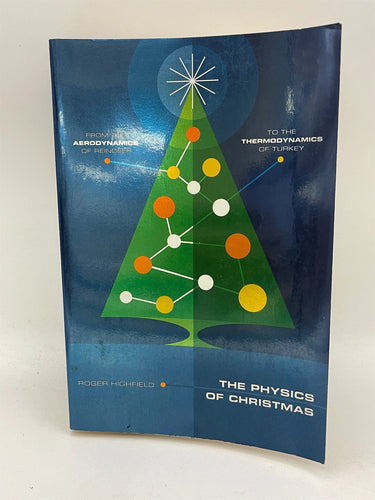
The Physics of Christmas: From the Aerodynamics of Reindeer to the Thermodynamics of Turkey by Roger Highfield
Can reindeer fly? Could scientists clone the perfect Christmas tree? How does Santa manage to deliver presents to an estimated 824 million households in a single night? These are among the questions explored in an irresistibly witty book that illuminates the cherished rituals, legends, and icons of Christmas from a unique and fascinating perspective: science. Excellent entertainment for the Christmas connoisseurs in your circle. --USA Today Editorial Reviews Imagine sitting down to Christmas dinner -- roast bird, glittering tree, stockings hung by the chimney with care -- when your dinner partner gestures to the turkey thigh on your plate. Did you know, he asks, that the leg meat is dark because it contains myoglobin, an oxygen-storing molecule that a turkey needs in its muscular legs but not in its lazy breast? Game birds, on the other hand spend more time on the wing, and their breast meat may be as dark as their drumsticks, seasoned with myoglobin throughout. Oh yes, he goes on, and that dreaded plum pudding is a descendant of frumenty, a type of porridge made from hulled wheat spiced and boiled in milk, while the brandy sauce that makes it edible is of huge interest to surface scientists because of the unusual way the molecules bind together. As for the role of the chimney at Christmas, some psychologists believe it is a metaphor for the vagina: One reason people become depressed at Christmas may be that Santa's descent revives memories of their birth traumas. If this is your idea of great holiday chitchat, Roger Highfield, the science editor at London's Daily Telegraph, has written the book for you. The Physics of Christmas: From the Aerodynamics of Reindeer to the Thermodynamics of Turkey is a collection of short, bright essays that attempt to explain by means of science -- very broadly defined to include anthropology, psychology and sociology as well chemistry and biology -- all the wacky things people do during the holidays. No subject is too small for Highfield's enthusiastic scrutiny. He devotes one essay to the reasons Brussels sprouts are bitter; another to the architecture of snowflakes; yet another to the biology of reindeer. Sampled in small doses, these essays can be fascinating. You may have some dim notion that Santa Claus harks back to St. Nicholas, a holy man from the coast of Turkey. It is less well known that some academics posit that his suit is red because people liked to ingest psychedelic toadstools -- the recreational and ritualistic drug of choice in parts of northern Europe before vodka was imported from the East. Santa's vivid robes, Highfield writes, are thought by some to honor the red-and-white dot color scheme of this potent mind-altering mushroom. It will be a long time before I forget that the Lapps of northern Scandinavia -- who pulverize reindeer horns and market the stuff as an aphrodisiac -- actually have a genetic mutation rendering some of the men unusually virile. Or that a cancer research organization has found that Christmas is the only meal of the year at which most British children eat sufficient amounts of vegetables. But read more than one or two of Highfield's pieces at a time, and you may find yourself reaching anxiously for another egg nog. Highfield is an engaging writer, with an obvious and endearing passion for his subject. But what he has assembled in this pretty volume is an intimidating mountain of random scientific trivia. Taken as a whole, it is more exhausting than explanatory. Like Christmas cheer -- the fermentation of fruit and grain by the activity of fungi called yeasts -- The Physics of Christmas is best enjoyed in moderation. -- Salon - Jennifer Reese Surveying a range of scientific fields' answers to Christmas puzzlers, the author argues that, among other things, Rudolph's red nose stems from a parasitical infection, the star of Bethlehem may have been the conjunction of planets, and Santa relies on a superconducting quantum interference device to interpret the magnetic brainwaves of bad and good children. Annotation c. by Book News, Inc., Portland, Or. - Booknews Relying on the research of . . .scholars from around the world, he endeavors to enrich our understanding of everything associated with the holiday, providing genuine insights as well as fanciful speculation. . . .the book covers a range of scientific topics, including. . .the explanation behind the strange taste of brussels sprouts and the hunt for the perfect Christmas tree. . . -- The New York Times Book Review - Simon Singh
Publication Details
Title:
Author(s):
Illustrator:
Binding: Paperback
Published by: Little, Brown and Company: , 1999
Edition:
ISBN: 9780316366953 | 0316366951
320 pages.
Book Condition: Very Good
products.product.pickup_availability.unavailable
Product information
New Zealand Delivery
Shipping Options
Shipping options are shown at checkout and will vary depending on the delivery address and weight of the books.
We endeavour to ship the following day after your order is made and to have pick up orders available the same day. We ship Monday-Friday. Any orders made on a Friday afternoon will be sent the following Monday. We are unable to deliver on Saturday and Sunday.
Pick Up is Available in NZ:
Warehouse Pick Up Hours
- Monday - Friday: 9am-5pm
- 35 Nathan Terrace, Shannon NZ
Please make sure we have confirmed your order is ready for pickup and bring your confirmation email with you.
Rates
-
New Zealand Standard Shipping - $6.00
- New Zealand Standard Rural Shipping - $10.00
- Free Nationwide Standard Shipping on all Orders $75+
Please allow up to 5 working days for your order to arrive within New Zealand before contacting us about a late delivery. We use NZ Post and the tracking details will be emailed to you as soon as they become available. There may be some courier delays that are out of our control.
International Delivery
We currently ship to Australia and a range of international locations including: Belgium, Canada, China, Switzerland, Czechia, Germany, Denmark, Spain, Finland, France, United Kingdom, United States, Hong Kong SAR, Thailand, Philippines, Ireland, Israel, Italy, Japan, South Korea, Malaysia, Netherlands, Norway, Poland, Portugal, Sweden & Singapore. If your country is not listed, we may not be able to ship to you, or may only offer a quoting shipping option, please contact us if you are unsure.
International orders normally arrive within 2-4 weeks of shipping. Please note that these orders need to pass through the customs office in your country before it will be released for final delivery, which can occasionally cause additional delays. Once an order leaves our warehouse, carrier shipping delays may occur due to factors outside our control. We, unfortunately, can’t control how quickly an order arrives once it has left our warehouse. Contacting the carrier is the best way to get more insight into your package’s location and estimated delivery date.
- Global Standard 1 Book Rate: $37 + $10 for every extra book up to 20kg
- Australia Standard 1 Book Rate: $14 + $4 for every extra book
Any parcels with a combined weight of over 20kg will not process automatically on the website and you will need to contact us for a quote.
Payment Options
On checkout you can either opt to pay by credit card (Visa, Mastercard or American Express), Google Pay, Apple Pay, Shop Pay & Union Pay. Paypal, Afterpay and Bank Deposit.
Transactions are processed immediately and in most cases your order will be shipped the next working day. We do not deliver weekends sorry.
If you do need to contact us about an order please do so here.
You can also check your order by logging in.
Contact Details
- Trade Name: Book Express Ltd
- Phone Number: (+64) 22 852 6879
- Email: sales@bookexpress.co.nz
- Address: 35 Nathan Terrace, Shannon, 4821, New Zealand.
- GST Number: 103320957 - We are registered for GST in New Zealand
- NZBN: 9429031911290
We have a 30-day return policy, which means you have 30 days after receiving your item to request a return.
To be eligible for a return, your item must be in the same condition that you received it, unworn or unread.
To start a return, you can contact us at sales@bookexpress.co.nz. Please note that returns will need to be sent to the following address: 35 Nathan Terrace, Shannon, New Zealand 4821.
If your return is for a quality or incorrect item, the cost of return will be on us, and will refund your cost. If it is for a change of mind, the return will be at your cost.
You can always contact us for any return question at sales@bookexpress.co.nz.
Damages and issues
Please inspect your order upon reception and contact us immediately if the item is defective, damaged or if you receive the wrong item, so that we can evaluate the issue and make it right.
Exceptions / non-returnable items
Certain types of items cannot be returned, like perishable goods (such as food, flowers, or plants), custom products (such as special orders or personalised items), and personal care goods (such as beauty products). Although we don't currently sell anything like this. Please get in touch if you have questions or concerns about your specific item.
Unfortunately, we cannot accept returns on gift cards.
Exchanges
The fastest way to ensure you get what you want is to return the item you have, and once the return is accepted, make a separate purchase for the new item.
European Union 14 day cooling off period
Notwithstanding the above, if the merchandise is being shipped into the European Union, you have the right to cancel or return your order within 14 days, for any reason and without a justification. As above, your item must be in the same condition that you received it, unworn or unused, with tags, and in its original packaging. You’ll also need the receipt or proof of purchase.
Refunds
We will notify you once we’ve received and inspected your return, and let you know if the refund was approved or not. If approved, you’ll be automatically refunded on your original payment method within 10 business days. Please remember it can take some time for your bank or credit card company to process and post the refund too.
If more than 15 business days have passed since we’ve approved your return, please contact us at sales@bookexpress.co.nz.