
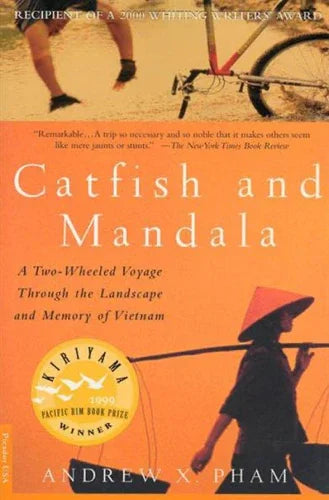
Catfish and Mandala: A Two-Wheeled Voyage Through the Landscape and Memory of Vietnam by Andrew X. Pham
Winner of the Kiriyama Pacific Rim Book Prize A New York Times Notable Book of the Year Winner of the Whiting Writers' Award A Seattle Post-Intelligencer Best Book of the Year Catfish and Mandala is the story of an American odyssey-a solo bicycle voyage around the Pacific Rim to Vietnam-made by a young Vietnamese-American man in pursuit of both his adopted homeland and his forsaken fatherland. Intertwined with an often humorous travelogue spanning a year of discovery is a memoir of war, escape, and ultimately, family secrets. Andrew X. Pham was born in Vietnam and raised in California. His father had been a POW of the Vietcong; his family came to America as boat people. Following the suicide of his sister, Pham quit his job, sold all of his possessions, and embarked on a year-long bicycle journey that took him through the Mexican desert; on a thousand-mile loop from Narita in South Korea to Kyoto in Japan; and, after five months and 2,357 miles, to Saigon, where he finds nothing familiar in the bombed-out darkness. In Vietnam, he's taken for Japanese or Korean by his countrymen, except, of course, by his relatives, who doubt that as a Vietnamese he has the stamina to complete his journey (Only Westerners can do it); and in the United States he's considered anything but American. A vibrant, picaresque memoir written with narrative flair and an eye-opening sense of adventure, Catfish and Mandala is an unforgettable search for cultural identity. Editorial Reviews Thoreau, Theroux, Kerouac, Steinbeck, Mark Twain and William Least Heat-Moon-the roster of those who have turned to their travels for inspiration includes some of America's most noted scribes. Now add Andrew X. Pham to the list . . . Catfish and Mandala records a remarkable odyssey across landscape and into memory. -The Seattle Times An engaging and vigorously told story . . . a fresh and original look at how proud Vietnamese on the war's losing side reconciled having their identity abruptly hyphenated to Vietnamese-American. -Gavin Scott, Chicago Tribune A modern Plutarch might pair Pham's story with that of Chris McCandless, the uncompromising young man whose spiritual quest led him to a forlorn death in Alaska. Pham, instead of seeking out remote places where he could explore fantasies of self-sufficiency, instictively understood that self-knowledge emerges from engagement with others. In his passionate telling, his travelogue acquires the universality of a bildungsroman. -The New Yorker A trip so necessary and so noble makes others seem like mere jaunts or stunts. -The New York Times Book Review Part memoir, part travelogue . . . Catfish and Mandala [is] a visceral, funny and tender look at modern-day Vietnam, interwoven with the saga of Pham's refugee family. -Annie Nakao, San Francisco Examiner Far more than a travelogue . . . Catfish and Mandala is a seamlessly constructed work deftly combining literary techniques with careful, evenhanded reportage . . . A gifted writer . . . Pham opens readers to the full sadness of the human condition on both sides of the world, marveling at spiritual resilience amid irreconcilable facts. -Roland Kelts, The Philadelphia Inquirer No small achievement . . . Scenes of [Pham's] wild road adventure [are] worthy of Jack Kerouac. -The San Francisco Chronicle Stunning . . . A brilliantly written memoir in which a young Vietnamese-American uses a bicycle journey in his homeland as a vehicle to tell his eventful life story . . . Pham (born Pham Xuan An) fled Vietnam with his family in 1977 at age ten. Raised in California, he worked hard, went to UCLA, and landed a good engineering job. A few years ago, rebelling against family pressures to succeed and a patronizing, if not racist, work environment, Pham quit his job. Much to his parents' displeasure, he set off on bicycle excursions through Mexico, Japan, and, finally, Vietnam. 'I have to do something unethnic,' he says. 'I have to go. Make my pilgrimage.' In his first book, Pham details his solo cycling journeys, mixing in stories of his and his family's life before and after leaving Vietnam. The most riveting sections are Pham's exceptional evocations of his father's time in a postwar communist reeducation (read: concentration) camp and the family's near miraculous escape by sea from their homeland . . . An insightful, creatively written report on Vietnam today and on the fate of a Vietnamese family in America. -Kirkus Reviews [Pham] fuels his memoir and travelogue, full of both comic and painful adventures, with a broad appreciation of the variety and vividness of creation. The people, the landscapes, the poverty and grime of Vietnam live for us through him, a man full of sadness and unrequited longing and love . . . a powerful memoir of grief and a doomed search for cultural identity. -Vince Passaro, Elle In narrating his search for his roots, Vietnamese-American and first-time author Pham alternates between two story lines. The first, which begins in war-torn Vietnam, chronicles the author's hair-raising escape to the U.S. as an adolescent in 1977 and his family's subsequent and somewhat troubled life in California. The second recounts his return to Vietnam almost two decades later as an Americanized but culturally confused young man. Uncertain if his trip is a 'pilgrimage or a farce,' Pham pedals his bike the length of his native country, all the while confronting the guilt he feels as a successful Viet-kieu (Vietnamese expatriate) and as a survivor of his older sister Chai, whose isolation in America and eventual suicide he did little to prevent. Flipping between the two story lines, Pham elucidates his main dilemma: he's an outsider in both America and Vietnam-in the former for being Vietnamese, and the latter for being Viet-kieu . . . In writing a sensitive, revealing book about cultural identity, Pham also succeeds in creating an exciting adventure story. -Publishers Weekly Perhaps the most American writing theme is the road trip as search for identity. Pham has written a memoir (and, in the process, a travelogue) that will be widely appealing. His family immigrated to the U.S. after escaping from Vietnam, where his father had been held in a communist 're-education camp' after the war. Once in the U.S., his parents worked grueling hours to afford to educate their children. During those years Pham's sister ran away after being beaten by her father, and when she returned years later, she had become a transsexual. Eventually, she commited suicide, and her death was a dark, unspoken family secret. Pham, who had become an engineer, had an identity crisis and left his career to bicycle through the U.S., Mexico, Japan, and, eventually, Vietnam, to examine his roots. Seeing his native country through Americanized eyes, he finds it both attractive and repellent. Ultimately, he must reconcile to being an outsider in all cultures. -Eric Robbins, Booklist - From the Publisher I took a break from reading Andrew X. Pham's brilliant, haunting memoir of his trip through Vietnam, Catfish and Mandala, to watch TV. My remote control landed me on MTV, right in the middle of a Road Rules: Semester at Sea marathon. Confession: I am a Road Rules junkie. This travelogue-cum-voyeuristic adventure soap opera series has the power to reel me in like nothing else on television does. And as I sat on my couch, savoring this mind candy, I got an extra treat. I had happened upon the episodes where the cast is in Vietnam. These episodes of Road Rules were full of images to complement my day's reading. Pham's descriptions of riding his bicycle through the clogged streets of Saigon were made all the more vivid when I watched the cast trying to race around the congested, polluted city. The cast ate many of the Vietnamese delicacies that turned Pham's stomach. The cast was confronted by beggars, as was Pham, who was plagued with guilt about them throughout his trip. As the episode drew to a close, I realized that surprisingly, despite a massive difference in perspective, the Road Rulers and Pham had similar observations of Vietnam that stemmed from the bizarre experience of being an American in a country America was at war with. I also realized that not only is Pham's book wonderful in its own right, but it's also an important addition to the growing body of literature about the relationship between America and Vietnam. However, Catfish and Mandala's premise -- Pham bikes from California to Vietnam, the land of his birth, in an attempt to make sense of his trans-national identity -- renders it a challenging and extremely complex read. There is more here than just a story of a native son returning home. A recurring theme throughout Catfish and Mandala is the fact that Pham doesn't feel at home anywhere in the world. His ethnicity and familial obligations prevent him from truly assimilating in America. In Vietnam, his American passport earns him the moniker Viet-kieu, a term that means foreign Vietnamese and that is highly stigmatized. Often in Vietnam, his claims to his ethnicity are challenged violently. But epithets, fists and dysentery don't stop Pham from traveling to through Vietnam on his bicycle; the town of his birth is his final destination. Although the places of his youth bear no resemblance to the country he remembers, Pham draws a grounding sense of knowing, and ultimately, closure from them. It's as if seeing how different Vietnam is from his memories gives him the courage to make peace with the role his roots play in his American life. Pham is a boat person who came to the US in 1977. His father, a former Nationalist Army propagandist, is a survivor of a communist reeducation death camp. His mother meticulously plotted their family's harrowing escape from Vietnam under constant threat of incarceration. Pham spends most of his life trying to reconcile his desire to live his own life with the remnants of the life his parents' left behind. Our father sacrificed for us as his father had sacrificed for him, each one of us racking up a debt so large we'd never dare to contemplate pursuing our own dreams. No, there are no independent visionaries in a line of sacrifices, Pham writes. His decision to pick up and bicycle to Vietnam, something he views as wholly unethnic, stems from these frustrations. Pham's journey is also prompted by the suicide of his transsexual sister Chi. Intertwined with stories of his time in Vietnam, Chi's troubling relationship with Pham's father is recounted throughout Catfish and Mandala, as are the tales of his parents' personal histories, and Pham's own life story. This makes Catfish and Mandala less a travelogue and more an autobiography. But Pham's narration, and the stories themselves, make Catfish and Mandala breathtaking. In Vietnam, Pham bridges the gaps between past and present, and leaves with a true sense of himself. And along the way, he gives the reader a painfully intimate look at whom he is, and what Vietnam has become, that a reader will be richer for taking the time to understand. Pham's fascinating book is a very heavy, but ultimately an incredibly worthwhile read. -Emily Burg Emily Burg is a freelancer who reads travel books during the commercials. - bn.com In narrating his search for his roots, Vietnamese-American and first-time author Pham alternates between two story lines. The first, which begins in war-torn Vietnam, chronicles the author's hair-raising escape to the U.S. as an adolescent in 1977 and his family's subsequent and somewhat troubled life in California. The second recounts his return to Vietnam almost two decades later as an Americanized but culturally confused young man. Uncertain if his trip is a pilgrimage or a farce, Pham pedals his bike the length of his native country, all the while confronting the guilt he feels as a successful Viet-kieu (Vietnamese expatriate) and as a survivor of his older sister Chai, whose isolation in America and eventual suicide he did little to prevent. Flipping between the two story lines, Pham elucidates his main dilemma: he's an outsider in both America and Vietnam--in the former for being Vietnamese, and the latter for being Viet-kieu. Aside from a weakness for hyphenated compounds like people-thick and passion-rich, Pham's prose is fluid and fast, navigating deftly through time and space. Wonderful passages describe the magical qualities of catfish stew, the gruesome preparation of gaping fish (a fish is seared briefly in oil with its head sticking out, but is supposedly still alive when served), the furious flow of traffic in Ho Chi Minh City and his exasperating confrontations with gangsters, drunken soldiers and corrupt bureaucrats. In writing a sensitive, revealing book about cultural identity, Pham also succeeds in creating an exciting adventure story. (Oct.) Copyright 1999 Cahners Business Information. - Publishers Weekly - Publisher's Weekly As a child, Pham fled Vietnam with his family and settled in California. Here he recounts his return--by bicycle, as he wheels up the West Coast, boards a plane, and finds himself at the airport in Saigon, cursing out the nitwits in flip-flops who wrecked his bike. Clearly, this is no sentimental journey; Pham's is a soul divided. He's a contentious guide, but the journey is heartrending and invaluable. (LJ 10/1/99) Copyright 2000 Cahners Business Information. - Library Journal A brilliantly written memoir in which a young Vietnamese-American uses a bicycle journey in his homeland as a vehicle to tell his eventful life story. The veteran-penned going back book has become a subgenre of the American Vietnam War canon. So, too, has the multigenerational Vietnamese-refugee family saga. Now comes a stunning first: a family tale by a Vietnamese-American that centers on an eye-opening trip to his native land. Pham (born Pham Xuan An) fled Vietnam with his family in 1977 at age ten. Raised in California, he worked hard, went to UCLA, and landed a good engineering job. A few years ago, rebelling against family pressures to succeed and a patronizing, if not racist, work environment, Pham quit his job. Much to his parents' displeasure, he set off on bicycle excursions through Mexico, Japan, and, finally, Vietnam. I have to do something unethnic, he says. I have to go. Make my pilgrimage. In his first book, Pham details his solo cycling journeys, mixing in stories of his and his family's life before and after leaving Vietnam. The most riveting sections are Pham's exceptional evocations of his father's time in a postwar communist reeducation (read: concentration) camp and the family's near miraculous escape by sea from their homeland. The heart of the narrative is Pham's depiction of his five-month adventure in Vietnam, often not a pretty picture. Because of his unique status as a budget-minded Viet Kieu (overseas Vietnamese), he runs into significant harassment from the police and many unfriendly civilians. For every moment of self-discovery and enchantment there seem to be ten of disappointment and dispiritedness-plus nearly constant physical pain fromhis journey and a bout of dysentery. But Pham perseveres. He returns to his home, America, with a smile on his face. An insightful, creatively written report on Vietnam today and on the fate of a Vietnamese family in America. - Kirkus Reviews
Publication Details
Title:
Author(s):
Illustrator:
Binding: Paperback
Published by: Picador: , 2000
Edition:
ISBN: 9780312267179 | 0312267177
352 pages.
Book Condition: Fair
Cover worn. Spien chipped
products.product.pickup_availability.unavailable
Product information
New Zealand Delivery
Shipping Options
Shipping options are shown at checkout and will vary depending on the delivery address and weight of the books.
We endeavour to ship the following day after your order is made and to have pick up orders available the same day. We ship Monday-Friday. Any orders made on a Friday afternoon will be sent the following Monday. We are unable to deliver on Saturday and Sunday.
Pick Up is Available in NZ:
Warehouse Pick Up Hours
- Monday - Friday: 9am-5pm
- 35 Nathan Terrace, Shannon NZ
Please make sure we have confirmed your order is ready for pickup and bring your confirmation email with you.
Rates
-
New Zealand Standard Shipping - $6.00
- New Zealand Standard Rural Shipping - $10.00
- Free Nationwide Standard Shipping on all Orders $75+
Please allow up to 5 working days for your order to arrive within New Zealand before contacting us about a late delivery. We use NZ Post and the tracking details will be emailed to you as soon as they become available. There may be some courier delays that are out of our control.
International Delivery
We currently ship to Australia and a range of international locations including: Belgium, Canada, China, Switzerland, Czechia, Germany, Denmark, Spain, Finland, France, United Kingdom, United States, Hong Kong SAR, Thailand, Philippines, Ireland, Israel, Italy, Japan, South Korea, Malaysia, Netherlands, Norway, Poland, Portugal, Sweden & Singapore. If your country is not listed, we may not be able to ship to you, or may only offer a quoting shipping option, please contact us if you are unsure.
International orders normally arrive within 2-4 weeks of shipping. Please note that these orders need to pass through the customs office in your country before it will be released for final delivery, which can occasionally cause additional delays. Once an order leaves our warehouse, carrier shipping delays may occur due to factors outside our control. We, unfortunately, can’t control how quickly an order arrives once it has left our warehouse. Contacting the carrier is the best way to get more insight into your package’s location and estimated delivery date.
- Global Standard 1 Book Rate: $37 + $10 for every extra book up to 20kg
- Australia Standard 1 Book Rate: $14 + $4 for every extra book
Any parcels with a combined weight of over 20kg will not process automatically on the website and you will need to contact us for a quote.
Payment Options
On checkout you can either opt to pay by credit card (Visa, Mastercard or American Express), Google Pay, Apple Pay, Shop Pay & Union Pay. Paypal, Afterpay and Bank Deposit.
Transactions are processed immediately and in most cases your order will be shipped the next working day. We do not deliver weekends sorry.
If you do need to contact us about an order please do so here.
You can also check your order by logging in.
Contact Details
- Trade Name: Book Express Ltd
- Phone Number: (+64) 22 852 6879
- Email: sales@bookexpress.co.nz
- Address: 35 Nathan Terrace, Shannon, 4821, New Zealand.
- GST Number: 103320957 - We are registered for GST in New Zealand
- NZBN: 9429031911290
We have a 30-day return policy, which means you have 30 days after receiving your item to request a return.
To be eligible for a return, your item must be in the same condition that you received it, unworn or unread.
To start a return, you can contact us at sales@bookexpress.co.nz. Please note that returns will need to be sent to the following address: 35 Nathan Terrace, Shannon, New Zealand 4821.
If your return is for a quality or incorrect item, the cost of return will be on us, and will refund your cost. If it is for a change of mind, the return will be at your cost.
You can always contact us for any return question at sales@bookexpress.co.nz.
Damages and issues
Please inspect your order upon reception and contact us immediately if the item is defective, damaged or if you receive the wrong item, so that we can evaluate the issue and make it right.
Exceptions / non-returnable items
Certain types of items cannot be returned, like perishable goods (such as food, flowers, or plants), custom products (such as special orders or personalised items), and personal care goods (such as beauty products). Although we don't currently sell anything like this. Please get in touch if you have questions or concerns about your specific item.
Unfortunately, we cannot accept returns on gift cards.
Exchanges
The fastest way to ensure you get what you want is to return the item you have, and once the return is accepted, make a separate purchase for the new item.
European Union 14 day cooling off period
Notwithstanding the above, if the merchandise is being shipped into the European Union, you have the right to cancel or return your order within 14 days, for any reason and without a justification. As above, your item must be in the same condition that you received it, unworn or unused, with tags, and in its original packaging. You’ll also need the receipt or proof of purchase.
Refunds
We will notify you once we’ve received and inspected your return, and let you know if the refund was approved or not. If approved, you’ll be automatically refunded on your original payment method within 10 business days. Please remember it can take some time for your bank or credit card company to process and post the refund too.
If more than 15 business days have passed since we’ve approved your return, please contact us at sales@bookexpress.co.nz.