
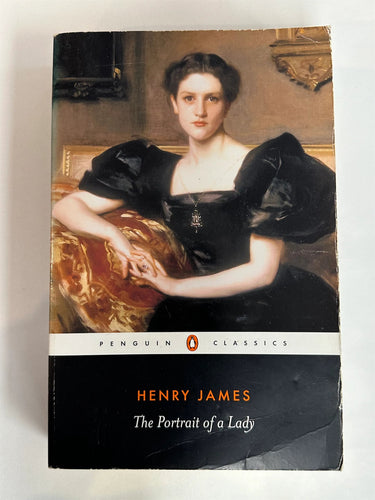
The Portrait of a Lady by Henry James
When Isabel Archer, a beautiful, spirited American is brought to Europe by her wealthy aunt Touchett, it is expected that she will soon marry. But Isabel, resolved to enjoy the freedom that her fortune has opened up and to determine her own fate, does not hesitate to turn down two eligible suitors. It is only when she finds herself irresistibly drawn to the cultivated but worthless Gilbert Osmond that she discovers that wealth is a two-edged sword and that there is a price to be paid for independence. With its subtle delineation of American characters in a European setting, Portrait of a Lady is one of the most accomplished and popular of Henry James's early novels. About the Author Born in New York of Irish and Scottish ancestry and educated in New York, London and Paris, Henry James is best known for his cosmopolitan and often haunting portraits of European and American life. He was also a prolific writer of literary criticism and shorter fiction. James settled in England in 1876, where he spent most of the rest of his life and completed his best-known work. Geoffrey Moore was General Editor for the works of Henry James in Penguin Patricia Crick teaches Modern Languages Excerpt. ? Reprinted by permission. All rights reserved. The Portrait of a Lady By Henry James Penguin Books Copyright © 2003 Henry James All right reserved. ISBN: 0141439637 Chapter One Under certain circumstances there are few hours in life more agreeable than the hour dedicated to the ceremony known as afternoon tea. There are circumstances in which, whether you partake of the tea or not-some people of course never do-the situation is in itself delightful. Those that I have in mind in beginning to unfold this simple history offered an admirable setting to an innocent pastime. The implements of the little feast had been disposed upon the lawn of an old English country house in what I should call the perfect middle of a splendid summer afternoon. Part of the afternoon had waned, but much of it was left, and what was left was of the finest and rarest quality. Real dusk would not arrive for many hours; but the flood of summer light had begun to ebb, the air had grown mellow, the shadows were long upon the smooth, dense turf. They lengthened slowly, however, and the scene expressed that sense of leisure still to come which is perhaps the chief source of one's enjoyment of such a scene at such an hour. From five o'clock to eight is on certain occasions a little eternity; but on such an occasion as this the interval could be only an eternity of pleasure. The persons concerned in it were taking their pleasure quietly, and they were not of the sex which is supposed to furnish the regular votaries of the ceremony I have mentioned. The shadows on the perfect lawn were straight and angular; they were the shadows of an old man sitting in a deep wicker-chair near the low table on which the tea had been served, and of two younger men strolling to and fro, in desultory talk, in front of him. The old man had his cup in his hand; it was an unusually large cup, of a different pattern from the rest of the set and painted in brilliant colours. He disposed of its contents with much circumspection, holding it for a long time close to his chin, with his face turned to the house. His companions had either finished their tea or were indifferent to their privilege; they smoked cigarettes as they continued to stroll. One of them, from time to time, as he passed, looked with a certain attention at the elder man, who, unconscious of observation, rested his eyes upon the rich red front of his dwelling. The house that rose beyond the lawn was a structure to repay such consideration and was the most characteristic object in the peculiarly English picture I have attempted to sketch. It stood upon a low hill, above the river-the river being the Thames at some forty miles from London. A long gabled front of red brick, with the complexion of which time and the weather had played all sorts of pictorial tricks, only, however, to improve and refine it, presented to the lawn its patches of ivy, its clustered chimneys, its windows smothered in creepers. The house had a name and a history; the old gentleman taking his tea would have been delighted to tell you these things: how it had been built under Edward the Sixth, had offered a night's hospitality to the great Elizabeth (whose august person had extended itself upon a huge, magnificent, and terribly angular bed which still formed the principle honour of the sleeping apartments), had been a good deal bruised and defaced in Cromwell's wars, and then, under the Restoration, repaired and much enlarged; and how, finally, after having been remodelled and disfigured in the eighteenth century, it had passed into the careful keeping of a shrewd American banker, who had bought it originally because (owing to circumstances too complicated to set forth) it was offered at a great bargain: bought it with much grumbling at its ugliness, its antiquity, its incommodity, and who now, at the end of twenty years, had become conscious of a real aesthetic passion for it, so that he knew all its points and would tell you just where to stand to see them in combination and just the hour when the shadows of its various protuberances-which fell so softly upon the warm, weary brickwork-were of the right measure. Besides this, as I have said, he could have counted off most of the successive owners and occupants, several of whom were known to general fame; doing so, however, with an undemonstrative conviction that the latest phase of its destiny was not the least honourable. The front of the house overlooking that portion of lawn with which we are concerned was not the entrance-front; this was in quite another quarter. Privacy here reigned supreme, and the wide carpet of turf that covered the level hill-top seemed but the extension of a luxurious interior. The great still oaks and beeches flung down a shade as dense as that of velvet curtains; and the place was furnished, like a room, with cushioned seats, with rich-coloured rugs, with the books and papers that lay upon the grass. The river was at some distance; where the ground began to slope the lawn, properly speaking, ceased. But it was none the less a charming walk down to the water. The old gentleman at the tea-table, who had come from America thirty years before, had brought with him, at the top of his baggage, his American physiognomy; and he had not only brought it with him, but he had kept it in the best order, so that, if necessary, he might have taken it back to his own country with perfect confidence. At present, obviously, nevertheless, he was not likely to displace himself; his journeys were over and he was taking the rest that precedes the great rest. He had a narrow, clean-shaven face, with features evenly distributed and an expression of placid acuteness. It was evidently a face in which the range of representation was not large, so that the air of contented shrewdness was all the more of a merit. It seemed to tell that he had been successful in life, yet it seemed to tell also that his success had not been exclusive and invidious, but had had much of the inoffensiveness of failure. He had certainly had a great experience of men, but there was an almost rustic simplicity in the faint smile that played upon his lean, spacious cheek and lighted up his humorous eye as he at last slowly and carefully deposited his big tea-cup upon the table. He was neatly dressed, in well-brushed black; but a shawl was folded upon his knees, and his feet were encased in thick, embroidered slippers. A beautiful collie dog lay upon the grass near his chair, watching the master's face almost as tenderly as the master took in the still more magisterial physiognomy of the house; and a little bristling, bustling terrier bestowed a desultory attendance upon the other gentlemen. One of these was a remarkably well-made man of five-and-thirty, with a face as English as that of the old gentleman I have just sketched was something else; a noticeably handsome face, fresh-coloured, fair and frank, with firm, straight features, a lively grey eye and the rich adornment of a chestnut beard. This person had a certain fortunate, brilliant, exceptional look-the air of a happy temperament fertilized by a high civilization-which would have made almost any observer envy him at a venture. He was booted and spurred, as if he had dismounted from a long ride; he wore a white hat, which looked too large for him; he held his two hands behind him, and in one of them-a large, white, well-shaped fist-was crumpled a pair of soiled dog-skin gloves. His companion, measuring the length of the lawn beside him, was a person of quite a different pattern, who, although he might have excited grave curiosity, would not, like the other, have provoked you to wish yourself, almost blindly, in his place. Tall, lean, loosely and feebly put together, he had an ugly, sickly, witty, charming face, furnished, but by no means decorated, with a straggling moustache and whisker. He looked clever and ill-a combination by no means felicitous; and he wore a brown velvet jacket. He carried his hands in his pockets, and there was something in the way he did it that showed the habit was inveterate. His gait had a shambling, wandering quality; he was not very firm on his legs. As I have said, whenever he passed the old man in the chair he rested his eyes upon him; and at this moment, with their faces brought into relation, you would easily have seen they were father and son. The father caught his son's eye at last and gave him a mild, responsive smile. I'm getting on very well, he said. Have you drunk your tea? asked the son. Yes, and enjoyed it. Shall I give you some more? The old man considered, placidly. Well, I guess I'll wait and see. He had, in speaking, the American tone. Are you cold? the son inquired. The father slowly rubbed his legs. Well, I don't know. I can't tell till I feel. Perhaps someone might feel for you, said the younger man, laughing. Oh, I hope someone will always feel for me! Don't you feel for me, Lord Warburton? Oh yes, immensely, said the gentleman addressed as Lord Warburton, promptly. I'm bound to say you look wonderfully comfortable. Well, I suppose I am, in most respects. And the old man looked down at his green shawl and smoothed it over his knees. The fact is I've been comfortable so many years that I suppose I've got so used to it I don't know it. Yes, that's the bore of comfort, said Lord Warburton. We only know when we're uncomfortable. It strikes me we're rather particular, his companion remarked. Oh yes, there's no doubt we're particular, Lord Warburton murmured. And then the three men remained silent a while; the two younger ones standing looking down at the other, who presently asked for more tea. I should think you would be very unhappy with that shawl, Lord Warburton resumed while his companion filled the old man's cup again. Oh no, he must have the shawl! cried the gentleman in the velvet coat. Don't put such ideas as that into his head. It belongs to my wife, said the old man simply. Oh, if it's for sentimental reasons- And Lord Warburton made a gesture of apology. I suppose I must give it to her when she comes, the old man went on. You'll please to do nothing of the kind. You'll keep it to cover your poor old legs Well, you mustn't abuse my legs, said the old man. I guess they are as good as yours. Oh, you're perfectly free to abuse mine, his son replied, giving him his tea. Well, we're two lame ducks; I don't think there's much difference. I'm much obliged to you for calling me a duck. How's your tea? Well, it's rather hot. That's intended to be a merit. Oh, there's a great deal of merit, murmured the old man, kindly. He's a very good nurse, Lord Warburton. Isn't he a bit clumsy? asked his lordship. Oh no, he's not clumsy-considering that he's an invalid himself. He's a very good nurse-for a sick-nurse. I call him my sick-nurse because he's sick himself. Oh, come, daddy! the ugly young man exclaimed. Well, you are; I wish you weren't. But I suppose you can't help it. I might try: that's an idea, said the young man. Were you ever sick, Lord Warburton? his father asked. Lord Warburton considered a moment. Yes, sir, once, in the Persian Gulf. He's making light of you, daddy, said the other young man. That's a sort of joke Well, there seem to be so many sorts now, daddy replied, serenely. You don't look as if you had been sick, anyway, Lord Warburton. He's sick of life; he was just telling me so; going on fearfully about it, said Lord Warburton's friend. Is that true, sir? asked the old man gravely. If it is, your son gave me no consolation. He's a wretched fellow to talk to-a regular cynic. He doesn't seem to believe in anything. That's another sort of joke, said the person accused of cynicism. It's because his health is so poor, his father explained to Lord Warburton. It affects his mind and colours his way of looking at things; he seems to feel as if he had never had a chance. But it's almost entirely theoretical, you know; it doesn't seem to affect his spirits. I've hardly ever seen him when he wasn't cheerful-about as he is at present. He often cheers me up. The young man so described looked at Lard Warburton and laughed. Is it a glowing eulogy or an accusation of levity? Should you like me to carry out my theories, daddy? By Jove, we should see some queer things! cried Lord Warburton. I hope you haven't taken up that sort of tone, said the old man. Warburton's tone is worse than mine; he pretends to be bored. I'm not in the least bored; I find life only too interesting. Ah, too interesting; you shouldn't allow it to be that, you know! I'm never bored when I come here, said Lord Warburton. One gets such uncommonly good talk. Is that another sort of joke? asked the old man. You've no excuse for being bored anywhere. When I was your age I had never heard of such a thing. You must have developed very late. No, I developed very quick; that was just the reason. When I was twenty years old I was very highly developed indeed. I was working tooth and nail. You wouldn't be bored if you had something to do; but all you young men are too idle. You think too much of your pleasure. You're too fastidious, and too indolent, and too rich. Oh, I say, cried Lord Warburton, you're hardly the person to accuse a fellow-creature of being too rich! Do you mean because I'm a banker? asked the old man. Because of that, if you like; and because you have-haven't you?-such unlimited means. He isn't very rich, the other young man mercifully pleaded. He has given away an immense deal of money. Well, I suppose it was his own, said Lord Warburton; and in that case could there be a better proof of wealth? Let not a public benefactor talk of one's being too fond of pleasure. Daddy's very fond of pleasure-of other people's. The old man shook his head. I don't pretend to have contributed anything to the amusement of my contemporaries. My dear father, you're too modest! That's a kind of joke, sir, said Lord Warburton. You young men have too many jokes. When there are no jokes you've nothing left. Fortunately there are always more jokes, the ugly young man remarked.< Continues... Excerpted from The Portrait of a Ladyby Henry James Copyright © 2003 by Henry James. Excerpted by permission. All rights reserved. No part of this excerpt may be reproduced or reprinted without permission in writing from the publisher. Excerpts are provided by Dial-A-Book Inc. solely for the personal use of visitors to this web site.
Publication Details
Title:
Author(s):
Illustrator:
Binding: Paperback
Published by: Penguin Classics: , 2003
Edition:
ISBN: 9780141439631 | 0141439637
656 pages.
Book Condition: Very Good
Cover worn.
products.product.pickup_availability.unavailable
Product information
New Zealand Delivery
Shipping Options
Shipping options are shown at checkout and will vary depending on the delivery address and weight of the books.
We endeavour to ship the following day after your order is made and to have pick up orders available the same day. We ship Monday-Friday. Any orders made on a Friday afternoon will be sent the following Monday. We are unable to deliver on Saturday and Sunday.
Pick Up is Available in NZ:
Warehouse Pick Up Hours
- Monday - Friday: 9am-5pm
- 35 Nathan Terrace, Shannon NZ
Please make sure we have confirmed your order is ready for pickup and bring your confirmation email with you.
Rates
-
New Zealand Standard Shipping - $6.00
- New Zealand Standard Rural Shipping - $10.00
- Free Nationwide Standard Shipping on all Orders $75+
Please allow up to 5 working days for your order to arrive within New Zealand before contacting us about a late delivery. We use NZ Post and the tracking details will be emailed to you as soon as they become available. There may be some courier delays that are out of our control.
International Delivery
We currently ship to Australia and a range of international locations including: Belgium, Canada, China, Switzerland, Czechia, Germany, Denmark, Spain, Finland, France, United Kingdom, United States, Hong Kong SAR, Thailand, Philippines, Ireland, Israel, Italy, Japan, South Korea, Malaysia, Netherlands, Norway, Poland, Portugal, Sweden & Singapore. If your country is not listed, we may not be able to ship to you, or may only offer a quoting shipping option, please contact us if you are unsure.
International orders normally arrive within 2-4 weeks of shipping. Please note that these orders need to pass through the customs office in your country before it will be released for final delivery, which can occasionally cause additional delays. Once an order leaves our warehouse, carrier shipping delays may occur due to factors outside our control. We, unfortunately, can’t control how quickly an order arrives once it has left our warehouse. Contacting the carrier is the best way to get more insight into your package’s location and estimated delivery date.
- Global Standard 1 Book Rate: $37 + $10 for every extra book up to 20kg
- Australia Standard 1 Book Rate: $14 + $4 for every extra book
Any parcels with a combined weight of over 20kg will not process automatically on the website and you will need to contact us for a quote.
Payment Options
On checkout you can either opt to pay by credit card (Visa, Mastercard or American Express), Google Pay, Apple Pay, Shop Pay & Union Pay. Paypal, Afterpay and Bank Deposit.
Transactions are processed immediately and in most cases your order will be shipped the next working day. We do not deliver weekends sorry.
If you do need to contact us about an order please do so here.
You can also check your order by logging in.
Contact Details
- Trade Name: Book Express Ltd
- Phone Number: (+64) 22 852 6879
- Email: sales@bookexpress.co.nz
- Address: 35 Nathan Terrace, Shannon, 4821, New Zealand.
- GST Number: 103320957 - We are registered for GST in New Zealand
- NZBN: 9429031911290
We have a 30-day return policy, which means you have 30 days after receiving your item to request a return.
To be eligible for a return, your item must be in the same condition that you received it, unworn or unread.
To start a return, you can contact us at sales@bookexpress.co.nz. Please note that returns will need to be sent to the following address: 35 Nathan Terrace, Shannon, New Zealand 4821.
If your return is for a quality or incorrect item, the cost of return will be on us, and will refund your cost. If it is for a change of mind, the return will be at your cost.
You can always contact us for any return question at sales@bookexpress.co.nz.
Damages and issues
Please inspect your order upon reception and contact us immediately if the item is defective, damaged or if you receive the wrong item, so that we can evaluate the issue and make it right.
Exceptions / non-returnable items
Certain types of items cannot be returned, like perishable goods (such as food, flowers, or plants), custom products (such as special orders or personalised items), and personal care goods (such as beauty products). Although we don't currently sell anything like this. Please get in touch if you have questions or concerns about your specific item.
Unfortunately, we cannot accept returns on gift cards.
Exchanges
The fastest way to ensure you get what you want is to return the item you have, and once the return is accepted, make a separate purchase for the new item.
European Union 14 day cooling off period
Notwithstanding the above, if the merchandise is being shipped into the European Union, you have the right to cancel or return your order within 14 days, for any reason and without a justification. As above, your item must be in the same condition that you received it, unworn or unused, with tags, and in its original packaging. You’ll also need the receipt or proof of purchase.
Refunds
We will notify you once we’ve received and inspected your return, and let you know if the refund was approved or not. If approved, you’ll be automatically refunded on your original payment method within 10 business days. Please remember it can take some time for your bank or credit card company to process and post the refund too.
If more than 15 business days have passed since we’ve approved your return, please contact us at sales@bookexpress.co.nz.