
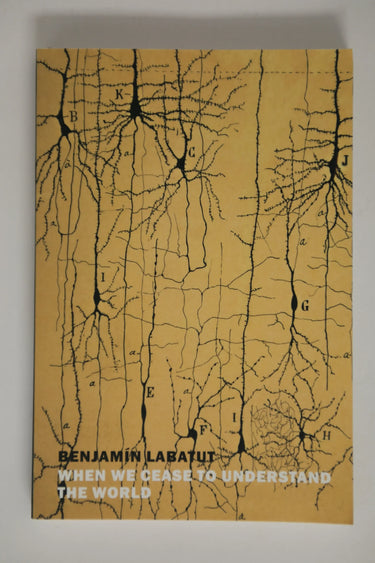
When We Cease to Understand the World by Benjamn Labatut, Adrian Nathan West
Notes From Your Bookseller This deceptively slim novel explores madness, divinity and scientific discovery -- and reads like the best of nonfiction. One of The New York Times Book Review's 10 Best Books of 2021 Shortlisted for the 2021 International Booker Prize and the 2021 National Book Award for Translated Literature A fictional examination of the lives of real-life scientists and thinkers whose discoveries resulted in moral consequences beyond their imagining. When We Cease to Understand the World is a book about the complicated links between scientific and mathematical discovery, madness, and destruction. Fritz Haber, Alexander Grothendieck, Werner Heisenberg, Erwin Schrdinger--these are some of luminaries into whose troubled lives Benjamn Labatut thrusts the reader, showing us how they grappled with the most profound questions of existence. They have strokes of unparalleled genius, alienate friends and lovers, descend into isolation and insanity. Some of their discoveries reshape human life for the better; others pave the way to chaos and unimaginable suffering. The lines are never clear. At a breakneck pace and with a wealth of disturbing detail, Labatut uses the imaginative resources of fiction to tell the stories of the scientists and mathematicians who expanded our notions of the possible. Editorial Reviews *07/12/2021 Reading like an episodic digest, Chilean writer Labatut's stylish English-language debut offers an embellished, heretical, and thoroughly engrossing account of the personalities and creative madness that gave rise to some of the 20th century's greatest scientific discoveries. Labatut begins with Prussian blue, the first synthetic pigment, created by alchemist Johann Conrad Dippel, and links it to the evolution of modern industrial poisons and the life of WWI German chemist Fritz Haber. Labatut then follows Alexander Grothendieck, the reclusive French mathematician whose political and spiritual inclinations led him to a life of monklike sequestration, before dramatizing the long battle between Werner Heisenberg and Erwin Schrdinger over the future of quantum physics. Labatut, like his single-minded, sometimes nearly demented protagonists, is interested in the underlying nature of things; his subject is the all-consuming human drive to discover, and the danger therein, which he explores with literary but never pretentious prose, impressively translated by West (on Prussian blue: something in the colour's chemical structure invoked violence: a fault, a shadow, an existential stain passed down from those experiments in which the alchemist dismembered living animals to create it). Hard to pin down and all the more enjoyable for it, this unique work is one to be savored. Agent: Constanza Martinez, Puentes Agency. (Sept.) - Publishers Weekly Selected by President Barack Obama for his Summer 2021 Reading List Finalist for the Los Angeles Times's Art Seidenbaum Award for First Fiction A gripping meditation on knowledge and hubris. . . . [Labatut] casts the flickering light of gothic fiction on 20th-century science. In five free-floating vignettes, he illuminates the kinship of knowledge and destruction, brilliance and madness. . . . His prose is masterfully paced and vividly rendered in Adrian Nathan West's magnetic translation. --Corinna da Fonseca-Wollheim, The New York Times Book Review When We Cease to Understand the World fuses fact and fiction to turn the modern history of physics into a gripping narrative of obsessed scientists, world-changing discoveries, and the ultimate results--often quite dark--of our drive to understand the fundamental workings of the universe. --John Williams, The New York Times Book Review Podcast [When We Cease to Understand the World] is as compact and potent as a capsule of cyanide, a poison whose origin story takes up much of the opening chapter--the first of many looping forays into the wonders and horrors unleashed by science in the past few centuries. . . . It is a meditation in prose that bears a familial relationship to the work of W. G. Sebald or Olga Tokarczuk: a sequence of accounts that skew biographical but also venture into the terrain of imagination. . . . The stories in this book nest inside one another, their points of contact with reality almost impossible to fully determine. --Ruth Franklin, The New Yorker Darkly dazzling. . . [Labatut] illustrates the unbreakable bond between horror and beauty, life-saving and life-destroying. . . . This book--as haunting as it is erudite--stubbornly insists on connecting the wonders of scientific advancement to the atrocities of history. --Sam Sacks, The Wall Street Journal Labatut's stylish English-language debut offers an embellished, heretical, and thoroughly engrossing account of the personalities and creative madness that gave rise to some of the 20th century's greatest scientific discoveries. . . [Labatut's] subject is the all-consuming human drive to discover, and the danger therein. . . Hard to pin down and all the more enjoyable for it, this unique work is one to be savored. --Publishers Weekly, starred review [When We Cease to Understand the World] rattles the prevailing narrative of heroic scientific innovators. --Mark Athitakis, Los Angeles Times Absolutely brilliant. I was utterly gripped and wolfed it down. It feels as if he has invented an entirely new genre. --Mark Haddon A thrilling account of theories of physics, and as a series of highly-wrought imaginative extrapolations about the physicists who arrived at them. --Geoff Dyer When We Cease to Understand the World by Benjamn Labatut is the strangest and most original book I've read for years. It hovers in a state between fiction and non-fiction, or wave and particle, and makes an account of modern mathematics and science into something as eerie as a great ghost story. --Philip Pullman, New Statesman, 'Books of the Year' A dazzling associative caper full of graceful arabesques linking continents and centuries and ideas. --The Sunday Times Culture Remind[s] us of fiction's power to take us to another world and expand our understanding of this one . . . When We Cease to Understand the World showcases the minds seeking to pierce the mysterious heart of mathematics. --The Guardian, 'Biggest books of autumn' It may be possible to actually feel your brain getting bigger as you read. --Evening Standard Labatut has written a dystopian nonfiction novel set not in the future but in the present. --John Banville, The Guardian An exquisitely written and continuously fascinating hybrid work of fiction and history. --Catherine Taylor, The Irish Times Wholly mesmerising and revelatory . . . Completely fascinating. --William Boyd Using epoch-defining moments from the history of science, from Albert Einstein's theory of relativity to Erwin Schrdinger and Werner Heisenberg's opposing views on quantum mechanics, Labatut uses fiction to crack open the stories of scientists and mathematicians who expanded our notions of the possible, while also presenting them as human, all too human. --Dazed You don't have to know anything about quantum theory to start reading this book, a deeply researched, exquisitely imagined group portrait of tormented geniuses. By the end, you'll know enough to be terrified. --The New York Times, 'The 100 Best Books of the 21st Century' - From the Publisher 2021-06-16 A belletristic exploration of the psychic and social tolls of 20th-century scientific innovation. The Nobel-winning chemist Fritz Haber discovered the process that made lifesaving nitrogen fertilizer but also facilitated chemical weapons that killed thousands in World War I. The physicist Karl Schwarzchild discovered the phenomena behind black holes but was haunted by the violence he witnessed during the same conflict. Alexander Grothendieck was a pioneering mathematician who became a troubled and eccentric recluse. The central figures in quantum physics were all stricken with physical and mental illnesses, as if they buckled under the weight of their research. The first novel published in English by Chilean author Labatut--which was a finalist for the 2021 International Booker Prize--is constructed out of vignettes on these figures, coolly undermining the notion of consistent forward scientific progress. Rather, he writes, we are borne of the whims of a many-armed goddess toying with chance. Each section of the novel centers on one of the scientists in question, and in the early going Labatut comes off as more of a scientific historian than a novelist; the first chapter, on Haber, reads like a biographical sketch. But by the time we get to Erwin Schrdinger, Labatut's writing becomes more interior and complex as the physicist scrabbles for footing within the scientific community and Indian religious tradition, then descends into an obsession with an underage girl he meets at a sanatorium. Just as quantum physics threw the bedrock principles of the universe into question, the novel shifts further from fact, closing with a fully fictional coda. In structure and content, the novel is highly mannered, but Labatut's high-concept approach makes room for an emotional impact; you can feel the center stop holding as scientific triumphs become Pyrrhic victories. A somber counterweight to the usual lore about scientific genius. - Kirkus Reviews It's difficult to characterize this work of fiction based on real events, but whatever the genre, it's a marvelous listen. Labatut's first work to be translated into English (and it's an outstanding rendering by Adrian West) is a series of narratives involving some of the twentieth century's greatest scientists and mathematicians, brought to our ears through the inviting baritone of Adam Barr. These enigmatic stories explore the idea that brilliant minds can straddle the line between heroism and horror; one example is Fritz Haber, whose discoveries led to fertilizers that saved millions from famine and to poison gas that slaughtered soldiers. This is an innovative and exciting work from a young writer, and Barr holds it together with his confident delivery. D.B. Winner of AudioFile Earphones Award AudioFile 2021, Portland, Maine - NOVEMBER 2021 - AudioFile
Publication Details
Title:
Author(s):
Illustrator:
Binding: Paperback
Published by: New York Review Books: , 2023
Edition:
ISBN: 9781681375663 | 1681375664
192 pages.
Book Condition: Very Good
products.product.pickup_availability.unavailable
Product information
New Zealand Delivery
Shipping Options
Shipping options are shown at checkout and will vary depending on the delivery address and weight of the books.
We endeavour to ship the following day after your order is made and to have pick up orders available the same day. We ship Monday-Friday. Any orders made on a Friday afternoon will be sent the following Monday. We are unable to deliver on Saturday and Sunday.
Pick Up is Available in NZ:
Warehouse Pick Up Hours
- Monday - Friday: 9am-5pm
- 35 Nathan Terrace, Shannon NZ
Please make sure we have confirmed your order is ready for pickup and bring your confirmation email with you.
Rates
-
New Zealand Standard Shipping - $6.00
- New Zealand Standard Rural Shipping - $10.00
- Free Nationwide Standard Shipping on all Orders $75+
Please allow up to 5 working days for your order to arrive within New Zealand before contacting us about a late delivery. We use NZ Post and the tracking details will be emailed to you as soon as they become available. There may be some courier delays that are out of our control.
International Delivery
We currently ship to Australia and a range of international locations including: Belgium, Canada, China, Switzerland, Czechia, Germany, Denmark, Spain, Finland, France, United Kingdom, United States, Hong Kong SAR, Thailand, Philippines, Ireland, Israel, Italy, Japan, South Korea, Malaysia, Netherlands, Norway, Poland, Portugal, Sweden & Singapore. If your country is not listed, we may not be able to ship to you, or may only offer a quoting shipping option, please contact us if you are unsure.
International orders normally arrive within 2-4 weeks of shipping. Please note that these orders need to pass through the customs office in your country before it will be released for final delivery, which can occasionally cause additional delays. Once an order leaves our warehouse, carrier shipping delays may occur due to factors outside our control. We, unfortunately, can’t control how quickly an order arrives once it has left our warehouse. Contacting the carrier is the best way to get more insight into your package’s location and estimated delivery date.
- Global Standard 1 Book Rate: $37 + $10 for every extra book up to 20kg
- Australia Standard 1 Book Rate: $14 + $4 for every extra book
Any parcels with a combined weight of over 20kg will not process automatically on the website and you will need to contact us for a quote.
Payment Options
On checkout you can either opt to pay by credit card (Visa, Mastercard or American Express), Google Pay, Apple Pay, Shop Pay & Union Pay. Paypal, Afterpay and Bank Deposit.
Transactions are processed immediately and in most cases your order will be shipped the next working day. We do not deliver weekends sorry.
If you do need to contact us about an order please do so here.
You can also check your order by logging in.
Contact Details
- Trade Name: Book Express Ltd
- Phone Number: (+64) 22 852 6879
- Email: sales@bookexpress.co.nz
- Address: 35 Nathan Terrace, Shannon, 4821, New Zealand.
- GST Number: 103320957 - We are registered for GST in New Zealand
- NZBN: 9429031911290
We have a 30-day return policy, which means you have 30 days after receiving your item to request a return.
To be eligible for a return, your item must be in the same condition that you received it, unworn or unread.
To start a return, you can contact us at sales@bookexpress.co.nz. Please note that returns will need to be sent to the following address: 35 Nathan Terrace, Shannon, New Zealand 4821.
If your return is for a quality or incorrect item, the cost of return will be on us, and will refund your cost. If it is for a change of mind, the return will be at your cost.
You can always contact us for any return question at sales@bookexpress.co.nz.
Damages and issues
Please inspect your order upon reception and contact us immediately if the item is defective, damaged or if you receive the wrong item, so that we can evaluate the issue and make it right.
Exceptions / non-returnable items
Certain types of items cannot be returned, like perishable goods (such as food, flowers, or plants), custom products (such as special orders or personalised items), and personal care goods (such as beauty products). Although we don't currently sell anything like this. Please get in touch if you have questions or concerns about your specific item.
Unfortunately, we cannot accept returns on gift cards.
Exchanges
The fastest way to ensure you get what you want is to return the item you have, and once the return is accepted, make a separate purchase for the new item.
European Union 14 day cooling off period
Notwithstanding the above, if the merchandise is being shipped into the European Union, you have the right to cancel or return your order within 14 days, for any reason and without a justification. As above, your item must be in the same condition that you received it, unworn or unused, with tags, and in its original packaging. You’ll also need the receipt or proof of purchase.
Refunds
We will notify you once we’ve received and inspected your return, and let you know if the refund was approved or not. If approved, you’ll be automatically refunded on your original payment method within 10 business days. Please remember it can take some time for your bank or credit card company to process and post the refund too.
If more than 15 business days have passed since we’ve approved your return, please contact us at sales@bookexpress.co.nz.