
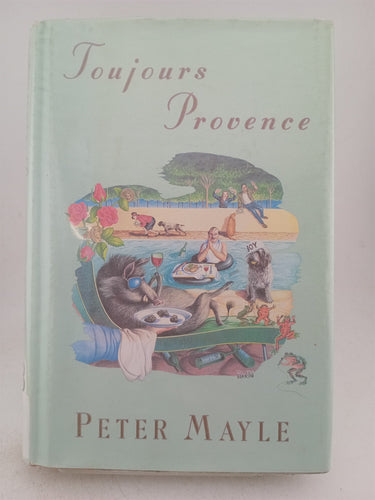
Toujours Provence by Peter Mayle
NATIONAL BESTSELLER Taking up where his beloved A Year in Provence leaves off, Peter Mayle offers us another funny, beautifully (and deliciously) evocative book about life in Provence. With tales only one who lives there could know-of finding gold coins while digging in the garden, of indulging in sumptuous feasts at truck stops-and with characters introduced with great affection and wit-the gendarme fallen from grace, the summer visitors ever trying the patience of even the most genial Provenaux, the straightforward dog Boy-Toujours Provence is a heart-warming portrait of a place where, if you can't quite get away from it all, you can surely have a very good time trying. From the Trade Paperback edition. Editorial Reviews From Publishers Weekly After writing A Year in Provence , Mayle and his family have made themselves at home in the Midi, as these new tales reveal. The British author infuses his adventures with natural humor, whether the subject is larking with Provencal pals, an epicurean diner sur l'herbe , the tangy wine of the countryside, a concert by Pavarotti. Each account is pure enchantment. But Mayle exhibits anger too, particularly when reporting on the undetectable wretch who sets fires impossible to contain during the season of the mistral. Overall, however, the book features the satisfactions of life with good friends and fresh discoveries in that lovely part of France. Reading about them is the next best thing to being in the Midi, where almost every prospect pleases. Copyright 1991 Reed Business Information, Inc. From Library Journal For fans of his A Year in Provence ( LJ 4/1/90; Best Books of 1990, LJ 1/91), Mayle is back with more amusing tales of la vie en rose in the south of France. Writing with affectionate humor, he recounts such adventures as sneaking through British customs with a suitcase full of expensive truffles and digging for gold coins in his backyard with his wily and greedy neighbor. He encounters truly French eccentrics like Regis, the athlete gourmet who wears a track suit to enjoy his meals, and the ambitious Monsieur Salques, the choirmaster of the singing toads of St. Panteleon who plans to celebrate the bicentennial of the French Revolution with an amphibian rendition of the Marseillaise. Describing a memorable 50th-birthday picnic that ends in a sudden rainstorm, Mayle conjures up hilarious images in vivid prose: Showing through a pair of once-white, once-opaque trousers, red-lettered knickers wished us all Merry Xmas. Recommended for all travel collections. - Wilda Williams, Library Journal Copyright 1991 Reed Business Information, Inc. From Kirkus Reviews Second installment by GQ columnist Mayle of his country life in the Provencal region of southern France, following the delightful A Year in Provence (1990). Mayle, as keen and sunny an entertainer as ever, tells of French medicine, the drolleries of a French liver crisis, and the difficulties of trying to fill a prescription when an American visitor with mononucleosis needs a state-of-the-art antibiotic on Sunday. He reviews his mail, the new celebrity brought to him as the local English writer, his wife's gradual cooling toward visitors (pretty blondes make her snappish), and a signing at a Cannes bookstore during the film festival. Mayle gets much mileage out of his wife, whose Frenchified rationality makes her head of the household; she arranges birthday picnics, social occasions--and adores stray dogs. He checks out a choir of toads that may, through electronic rechanneling, sing La Marseillaise. He attends a combined wine-tasting and fabulous country meal that leaves him stuffed and unconscious. We go with him on a secret truffle buy as he hustles two kilos of smelly contraband from the French countryside to Heathrow in London. We dig up gold napoleons in his rose garden and sweep the premises with a metal detector; sit through a knockout Pavarotti concert in a 2,000-year-old outdoor Roman amphitheater while the tenor eats dinner offstage between arias. Mayle spends an evening researching varieties of pastis, an anise and licorice aperitif, two drinks of which will twist your nose; and finds his scholarly and detached attitude smoothly numbed. Very winish, dinerish--and absolutely gustatory. -- Copyright 1991, Kirkus Associates, LP. All rights reserved. Review Light and loving . . . a welcoming, happy book. -San Francisco Chronicle Like returning to a country inn, where you know the owner, where they save your favorite room for you, and the bartender remembers what you drink. . . . Provence has been fortunate in its laureates. -The New York Times Book Review Peter Mayle [is] something of a wonder . . . chronicling the scene around him in irresistible prose . . . the joys of a bountiful climate, brilliant sun and a splendid cuisine. -Time From the Trade Paperback edition. From the Inside Flap offers us another funny and beautiful book about life in Provence. Here is a heart-warming portrait of a place where, if you can't quite get away from it all, you can surely have the best of times trying. From the Trade Paperback edition. About the Author Peter Mayle spent fifteen years in the advertising business, first as a copywriter and then as a reluctant executive, before escaping Madison Avenue in 1975 to write educational books for children. In 1990, Mr. Mayle published A Year in Provence, which became an international bestseller. He is also the author of Encore Provence, Hotel Pastis, A Dog's Life, Anything Considered and Chasing Cezanne. In addition to writing books which have been translated into more than twenty languages, Mayle has contributed to the Sunday Times, Financial Times, Independent, GQ and Esquire. He and his wife and two dogs live in the South of France. From the Trade Paperback edition. Excerpt. Reprinted by permission. All rights reserved. Les Invalides I had been to a pharmacy in Apt for toothpaste and suntan oil, two innocent and perfectly healthy purchases. When I arrived home and took them out of the bag, I found that the girl who served me had included an instructive but puzzling gift. It was an expensively printed leaflet in full color. On the front was a picture of a snail sitting on the toilet. He looked doleful, as if he'd been there for some time without achieving anything worthwhile. His horns drooped. His eye was lackluster. Above this sad picture was printed La Constipation. What had I done to deserve this? Did I look constipated? Or was the fact that I bought toothpaste and suntan oil somehow significant to the expert pharmacist's eye-a hint that all was not well in my digestive system? Maybe the girl knew something I didn't. I started to read the leaflet. Nothing, it said, is more banal and more frequent than constipation. About 20 percent of the French population, so the writer claimed, suffered from the horrors of ballonnement and g?ne abdominale. And yet, to a casual observer like myself, there were no obvious signs of discomfort among the people on the streets, in the bars and caf?s, or even in the restaurants-where presumably 20 percent of the clientele tucking into two substantial meals a day were doing so in spite of their ballonnements. What fortitude in the face of adversity! I had always thought of Provence as one of the healthier places in the world. The air is clean, the climate is dry, fresh fruit and vegetables are abundantly available, cooking is done with olive oil, stress doesn't seem to exist-there could hardly be a more wholesome set of circumstances. And everybody looks very well. But if 20 percent of those ruddy faces and hearty appetites were concealing the suffering caused by a traffic jam in the transit intestinal, what else might they be concealing? I decided to pay closer attention to Proven?al complaints and remedies, and gradually became aware that there is indeed a local affliction, which I think extends to the entire country. It is hypochondria. A Frenchman never feels out of sorts; he has a crise. The most popular of these is a crise de foie, when the liver finally rebels against the punishment inflicted by pastis, five-course meals, and the tots of marc and the vin d'honneur served at everything from the opening of a car showroom to the annual meeting of the village Communist Party. The simple cure is no alcohol and plenty of mineral water, but a much more satisfactory solution-because it supports the idea of illness rather than admitting self-indulgence-is a trip to the pharmacy and a consultation with the sympathetic white-coated lady behind the counter. I used to wonder why most pharmacies have chairs arranged between the surgical trusses and the cellulite treatment kits, and now I know. It is so that one can wait more comfortably while Monsieur Machin explains, in great whispered detail and with considerable massaging of the engorged throat, the tender kidney, the reluctant intestine, or whatever else ails him, how he came to this painful state. The pharmacist, who is trained in patience and diagnosis, listens carefully, asks a few questions, and then proposes a number of possible solutions. Packets and jars and ampoules are produced. More discussion. A choice is finally made, and Monsieur Machin carefully folds up the vital pieces of paper that will enable him to claim back most of the cost of his medication from Social Security. Fifteen or twenty minutes have passed, and everyone moves up a chair. These trips to the pharmacy are only for the more robust invalids. For serious illness, or imaginary serious illness, there is, even in relatively remote country areas like ours, a network of first aid specialists that amazes visitors from cities, where you need to be a millionaire before you can be sick in comfort. All the towns, and many of the villages, have their own ambulance services, on call 24 hours a day. Registered nurses will come to the house. Doctors will come to the house, a practice I'm told is almost extinct in London. We had a brief but intense experience with the French medical system early last summer. The guinea pig was Benson, a young American visitor on his first trip to Europe. When I picked him up at the Avignon railroad station, he croaked hello, coughed, and clapped a handkerchief to his mouth. I asked him what was the matter. He pointed to his throat and made wheezing noises. Mono, he said. Mono? I had no idea what that was, but I did know that Americans have much more sophisticated ailments than we do-hematomas instead of bruises, migraine instead of a headache, postnasal drip-and so I muttered something about fresh air soon clearing it up and helped him into the car. On the way home, I learned that mono was the intimate form of address for mononucleosis, a viral infection causing considerable soreness of the throat. Like broken glass, said Benson, huddled behind his sunglasses and his handkerchief. We have to call my brother in Brooklyn. He's a doctor. We got back to the house to find the phone out of order. It was the beginning of a long holiday weekend, and so we would be without it for three days, normally a blessing. But Brooklyn had to be called. There was one particular antibiotic, a state of the art antibiotic, that Benson said would overcome all known forms of mono. I went down to the phone booth at Les Baumettes and fed it with five-franc pieces while Brooklyn Hospital searched for Benson's brother. He gave me the name of the wonder drug. I called a doctor and asked him if he could come to the house. He arrived within an hour and inspected the invalid, who was resting behind his sunglasses in a darkened room. Alors, monsieur . . . the doctor began, but Benson cut him short. Mono, he said, pointing at his throat. Comment? Mono, man. Mononucleosis. Ah, mononucl?ose. Peut-?tre, peut-?tre. The doctor looked into Benson's angry throat and took a swab. He wanted to run a laboratory test on the virus. And now, would Monsieur lower his trousers? He took out a syringe, which Benson peered at suspiciously over his shoulder as he slowly dropped his Calvin Klein jeans to half-mast. Tell him I'm allergic to most antibiotics. He should call my brother in Brooklyn. Comment? I explained the problem. Did the doctor by any chance have the wonder drug in his bag? Non. We looked at each other around Benson's bare buttocks. They jerked as Benson coughed painfully. The doctor said he must be given something to reduce the inflammation, and that side effects from this particular shot were extremely rare. I passed the news on to Benson. Well . . . OK. He bent over, and the doctor injected with a flourish, like a matador going in over the horns. Voil?! While Benson waited for allergic reactions to send him reeling, the doctor told me that he would arrange for a nurse to come twice a day to give further injections, and that the test results would be in on Saturday. As soon as he had them, he would make out the necessary prescriptions. He wished us a bonne soir?e. Benson communed noisily with his handkerchief. I thought a bonne soir?e was unlikely. The nurse came and went, the test results came through, and the doctor reappeared on Saturday evening as promised. The young Monsieur had been correct. It was mononucl?ose, but we would conquer it with the resources of French medicine. The doctor began to scribble like a poet in heat. As prescription after prescription flowed from his pen, it seemed as though every single resource was going to be called into action. He passed over a wad of hieroglyphics, and wished us a bon weekend. That too was unlikely. The Sunday of a holiday weekend in rural France is not the easiest time to find a pharmacy open for business, and the only one for miles around was the pharmacie de garde on the outskirts of Cavaillon. I was there at 8:30, and joined a man clutching a wad of prescriptions almost as thick as mine. Together we read the notice taped to the glass door: Opening time was not until 10:00. The man sighed, and looked me up and down. Are you an emergency? No. It was for a friend. He nodded. He himself had an important arthrose in his shoulder, and also some malign fungus of the feet. He was not going to stand for an hour and a half in the sun to wait for the pharmacy to open. He sat down on the pavement next to the door and started to read chapter one of his prescriptions. I decided to go and have breakfast. Come back well before ten, he said. There will be many people today. How did he know? Was a Sunday morning visit to the pharmacy a regular prelunch treat? I thanked him and ignored his advice, killing time with an old copy of Le Proven?al in a caf?. When I returned to the pharmacy just before ten, it looked as though le tout Cavaillon had gathered outside. There were dozens of them standing with their voluminous prescriptions, swapping symptoms in the manner of an angler describing a prize fish. Monsieur Angine boasted about his sore throat. Madame Varices countered with the history of her varicose veins. The halt and the maimed chattered away cheerfully, consulting their watches and pressing ever closer to the still-locked door. At last, to a murmured accompaniment of enfin and elle arrive, a girl appeared from the back of the pharmacy, opened up, and stepped smartly aside as the stampede jostled through. Not for the first time, I realized that the Anglo-Saxon custom of the orderly queue has no place in French life. I must have been there for half an hour before I was able to take advantage of a gap in the m?l?e and give my documents to the pharmacist. She produced a plastic shopping bag and started to fill it with boxes and bottles, rubber-stamping each pr...
Publication Details
Title:
Author(s):
Illustrator:
Binding: Hardcover
Published by: Knopf : Distributed by Random House: , 1991
Edition:
ISBN: 9780679402534 | 0679402535
241 pages.
Book Condition: Good
ex-library
products.product.pickup_availability.unavailable
Product information

New Zealand Delivery
Shipping Options
Shipping options are shown at checkout and will vary depending on the delivery address and weight of the books.
We endeavour to ship the following day after your order is made and to have pick up orders available the same day. We ship Monday-Friday. Any orders made on a Friday afternoon will be sent the following Monday. We are unable to deliver on Saturday and Sunday.
Pick Up is Available in NZ:
Warehouse Pick Up Hours
- Monday - Friday: 9am-5pm
- 35 Nathan Terrace, Shannon NZ
Please make sure we have confirmed your order is ready for pickup and bring your confirmation email with you.
Rates
-
New Zealand Standard Shipping - $6.00
- New Zealand Standard Rural Shipping - $10.00
- Free Nationwide Standard Shipping on all Orders $75+
Please allow up to 5 working days for your order to arrive within New Zealand before contacting us about a late delivery. We use NZ Post and the tracking details will be emailed to you as soon as they become available. There may be some courier delays that are out of our control.
International Delivery
We currently ship to Australia and a range of international locations including: Belgium, Canada, China, Switzerland, Czechia, Germany, Denmark, Spain, Finland, France, United Kingdom, United States, Hong Kong SAR, Thailand, Philippines, Ireland, Israel, Italy, Japan, South Korea, Malaysia, Netherlands, Norway, Poland, Portugal, Sweden & Singapore. If your country is not listed, we may not be able to ship to you, or may only offer a quoting shipping option, please contact us if you are unsure.
International orders normally arrive within 2-4 weeks of shipping. Please note that these orders need to pass through the customs office in your country before it will be released for final delivery, which can occasionally cause additional delays. Once an order leaves our warehouse, carrier shipping delays may occur due to factors outside our control. We, unfortunately, can’t control how quickly an order arrives once it has left our warehouse. Contacting the carrier is the best way to get more insight into your package’s location and estimated delivery date.
- Global Standard 1 Book Rate: $37 + $10 for every extra book up to 20kg
- Australia Standard 1 Book Rate: $14 + $4 for every extra book
Any parcels with a combined weight of over 20kg will not process automatically on the website and you will need to contact us for a quote.
Payment Options
On checkout you can either opt to pay by credit card (Visa, Mastercard or American Express), Google Pay, Apple Pay, Shop Pay & Union Pay. Paypal, Afterpay and Bank Deposit.
Transactions are processed immediately and in most cases your order will be shipped the next working day. We do not deliver weekends sorry.
If you do need to contact us about an order please do so here.
You can also check your order by logging in.
Contact Details
- Trade Name: Book Express Ltd
- Phone Number: (+64) 22 852 6879
- Email: sales@bookexpress.co.nz
- Address: 35 Nathan Terrace, Shannon, 4821, New Zealand.
- GST Number: 103320957 - We are registered for GST in New Zealand
- NZBN: 9429031911290
We have a 30-day return policy, which means you have 30 days after receiving your item to request a return.
To be eligible for a return, your item must be in the same condition that you received it, unworn or unread.
To start a return, you can contact us at sales@bookexpress.co.nz. Please note that returns will need to be sent to the following address: 35 Nathan Terrace, Shannon, New Zealand 4821.
If your return is for a quality or incorrect item, the cost of return will be on us, and will refund your cost. If it is for a change of mind, the return will be at your cost.
You can always contact us for any return question at sales@bookexpress.co.nz.
Damages and issues
Please inspect your order upon reception and contact us immediately if the item is defective, damaged or if you receive the wrong item, so that we can evaluate the issue and make it right.
Exceptions / non-returnable items
Certain types of items cannot be returned, like perishable goods (such as food, flowers, or plants), custom products (such as special orders or personalised items), and personal care goods (such as beauty products). Although we don't currently sell anything like this. Please get in touch if you have questions or concerns about your specific item.
Unfortunately, we cannot accept returns on gift cards.
Exchanges
The fastest way to ensure you get what you want is to return the item you have, and once the return is accepted, make a separate purchase for the new item.
European Union 14 day cooling off period
Notwithstanding the above, if the merchandise is being shipped into the European Union, you have the right to cancel or return your order within 14 days, for any reason and without a justification. As above, your item must be in the same condition that you received it, unworn or unused, with tags, and in its original packaging. You’ll also need the receipt or proof of purchase.
Refunds
We will notify you once we’ve received and inspected your return, and let you know if the refund was approved or not. If approved, you’ll be automatically refunded on your original payment method within 10 business days. Please remember it can take some time for your bank or credit card company to process and post the refund too.
If more than 15 business days have passed since we’ve approved your return, please contact us at sales@bookexpress.co.nz.