
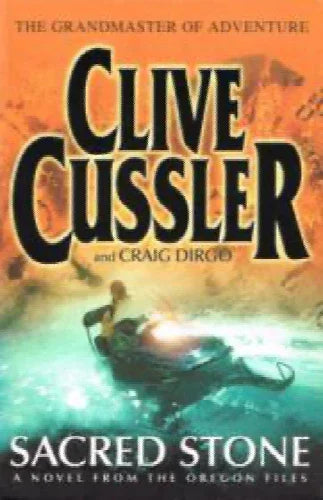
The sacred stone by Clive Cussler,Craig Dirgo
Clive Cussler debuted his new series, The Oregon Files, with the incredible adventure of Golden Buddha. Now he follows that triumph with Sacred Stone, a rollicking new tale featuring the enigmatic captain of The Oregon, Juan Cabrillo. In the remote wastelands of Greenland, an ancient artifact possessing catastrophic radioactive power is unearthed. But the astounding find puts the world at risk. Caught between two militant factions bent on wholesale slaughter, Juan Cabrillo and his network of spies known as The Corporation must fight to protect the stone - and prevent the outbreak of World War III... Editorial Reviews From Publishers Weekly Eric the Red's A.D. 1000 discovery of a radioactive meteorite has present-day life-or-death ramifications in Cussler and Dirgo's second novel (after Golden Buddha) featuring the Oregon, a state-of-the-art warship disguised as a rusty tramp steamer and manned by some of the world's finest ex-military and intelligence operatives. Known collectively as the Corporation, the men and women of the Oregon--mercenaries with a conscience--offer their services to various countries and individuals with specialized security and military needs. The Corporation's chairman, series hero Juan Cabrillo, has several pressing concerns: supply security for the emir of Qatar, who is attending a conference in Iceland; track down a nuclear bomb that has gone astray; and pick up the aforementioned meteorite, which has just been found ensconced in a mysterious shrine. These jobs become dangerously complicated when industrialist Halifax Hickman, a man fueled by revenge and hatred, enters the picture. The meteorite, the atomic bomb and a vial of plague are to be used in attacks on holy sites--Israel's Dome of the Rock and Saudi Arabia's al-Haram mosque--and at an Elton John concert. It's a deadly game, but the brilliant Cabrillo is a master player, moving his pieces at lightning speed on several boards until he outmaneuvers his opposition in this action-packed page-turner. Copyright Reed Business Information, a division of Reed Elsevier Inc. All rights reserved. --This text refers to an out of print or unavailable edition of this title. Review Just About the Best Storyteller in the Business. --This text refers to an out of print or unavailable edition of this title. From Booklist This is the second novel in the Oregon Files series featuring Juan Cabrillo as the chairman of the Corporation, a group of ex-military and intelligence operatives who hire themselves out to countries and individuals needing specialized services--a private army of mercenaries with a conscience. The Oregon is a 500-foot-long cargo steamer with a state-of-the-art communications and command center and a helicopter. The group's mission is to pick up a meteorite and deliver it to the CIA. It might be made of iridium, and iridium can be used to construct a dirty bomb. Muslim terrorists who have stolen a nuclear device may use the radioactive material in the meteorite to vaporize a large Western city. Another group, led by a demented industrialist, seeks to destroy the Islamic world. As always, the plot covers many locales around the world, and the dialogue contains lots of military jargon. The large cast of characters includes Elton John and Eric the Red (yes, the legendary explorer). Even though the good guys always win, Cussler fans will remain engaged. George Cohen Copyright American Library Association. All rights reserved --This text refers to an out of print or unavailable edition of this title. About the Author Clive Cussler is the author of numerous New York Times bestsellers. He splits his time between Telluride, Colorado and Paradise Valley, Arizona. Craig Dirgo has been special projects director on many NUMA® expeditions since 1987 and now serves as a trustee. He also cowrote The Sea Hunters series. --This text refers to an out of print or unavailable edition of this title. From AudioFile In another of Cussler's high-tech potboilers, a small band of heroes rushes from one intricate crisis to another in an effort to save the world and the Islamic religion. The latter is presented with objectivity: Some Muslims are terrorists; some are among the good guys; most just go about their business. The artifacts of Islam occupy a central role in the story. The jacket blurb describes J. Charles as having more than forty years of experience in entertainment, but his voice reminds one of emerging younger narrators such as Scott Brick. Charles distinguishes the players skillfully through accent and cadence. This is a fun listen. D.R.W. AudioFile 2005, Portland, Maine-- Copyright AudioFile, Portland, Maine --This text refers to an out of print or unavailable edition of this title. Excerpt. Reprinted by permission. All rights reserved. Chapter One LIEUTENANT CHRIS HUNT rarely talked about his past, but the men he served with had gathered a few clues from his demeanor. The first was that Hunt had not grown up in some backwoods hillbilly haven and used the army to see the world. He was from Southern California. And, if pressed, Hunt would volunteer he was raised in the Los Angeles area, not wanting to disclose that he grew up in Beverly Hills. The second thing the men noticed was that Hunt was a natural leader-he was neither patronizing nor put on an air of superiority, but neither did he try to hide the fact that he was competent and smart. The third thing the men found out today. A chill wind was blowing down from the mountains into the Afghanistan valley where the platoon under Hunt's command was breaking camp. Hunt and three other soldiers were wrestling with a tent they were folding for storage. While the men were bringing the ends together longways, Sergeant Tom Agnes decided to ask about the rumor he had heard. Hunt handed him the side of the tent so Agnes could fold it into halves. Sir, Agnes said, rumor has it you graduated from Yale University-that true? All the men were wearing tinted ski goggles but Agnes was close enough to see Hunt's eyes. A flicker of surprise, followed by resignation, flashed quickly. Then Hunt smiled. Ah, he said quietly, you've found out my terrible secret. Agnes nodded and folded the tent in half. Not exactly a hotbed for military recruiting. George Bush went there, Hunt said. He was a navy pilot. I thought he was in the National Guard, Specialist Jesus Herrara, who was taking the tent from Agnes, said. George Bush Senior, Hunt said. Our president also graduated from Yale, and yes, he was a National Guard jet pilot. Yale, Agnes said. If you don't mind me asking, how did you end up here? Hunt brushed some snow from his gloves. I volunteered, he said, just like you. Agnes nodded. Now let's finish breaking down this camp, Hunt said, pointing to the mountain nearby, and head up there and find that bastard who attacked the United States. Yes, sir, the men said in unison. Ten minutes later, with fifty-pound packs on their backs, they started up the mountain. IN A TOWN where beautiful women abound, at age forty-nine Michelle Hunt still caused men to turn their heads. Tall, with hazel hair and bluegreen eyes, she was blessed with a figure that required neither constant dieting nor endless exercise to appear trim. Her lips were full and her teeth straight, but it was her doelike eyes and flawless skin that gave the strongest visual impression. And while she was a beautiful woman, that was as common in Southern California as sunshine and earthquakes. What drew people closer to Michelle was something that cannot be created by a surgeon's knife, honed through dress or manicure, or developed through ambition or change. Michelle had that thing that made both men and women like her and want to be around her-she was happy, content and positive. Michelle Hunt was herself. And people flocked to her like bees to a flower in bloom. Sam, she said to the painter who had just finished the walls in her art gallery, you do such nice work. Sam was thirty-eight years old and he blushed. Only my best for you, Ms. Hunt, he said. Sam had painted her gallery when it had opened five years before, her Beverly Hills house, her condo in Lake Tahoe and now this remodel. And every time she made him feel appreciated and talented. You want a bottle of water or a Coke or something? she asked. I'm okay, thanks. Just then an assistant called from the front of the gallery that she had a telephone call, and she smiled, waved and began to walk away. That's a lady, Sam said under his breath, a lady. Walking to the front of the gallery, where her desk faced out onto Rodeo Drive, Michelle noticed that one of the artists she represented was coming through the front door. Here her amiability had also paid off in spades-artists are a fickle and temperamental lot, but Michelle's artists adored her and rarely changed galleries. That and the fact that she had started her business fully funded had contributed greatly to her years of success. I knew today was going to be good, she said to the bearded man. I just didn't know it would be because my favorite artist would be paying me a visit. The man smiled. Just let me take this telephone call, she said, and we'll talk. Her aide corralled the artist toward an area with couches and a wet bar off to one side. As Michelle slid into her desk chair and reached for the telephone, the aide took the artist's drink order and a few seconds later began packing ground espresso into the machine to draw him a cappuccino. Michelle Hunt. It's me, a gravelly voice said. The voice was one that needed no introduction. He had swept her off her feet when she was a young woman of twenty-one, freshly arrived from Minnesota, seeking a new life of fun and sun in 1980s Southern California. After an on-again, off-again relationship, necessitated both by his inability to be bound to a relationship, as well as his frequent absences for business, she had borne his son at age twenty-four. And though his name never appeared on the birth certificate-nor had Michelle and he actually lived together before or since-the pair had remained close. At least as close as the man allowed anyone ever to come. How are you? she asked. I've been okay. Where are you? It was the standard question she asked him to break the ice. Over the years the answers had ranged from Osaka to Peru to Paris to Tahiti. Hang on, the man said easily. He stared at a moving map on a forward wall near the cockpit of his jet. Six hundred and eighty-seven miles from Honolulu on the way to Vancouver, British Columbia. Going skiing? she asked. The sport was something they had enjoyed together. Building a skyscraper, he answered. You're always up to something. True, he noted. Michelle, I called because I heard our boy has been sent to Afghanistan, he said quietly. Michelle had been unaware-the deployment was still secret and Chris had not been able to disclose his destination when he'd been dispatched. Oh my, she blurted, that's not good. That's what I thought you'd say. How'd you find out? Michelle asked. I'm always amazed by your ability to ferret out information. It's not magic, the man said. I have so many senators and other politicians in my pocket I've had to buy larger pants. Any word on how it's going? I guess the mission is proving harder than the president envisioned, he said. Chris is apparently leading a hunter-killer squad to locate the bad guys. Limited contact so far-but my sources claim it is cold and dirty work. If he doesn't contact you for a while, don't be surprised. I'm afraid for him, Michelle said slowly. Do you want me to put in a fix? the man asked. Have him pulled out and sent stateside? I thought he made you agree never to do that. He did, the man admitted. Then don't. I'll call you when I know more. Are you going to be down this way soon? Michelle asked. I'll call you if I am, the man said. Now I'd better go-I'm starting to get static on the satellite line. Must be sunspots. Pray our boy is safe, she said. I might do more than that, the man said as the call ended. Michelle replaced the receiver in its cradle and sat back. Her ex-beau was not one to show worry or fear. Still, his concern for his son had been palpable and personal. She could only hope his worry was misplaced, and that Chris would come home soon. Rising from the desk, she walked toward the artist. Tell me you have something good, she said easily. Outside in the van, the artist said, and I think you'll like it. FOUR HOURS AFTER sunrise, one thousand feet higher up the ridge from the camp where they had spent the night, Hunt's platoon met a determined enemy. The fire came from a series of caves just above and to the east. And it came all at once. Rifle fire, rocket-propelled grenades, mortars, handgun fire rained down. The enemy dynamited the mountain to create rock slides, pelting the ground below, and they had mined the ground where Hunt's troops sought refuge. The enemy's goal was to wipe out Hunt's team all at once-and they would come close. Hunt had taken refuge behind a series of boulders. Bullets were ricocheting off the rocks to all sides, sending chips flying through the air and striking his men. There was nowhere to hide, no way to advance, and their retreat had been cut off by a rock slide. Radio, Hunt shouted. Half his team was twenty yards ahead, another quarter ahead and to the left. Luckily, his radio operator had stayed close to the lieutenant. The man edged toward Hunt on his back to protect the radio. For his effort he received a wound to his kneecap when a bullet grazed his raised knee as the man pushed himself closer. Hunt dragged him the rest of the way. Antencio, Hunt shouted to a man a few feet away, take care of Lassiter's wound. Antencio scurried over and began cutting away the radio operator's pants. He found the opening was not deep and began to wrap a bandage around the knee as Hunt flicked on the radio and adjusted the dial. You're going to be okay, Lassiter, he said to the radio operator. I'm going to get us some help in here posthaste. Then we'll have you medevaced. The fear in the soldiers' faces was obvious. For most of them, as for Hunt, this was their first time in battle. As their leader, he needed to take control and form a plan. Control, Control, Advance Three, Hunt yelled into the microphone, need positive support, grid three zero one eight. Taking heavy fire. Advance Three, a voice said immediately, report situation. We're pinned down, Hunt said, and they have the high ground. Situation critical. Hunt glanced up as he was talking. A dozen bearded men in flowing robes were starting down the hill. Get some fire up there, men, he screamed to the forward half of his team. A second later a volley of shots rang out. Advance Three, we have a Spectre two minutes out and inbound. Four whirlies-two carriers and two gunships-will be off the ground in three. It'll take them another ten minutes to reach your site. Hunt could hear the whine of the massive propeller-driven gunship racing up the canyon miles below them. He peeked over the rock to see eight of the enemy still advancing down the hill. Raising himself, he shot off a rocket-propelled grenade. A whoosh then a thump as the charge flew through the air and ignited. He followed up with a volley of automatic weapon fire. Advance Three, acknowledge. Advance Three, affirmative, Hunt yelled into the microphone. Where there had been eight there were now just four. They were only twenty yards from his forward team. Hunt swiveled his bayonet and locked it in place. The forward team seemed paralyzed. They were young, unseasoned and about to be overrun. A mortar landed close to the boulders and exploded. The area was showered with powdered rock and dust. From higher up the mountain another group of the enemy started down the hill. Hunt stood up and started firing. He sprinted the twenty yards ahead to his men and met the advancing enemy head-on. Three's a charm, and that's how many Hunt shot dead in the gut. The last one he bayoneted, as his clip was empty. Tasking his sidearm from his holster, he finished the man off, then slid to the ground, replaced his clip and rose and started firing again. Back it up, men, he shouted, behind the boulders. Two by two his men retreated to the relative safety of the boulders to the rear, while the men remaining kept fire on an advancing enemy. The enemy was high on distilled poppy, misplaced religious zeal and the narcotic khat leaves they were chewing. The slope was red with the blood of their fallen comrades but still they advanced. Advance Three, the radio squawked. Antencio reached for the radio. This is Advance Three, he said. Our C.O. is away from the radio, this is Specialist 367. We've located a B-52 at another target, the voice said. We've diverted her to assist. Affirm-I'll tell the lieutenant. But Antencio would never have a chance to relay the message. Only Hunt and a grizzled old sergeant were left at the forward site when the AC-130 arrived on station. A second later a wall of lead began pouring from the 25-, 40- and 105-millimeter guns that poked from her sides. The sergeant had seen a Spectre live-fire before and he wasted no time. Let's back it up, sir, he shouted to Hunt, we have a few seconds of cover. Go, go, go, Hunt said, yanking the sergeant upright and pushing him toward safety. I'm right behind you. The Spectre crabbed sideways from the recoil of her firing guns. A few seconds later the pilot pulled her up and out to turn and make another pass through the narrow canyon. As the gunship ended her turn and lined up for her second run, seven of the enemy still advanced. Hunt covered his sergeant's retreat. He killed five of the enemy with a combination of a rocket-propelled grenade and a concentrated field of fire. But two made it close to Hunt's position. One shot him in the shoulder as he turned to retreat. The second one slit his throat with a wicked-looking curved knife. Starting down in the dive for the fire run, the pilot of the AC-130 saw Hunt being killed and radioed it to the other aircraft. Hunt's troops saw it as well-and the sight removed their fear and replaced it with rage. As the AC-130 lined up for the pass, the troops rose and charged another wave that had just left the cave and was advancing downhill. Pushing forward as a team, they reached their fallen leader and erected a protective circle around his body. They waited for the enemy to advance, but as if by magic, or sensing the fury of the American troops, the enemy began to turn and retreat. TWENTY THOUSAND FEET above them and less than ten minutes from the target, the pilot of the B-52 flicked off the microphone and replaced it in its cradle. Did you all hear that? he said quietly on the intercom to his crew. The plane was silent save for the drone from the eight engines. The pilot didn't need an answer-he knew they'd all heard what he had heard. We're going to turn this mountain into dust, he said. When the enemy comes for the bodies, I want them to need to collect them with a sponge. * * * FOUR MINUTES LATER the helicopters came for Advance Three. --This text refers to an out of print or unavailable edition of this title.
Publication Details
Title:
Author(s):
Illustrator:
Binding: Paperback
Published by: Penguin: , 2005
Edition:
ISBN: 9780718147761 | 0718147766
320 pages.
Book Condition: Very Good
products.product.pickup_availability.unavailable
Product information
New Zealand Delivery
Shipping Options
Shipping options are shown at checkout and will vary depending on the delivery address and weight of the books.
We endeavour to ship the following day after your order is made and to have pick up orders available the same day. We ship Monday-Friday. Any orders made on a Friday afternoon will be sent the following Monday. We are unable to deliver on Saturday and Sunday.
Pick Up is Available in NZ:
Warehouse Pick Up Hours
- Monday - Friday: 9am-5pm
- 35 Nathan Terrace, Shannon NZ
Please make sure we have confirmed your order is ready for pickup and bring your confirmation email with you.
Rates
-
New Zealand Standard Shipping - $6.00
- New Zealand Standard Rural Shipping - $10.00
- Free Nationwide Standard Shipping on all Orders $75+
Please allow up to 5 working days for your order to arrive within New Zealand before contacting us about a late delivery. We use NZ Post and the tracking details will be emailed to you as soon as they become available. There may be some courier delays that are out of our control.
International Delivery
We currently ship to Australia and a range of international locations including: Belgium, Canada, China, Switzerland, Czechia, Germany, Denmark, Spain, Finland, France, United Kingdom, United States, Hong Kong SAR, Thailand, Philippines, Ireland, Israel, Italy, Japan, South Korea, Malaysia, Netherlands, Norway, Poland, Portugal, Sweden & Singapore. If your country is not listed, we may not be able to ship to you, or may only offer a quoting shipping option, please contact us if you are unsure.
International orders normally arrive within 2-4 weeks of shipping. Please note that these orders need to pass through the customs office in your country before it will be released for final delivery, which can occasionally cause additional delays. Once an order leaves our warehouse, carrier shipping delays may occur due to factors outside our control. We, unfortunately, can’t control how quickly an order arrives once it has left our warehouse. Contacting the carrier is the best way to get more insight into your package’s location and estimated delivery date.
- Global Standard 1 Book Rate: $37 + $10 for every extra book up to 20kg
- Australia Standard 1 Book Rate: $14 + $4 for every extra book
Any parcels with a combined weight of over 20kg will not process automatically on the website and you will need to contact us for a quote.
Payment Options
On checkout you can either opt to pay by credit card (Visa, Mastercard or American Express), Google Pay, Apple Pay, Shop Pay & Union Pay. Paypal, Afterpay and Bank Deposit.
Transactions are processed immediately and in most cases your order will be shipped the next working day. We do not deliver weekends sorry.
If you do need to contact us about an order please do so here.
You can also check your order by logging in.
Contact Details
- Trade Name: Book Express Ltd
- Phone Number: (+64) 22 852 6879
- Email: sales@bookexpress.co.nz
- Address: 35 Nathan Terrace, Shannon, 4821, New Zealand.
- GST Number: 103320957 - We are registered for GST in New Zealand
- NZBN: 9429031911290
We have a 30-day return policy, which means you have 30 days after receiving your item to request a return.
To be eligible for a return, your item must be in the same condition that you received it, unworn or unread.
To start a return, you can contact us at sales@bookexpress.co.nz. Please note that returns will need to be sent to the following address: 35 Nathan Terrace, Shannon, New Zealand 4821.
If your return is for a quality or incorrect item, the cost of return will be on us, and will refund your cost. If it is for a change of mind, the return will be at your cost.
You can always contact us for any return question at sales@bookexpress.co.nz.
Damages and issues
Please inspect your order upon reception and contact us immediately if the item is defective, damaged or if you receive the wrong item, so that we can evaluate the issue and make it right.
Exceptions / non-returnable items
Certain types of items cannot be returned, like perishable goods (such as food, flowers, or plants), custom products (such as special orders or personalised items), and personal care goods (such as beauty products). Although we don't currently sell anything like this. Please get in touch if you have questions or concerns about your specific item.
Unfortunately, we cannot accept returns on gift cards.
Exchanges
The fastest way to ensure you get what you want is to return the item you have, and once the return is accepted, make a separate purchase for the new item.
European Union 14 day cooling off period
Notwithstanding the above, if the merchandise is being shipped into the European Union, you have the right to cancel or return your order within 14 days, for any reason and without a justification. As above, your item must be in the same condition that you received it, unworn or unused, with tags, and in its original packaging. You’ll also need the receipt or proof of purchase.
Refunds
We will notify you once we’ve received and inspected your return, and let you know if the refund was approved or not. If approved, you’ll be automatically refunded on your original payment method within 10 business days. Please remember it can take some time for your bank or credit card company to process and post the refund too.
If more than 15 business days have passed since we’ve approved your return, please contact us at sales@bookexpress.co.nz.