
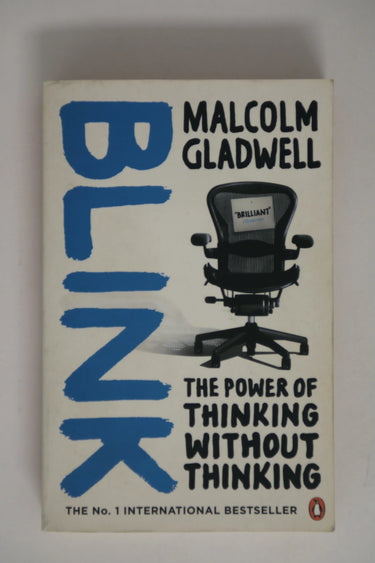
Blink: The Power of Thinking without Thinking by Malcolm Gladwell
How do we make decisions--good and bad--and why are some people so much better at it than others? That's the question Malcolm Gladwell asks and answers in the follow-up to his huge bestseller, The Tipping Point. Utilizing case studies as diverse as speed dating, pop music, and the shooting of Amadou Diallo, Gladwell reveals that what we think of as decisions made in the blink of an eye are much more complicated than assumed. Drawing on cutting-edge neuroscience and psychology, he shows how the difference between good decision-making and bad has nothing to do with how much information we can process quickly, but on the few particular details on which we focus. Leaping boldly from example to example, displaying all of the brilliance that made The Tipping Point a classic, Gladwell reveals how we can become better decision makers--in our homes, our offices, and in everyday life. The result is a book that is surprising and transforming. Never again will you think about thinking the same way. Editorial Reviews Rash, impetuous, hasty, careless -- snap judgments conjure up a troubling list of negatives. But Tipping Point author Malcolm Gladwell, aware that the flip side of a snap judgment is a brilliant intuitive act, set out to discover what underlies our gut decisions, exploring when we can (and should) trust them...even whether we can learn to make good ones. From recognizing a brilliant French horn soloist to avoiding another Amadou Diallo shooting, he offers surprising insights into the power of the unconscious to get it right. - bn.com In Blink, Malcolm Gladwell, a former science and business reporter at The Washington Post who now writes for the New Yorker, offers his account of this sort of seemingly instantaneous judgment. Readers acquainted with Gladwell's articles and his 2000 bestseller The Tipping Point will have high anticipations for this volume; those expectations will be met. The book features the fascinating case studies, skilled interweavings of psychological experiments and explanations and unexpected connections among disparate phenomenon that are Gladwell's impressive trademark. - The Washington Post - Howard Gardner Best-selling author Gladwell (The Tipping Point) has a dazzling ability to find commonality in disparate fields of study. As he displays again in this entertaining and illuminating look at how we make snap judgments-about people's intentions, the authenticity of a work of art, even military strategy-he can parse for general readers the intricacies of fascinating but little-known fields like professional food tasting (why does Coke taste different from Pepsi?). Gladwell's conclusion, after studying how people make instant decisions in a wide range of fields from psychology to police work, is that we can make better instant judgments by training our mind and senses to focus on the most relevant facts-and that less input (as long as it's the right input) is better than more. Perhaps the most stunning example he gives of this counterintuitive truth is the most expensive war game ever conducted by the Pentagon, in which a wily marine officer, playing a rogue military commander in the Persian Gulf and unencumbered by hierarchy, bureaucracy and too much technology, humiliated American forces whose chiefs were bogged down in matrixes, systems for decision making and information overload. But if one sets aside Gladwell's dazzle, some questions and apparent inconsistencies emerge. If doctors are given an algorithm, or formula, in which only four facts are needed to determine if a patient is having a heart attack, is that really educating the doctor's decision-making ability-or is it taking the decision out of the doctor's hands altogether and handing it over to the algorithm? Still, each case study is satisfying, and Gladwell imparts his own evident pleasure in delving into a wide range of fields and seeking an underlying truth. Agent, Tina Bennett. (Jan. 13) Forecast: A 25-city tour (including several university towns) should introduce Gladwell to new readers and help sell out the 200,000-copy first printing. Copyright 2004 Reed Business Information. - Publishers Weekly Journalist Gladwell (The Tipping Point) examines the process of snap decision making. Contrary to the model of a rational process involving extensive information gathering and rational analysis, most decisions are made instantaneously and unconsciously. This works well for us much of the time because we learn to thin-slice-that is, to ignore extraneous input and concentrate on one or two cues. Sometimes, we don't even consciously know what these cues are, as in Gladwell's anecdote about a tennis coach who can predict when a player is going to make a rare sort of error but doesn't know how he knows. The book also explores how this process can go horribly wrong, as in the Amadou Diallo shooting. Gladwell gets the science facts right and has the journalistic skills to make them utterly engrossing. A big promo campaign is planned; for once a best seller will be more than worthy. Essential for all libraries. [See Prepub Alert, LJ 9/15/04.]-Mary Ann Hughes, Neill P.L., Pullman, WA Copyright 2004 Reed Business Information. - Library Journal Blink is about how we think without thinking, about choices that seem to be made in an instant in the blink of an eye that actually aren't as simple as they seem, and about those instantaneous decisions that are impossible to explain to others. In his landmark bestseller, The Tipping Point, author Malcolm Gladwell redefined how we understand the world around us. Now, in Blink, he revolutionizes the way we understand the world within by exploring the decisions made by experts in museums, sales, sports, the military and the high-speed world of the New York Mercantile Exchange. Drawing on cutting-edge neuroscience and psychology, and displaying all of the brilliance that made The Tipping Point a classic, Blink changes the way you understand every decision you make. Never again will you think about thinking the same way. The Locked Door Here is a critical fact about the thoughts and decisions that bubble up from our unconscious. Snap judgments are, first of all, enormously quick: They rely on the thinnest slices of experience. They are also unconscious. Snap judgments and rapid cognition take place behind a locked door. We are not very good at dealing with the fact of that locked door. It's one thing to acknowledge the enormous power of snap judgments and thin slices but quite another to place our trust in something so seemingly mysterious. If we are to learn to improve the quality of the decisions we make, we need to accept the mysterious nature of our snap judgments. The Storytelling Problem On a brisk spring evening not long ago, two dozen men and women gathered in the back room of a Manhattan bar to engage in a peculiar ritual known as speed-dating. Each man would have six minutes of conversation with each woman. The women would sit for the duration of the evening against the wall on the long, low couches that ringed the room, and the men would rotate from woman to woman, moving to the next woman whenever the coordinator rang a bell signaling that the six minutes were over. The daters were all given a badge, a number and a short form to complete, with the instruction that if they liked someone after six minutes, they should check the box next to his or her number. If the person whose box he or she checked also checked his or her box, both daters would be notified of the other's e-mail address within 24 hours. Speed-dating has become enormously popular around the world over the last few years, and it's not hard to understand why. It's the distillation of dating to a simple snap judgment. Everyone who sat down at one of those tables was trying to answer a very simple question: Do I want to see this person again? And to answer that, we don't need an entire evening. We really need only a few minutes. When it comes to thin-slicing potential dates, pretty much everyone is smart. But suppose we were to alter the rules of speed-dating just slightly. What if we tried to look behind the locked door and made everyone explain his or her choices? We know, of course, that that can't be done: The machinery of our unconscious thinking is forever hidden. But what if we forced people to explain their first impressions and snap judgments anyway? That is what two professors from Columbia University have done, and they have discovered that if you make people explain themselves, something very strange and troubling happens. What once seemed like the most transparent and pure of thin-slicing exercises turns into something quite confusing. Behind the Locked Door The professors found that when they compare what speed-daters say they want in a preliminary questionnaire with what they are actually attracted to in the moment, those two things don't match. A speed-dater has an idea about what she wants in a man, and that idea isn't wrong. It's just incomplete. The description that she starts with is her conscious ideal: what she believes she wants when she sits down and thinks about it. But what she cannot be as certain about are the criteria she uses to form her preferences in that first instant of meeting someone face to face. That information is behind the locked door. We have, as human beings, a storytelling problem. We're a bit too quick to come up with explanations for things we really don't have an explanation for. Copyright 2005 Soundview Executive Book Summaries -Soundview Summary - Soundview Executive Book Summaries We need to place more trust in our thin-slicer-our capacity to make instant judgments-but we also need to sharpen its edge more keenly with experience and education. Gladwell's second entry into the aren't-our-brains-amazing genre (The Tipping Point, 2000) has an Obi-Wan Kenobi flavor, a trust-your-feelings-Luke antirationalism that attempts, in some ways, to deconstruct the Force. The author's great strength lies in his stories, and here he crafts a number of engaging ones: an account of art experts fooled by a fake; a summary of how a psychologist, looking at an hourlong video of a married couple conversing, can predict with 95% accuracy if they will divorce; an unnerving narrative about the Millennium Challenge, a war game in which a maverick commander deals a devastating blow to the bean-counting rule-followers on the team that was supposed to win. There are stories of a rock star fighting the odds, of cops shooting an innocent man who looked suspicious, of Coca-Cola making a big marketing mistake. We learn about the Aeron chair, All in the Family, Lee at Chancellorsville. (Unconventional people sometimes surprise.) We ponder the odd political rise of Warren G. Harding. We have a power lunch with some professional food-tasters-the author quips that it was like cello-shopping with Yo-Yo Ma. We chat with a car-selling superstar. Gladwell also rediscovers something Poe described in The Haunted Palace: our eyes and our faces are windows to the soul. He tells us that the autistic are unable to decode or even notice the facial information of others. All these stories are nicely written and most inform and entertain at the same time, but they don't add up to anything terribly profound,despite the author's sometimes Skywalker-ish enthusiasm. Brisk, impressively done narratives that should sell very well indeed, particularly to Gladwell's already well-established fan base. Author tour - Kirkus Reviews
Publication Details
Title:
Author(s):
Illustrator:
Binding: Paperback
Published by: 9.78014E+12: , 2007
Edition:
ISBN: 9780141014593 | 0141014598
277 pages.
Book Condition: Very Good
products.product.pickup_availability.unavailable
Product information
New Zealand Delivery
Shipping Options
Shipping options are shown at checkout and will vary depending on the delivery address and weight of the books.
We endeavour to ship the following day after your order is made and to have pick up orders available the same day. We ship Monday-Friday. Any orders made on a Friday afternoon will be sent the following Monday. We are unable to deliver on Saturday and Sunday.
Pick Up is Available in NZ:
Warehouse Pick Up Hours
- Monday - Friday: 9am-5pm
- 35 Nathan Terrace, Shannon NZ
Please make sure we have confirmed your order is ready for pickup and bring your confirmation email with you.
Rates
-
New Zealand Standard Shipping - $6.00
- New Zealand Standard Rural Shipping - $10.00
- Free Nationwide Standard Shipping on all Orders $75+
Please allow up to 5 working days for your order to arrive within New Zealand before contacting us about a late delivery. We use NZ Post and the tracking details will be emailed to you as soon as they become available. There may be some courier delays that are out of our control.
International Delivery
We currently ship to Australia and a range of international locations including: Belgium, Canada, China, Switzerland, Czechia, Germany, Denmark, Spain, Finland, France, United Kingdom, United States, Hong Kong SAR, Thailand, Philippines, Ireland, Israel, Italy, Japan, South Korea, Malaysia, Netherlands, Norway, Poland, Portugal, Sweden & Singapore. If your country is not listed, we may not be able to ship to you, or may only offer a quoting shipping option, please contact us if you are unsure.
International orders normally arrive within 2-4 weeks of shipping. Please note that these orders need to pass through the customs office in your country before it will be released for final delivery, which can occasionally cause additional delays. Once an order leaves our warehouse, carrier shipping delays may occur due to factors outside our control. We, unfortunately, can’t control how quickly an order arrives once it has left our warehouse. Contacting the carrier is the best way to get more insight into your package’s location and estimated delivery date.
- Global Standard 1 Book Rate: $37 + $10 for every extra book up to 20kg
- Australia Standard 1 Book Rate: $14 + $4 for every extra book
Any parcels with a combined weight of over 20kg will not process automatically on the website and you will need to contact us for a quote.
Payment Options
On checkout you can either opt to pay by credit card (Visa, Mastercard or American Express), Google Pay, Apple Pay, Shop Pay & Union Pay. Paypal, Afterpay and Bank Deposit.
Transactions are processed immediately and in most cases your order will be shipped the next working day. We do not deliver weekends sorry.
If you do need to contact us about an order please do so here.
You can also check your order by logging in.
Contact Details
- Trade Name: Book Express Ltd
- Phone Number: (+64) 22 852 6879
- Email: sales@bookexpress.co.nz
- Address: 35 Nathan Terrace, Shannon, 4821, New Zealand.
- GST Number: 103320957 - We are registered for GST in New Zealand
- NZBN: 9429031911290
We have a 30-day return policy, which means you have 30 days after receiving your item to request a return.
To be eligible for a return, your item must be in the same condition that you received it, unworn or unread.
To start a return, you can contact us at sales@bookexpress.co.nz. Please note that returns will need to be sent to the following address: 35 Nathan Terrace, Shannon, New Zealand 4821.
If your return is for a quality or incorrect item, the cost of return will be on us, and will refund your cost. If it is for a change of mind, the return will be at your cost.
You can always contact us for any return question at sales@bookexpress.co.nz.
Damages and issues
Please inspect your order upon reception and contact us immediately if the item is defective, damaged or if you receive the wrong item, so that we can evaluate the issue and make it right.
Exceptions / non-returnable items
Certain types of items cannot be returned, like perishable goods (such as food, flowers, or plants), custom products (such as special orders or personalised items), and personal care goods (such as beauty products). Although we don't currently sell anything like this. Please get in touch if you have questions or concerns about your specific item.
Unfortunately, we cannot accept returns on gift cards.
Exchanges
The fastest way to ensure you get what you want is to return the item you have, and once the return is accepted, make a separate purchase for the new item.
European Union 14 day cooling off period
Notwithstanding the above, if the merchandise is being shipped into the European Union, you have the right to cancel or return your order within 14 days, for any reason and without a justification. As above, your item must be in the same condition that you received it, unworn or unused, with tags, and in its original packaging. You’ll also need the receipt or proof of purchase.
Refunds
We will notify you once we’ve received and inspected your return, and let you know if the refund was approved or not. If approved, you’ll be automatically refunded on your original payment method within 10 business days. Please remember it can take some time for your bank or credit card company to process and post the refund too.
If more than 15 business days have passed since we’ve approved your return, please contact us at sales@bookexpress.co.nz.