
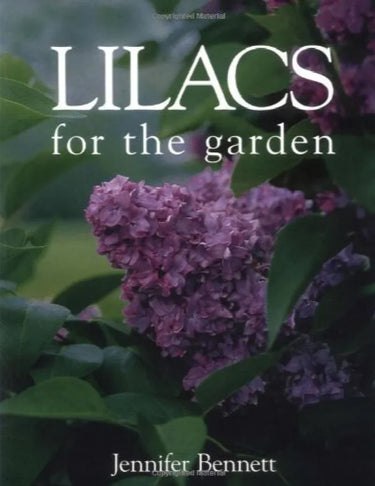
Lilacs for the Garden by Jennifer Bennett
Jennifer Bennett has lived lilac country for more than 20 years, and is well placed to appreciate the lilac, which not only flourishes in cultivated gardens but roams wild across the countryside. Tracing the journey of a plant that will grow well everywhere, in every soil, from its origins in Asia through Europe and the United Kingdom to North America some 250 years ago, Bennett brings this most familiar and glorious of flowers to vibrant life. The lilac's bloom is a sign of spring everywhere, but a lesser-known fact is that its emerging flowers are also used as indicators by farmers planning pest control and crop plantings and by scientists engaged in charting global warming. Filled with uncommon information about this common plant, Bennett's book features chapters on its history; planning, planting and pruning; the lilac's place in the landscape, whether alone, in groupings or with perennials; a species list of usual and unusual plants, with names that range from 'Charles Lindbergh' and 'Martha Stewart' to 'Charm' and 'Glory'; exotic lilacs for the adventurous connoisseur; and lilac aid, which addresses one of gardening's most vexing questions: Why won't it bloom? Lilacs for the Garden is a compendium of essential information for all who cherish this most resonant of garden companions. Whether you seek detail on plant requirements, mulching, grafting, fertilizing, multiplication, bloom time, fragrance, abiotic and biotic stresses, renovating neglected lilacs or a list of recommended species and where to find them, Bennett's latest book is an essential resource. Editorial Reviews Review An excellent book for the beginner or the veteran gardener. (Gerald Filipski The Edmonton Journal 2007-11-21) Total details on buying, planting, pruning, diseases and propagating from cuttings; for mail-order sources and public gardens with fine displays. (Kerry Moore Vancouver Province 2002-06-04) Perhaps every gardener's library should include a book dedicated to this fragrant shrub. (Susan Mulvihill Spokane Spokesman 2003-06-20) Plain language -- combined with Bennett's seemingly limitless lilac enthusiasm -- makes caring for these hearty plants sound doable, even for readers with only a green-ish thumb. (HGTV.ocm 2003-05-19) A lucid, beautifully illustrated (with over 90 stunning color photographs) tribute to this much-loved shrub... Well researched and written, Bennett's book is an invaluable resource for lilac amateurs and enthusiasts alike. It is highly recommended for any library's collection. (Rachael Green American Reference Books Annual, Volume 35) In simple plain language, you will learn how (and where and when) to plant lilacs, care for lilacs, be as much a friend to lilacs as they are to all of us. (Dan Hays Salem Statesman Journal 2002-08-04) Recommended ... The information is all there: what lilacs to select; how to plant, prune, maintain and propagate them; and what to observe when diagnosing pests. (Peter W. Bristol Chicago Botanical Garden 2003-05-11) Combines practical advice, personal observations, literary quotes and full-color photographs in an irresistible mix. (Jo Clavert Canadian Living 2003-04-01) Well-researched and -written, and lavishly illustrated, Bennett's book is an invaluable resource for the lilac lover. (Gardening Life 2002-06-01) Practical, thorough and informative ... a must-have for anyone interested in growing this gloriously hardy, sweet-smelling shrub. (Kitchener-Waterloo Record 2002-05-04) Full of gorgeous pictures, lilac facts ... and advice for selecting, planting, pruning and tending lilacs. (Beth Botts Chicago Tribune 2002-05-02) Beautifully illustrated ... likely to become a classic -- one of those you just can't bear to do without. (Jessie Deslauriers Kingston This Week 2002-05-03) After flipping through page after page of gorgeous photographs, I'm hooked. (David Hobson Kitchener-Waterloo Record 2002-05-11) An excellent guide. (Steve Whysall Southam Newspapers 2002-05-18) Covers everything... easy to read and understand -- even as she delves into hybrids and cultivars. (Patty Jesome Edmonton Sun 2004-05-01) Detailed portraits... expert growing advice... prompted me to make room for four more of these beauties in my already crowded garden. (Beckie Fox Canadian Gardening) A great resource book. (Rhea Hamilton-Seeger The Rural Voice (Blyth ON) 2008-04-30) About the Author Jennifer Bennett is the author of the best-selling The New Northern Gardener, Lilies of the Hearth, Our Gardens Ourselves and The Annual Garden. Excerpt. ® Reprinted by permission. All rights reserved. Considering the Lilacs From Old World to New with a French connection These are well-known hardy shrubs which grow well everywhere, in every soil and all exposures. -- D.W. Beadle, Canadian Fruit Flower and Kitchen Gardener (1872) Everywhere. Every soil. All exposures. Consider the lilacs of the field, how they grow. They are not fertilized, nor are they pruned, yet Solomon in all his glory was not arrayed like one of these. Come May, the Bible is paraphrased in abandoned farm fields and along country roads in eastern Ontario, where I live. This is lilac country, where for two weeks in spring, the abundance of flower and perfume has to be experienced to be believed. And like sleek pets looking over the fence at their wilder kin, there are lilacs in almost every garden showing off bigger blooms and brighter colors before, during and after the roadside show. The lilac was once called the poor man's flower. The reason was that common lilacs were the chain letters of horticulture: You simply pried a rooted shoot from the base of a shrub and planted it somewhere else -- just about anywhere else. Even mature lilacs could be moved. More than two centuries ago, George Washington wrote in his journal, Removed two pretty large and full grown Lilacs to the No. Garden gate, one on each side, taking up as much dirt with the roots as cd. be well obtained. Lilacs tolerate drought, cold winters, dry, hot summers and almost any soil. They are undemanding and generous, the perfect guests. Thanks to lilac tenacity, they grow splendidly and abundantly -- sometimes too abundantly -- from northern Canada to Colorado, as tough as the settlers who brought them. The lilac is the state flower of New Hampshire because, according to historian Leon Anderson, it is symbolic of that hardy character of the men and women of the Granite State. Lilacs flourish as though they've always been here, but their time on this continent has been brief. As Ernest H. Wilson of the Arnold Arboretum in Massachusetts said about lilacs, None are indigenous in America, but notwithstanding this, all the species introduced have proved hardy in the arboretum. A singular and most interesting fact. Lilacs simply happen to like it here, all 20-odd species of them.
Publication Details
Title:
Author(s):
Illustrator:
Binding: Paperback
Published by: Firefly Books: , 2002
Edition:
ISBN: 9781552975626 | 1552975622
128 pages.
Book Condition: Very Good
products.product.pickup_availability.unavailable
Product information
New Zealand Delivery
Shipping Options
Shipping options are shown at checkout and will vary depending on the delivery address and weight of the books.
We endeavour to ship the following day after your order is made and to have pick up orders available the same day. We ship Monday-Friday. Any orders made on a Friday afternoon will be sent the following Monday. We are unable to deliver on Saturday and Sunday.
Pick Up is Available in NZ:
Warehouse Pick Up Hours
- Monday - Friday: 9am-5pm
- 35 Nathan Terrace, Shannon NZ
Please make sure we have confirmed your order is ready for pickup and bring your confirmation email with you.
Rates
-
New Zealand Standard Shipping - $6.00
- New Zealand Standard Rural Shipping - $10.00
- Free Nationwide Standard Shipping on all Orders $75+
Please allow up to 5 working days for your order to arrive within New Zealand before contacting us about a late delivery. We use NZ Post and the tracking details will be emailed to you as soon as they become available. There may be some courier delays that are out of our control.
International Delivery
We currently ship to Australia and a range of international locations including: Belgium, Canada, China, Switzerland, Czechia, Germany, Denmark, Spain, Finland, France, United Kingdom, United States, Hong Kong SAR, Thailand, Philippines, Ireland, Israel, Italy, Japan, South Korea, Malaysia, Netherlands, Norway, Poland, Portugal, Sweden & Singapore. If your country is not listed, we may not be able to ship to you, or may only offer a quoting shipping option, please contact us if you are unsure.
International orders normally arrive within 2-4 weeks of shipping. Please note that these orders need to pass through the customs office in your country before it will be released for final delivery, which can occasionally cause additional delays. Once an order leaves our warehouse, carrier shipping delays may occur due to factors outside our control. We, unfortunately, can’t control how quickly an order arrives once it has left our warehouse. Contacting the carrier is the best way to get more insight into your package’s location and estimated delivery date.
- Global Standard 1 Book Rate: $37 + $10 for every extra book up to 20kg
- Australia Standard 1 Book Rate: $14 + $4 for every extra book
Any parcels with a combined weight of over 20kg will not process automatically on the website and you will need to contact us for a quote.
Payment Options
On checkout you can either opt to pay by credit card (Visa, Mastercard or American Express), Google Pay, Apple Pay, Shop Pay & Union Pay. Paypal, Afterpay and Bank Deposit.
Transactions are processed immediately and in most cases your order will be shipped the next working day. We do not deliver weekends sorry.
If you do need to contact us about an order please do so here.
You can also check your order by logging in.
Contact Details
- Trade Name: Book Express Ltd
- Phone Number: (+64) 22 852 6879
- Email: sales@bookexpress.co.nz
- Address: 35 Nathan Terrace, Shannon, 4821, New Zealand.
- GST Number: 103320957 - We are registered for GST in New Zealand
- NZBN: 9429031911290
We have a 30-day return policy, which means you have 30 days after receiving your item to request a return.
To be eligible for a return, your item must be in the same condition that you received it, unworn or unread.
To start a return, you can contact us at sales@bookexpress.co.nz. Please note that returns will need to be sent to the following address: 35 Nathan Terrace, Shannon, New Zealand 4821.
If your return is for a quality or incorrect item, the cost of return will be on us, and will refund your cost. If it is for a change of mind, the return will be at your cost.
You can always contact us for any return question at sales@bookexpress.co.nz.
Damages and issues
Please inspect your order upon reception and contact us immediately if the item is defective, damaged or if you receive the wrong item, so that we can evaluate the issue and make it right.
Exceptions / non-returnable items
Certain types of items cannot be returned, like perishable goods (such as food, flowers, or plants), custom products (such as special orders or personalised items), and personal care goods (such as beauty products). Although we don't currently sell anything like this. Please get in touch if you have questions or concerns about your specific item.
Unfortunately, we cannot accept returns on gift cards.
Exchanges
The fastest way to ensure you get what you want is to return the item you have, and once the return is accepted, make a separate purchase for the new item.
European Union 14 day cooling off period
Notwithstanding the above, if the merchandise is being shipped into the European Union, you have the right to cancel or return your order within 14 days, for any reason and without a justification. As above, your item must be in the same condition that you received it, unworn or unused, with tags, and in its original packaging. You’ll also need the receipt or proof of purchase.
Refunds
We will notify you once we’ve received and inspected your return, and let you know if the refund was approved or not. If approved, you’ll be automatically refunded on your original payment method within 10 business days. Please remember it can take some time for your bank or credit card company to process and post the refund too.
If more than 15 business days have passed since we’ve approved your return, please contact us at sales@bookexpress.co.nz.