
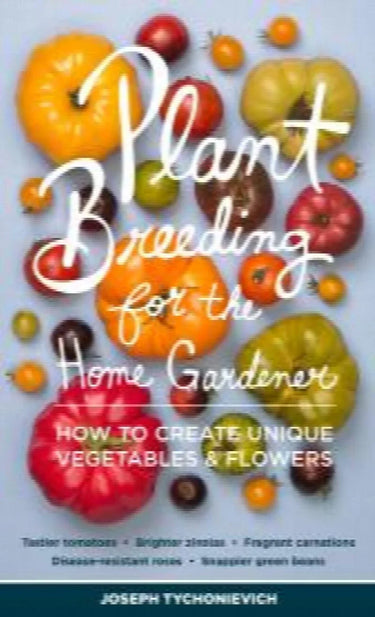
Plant Breeding for the Home Gardener: How to Create Unique Vegetables and Flowers by Joseph Tychonievich
Brighter zinnias, fragrant carnations, snappier green beans Plant Breeding for the Home Gardener makes it easier than ever to breed and grow your own varieties of vegetables and flowers. This comprehensive and accessible guide explains how to decide what to breed, provides simple explanations on how to cross plants, and features a basic primer on genetics and advanced techniques. Case studies provide breeding examples for favorite plants like daffodils, hollyhocks, roses, sweet corn, and tomatoes. Editorial Reviews From Booklist Home gardeners seeking to breed customized vegetables and flowers will find much to treasure here, as Tychonievich describes the literal fruits of reviving an ancient art by repeatedly choosing preferred plantings to develop rather than settling for commercial varieties with least-common-denominator qualities. After a brief history of plant breeding, he proceeds to outline detailed and knowledgeable steps to follow, including goal setting, the basics of cross-pollination (starting with flower anatomy), genetic-trait selection, and patterns of inheritance. All are applied to backyard gardening as he introduces a personal touch by evaluating and narrowing selection and covers such advanced techniques as restoring fertility. Perhaps most directly useful are the specific examples of applications he offers, from hollyhocks to zinnias, beans, lettuce, and other familiar garden plantings. Occasional line drawings complement the text on developing these new heirlooms via controlled selection, while appendix materials include an index plus listings of recommended readings, useful websites, and plant sources. Those interested in plant genetics and advanced gardeners will cheer. --Whitney Scott Review New and seasoned gardeners will appreciate this nicely presented book. It could even spur caregivers or teachers to get kids into the garden, growing their very own varieties of vegetables. --Library Journal Home gardeners seeking to breed customized vegetables and flowers will find much to treasure here. Those interested in plant genetics and advanced gardeners will cheer. --Booklist Gardener[s] will also be thankful that a skilled geneticist with a green thumb and a heart for the average citizen has opened up a universe of horticultural possibility. --Publishers Weekly It's a gift to be able to break such technical things down and present them in a way that's not only fascinating, but also in language simple enough that you don't need a degree in horticulture to understand it. --Horticulture This wonderful little book reads like a novel. Tychonievich is in love with plant breeding, and soon you are too...This lighthearted book will make you smile. --The Times News From the Back Cover It's the holy grail of gardening: a plant that perfectly matches your tastes and the conditions in your garden. The hitch is, you're not likely to find it at your local nursery or garden center. You're going to have to create it yourself. But don't worry--it isn't hard. After all, gardeners have been doing it for centuries, simply by saving seed of the varieties that tasted or performed best. But you'll get even better results by following the advice in Plant Breeding for the Home Gardener. You'll learn how to set achievable goals in your breeding program; the ins and outs of genetics (in non-technical language!); how to pick the best parent plants; how to cross-pollinate; the best techniques to use for popular vegetables and flowers; and how to harvest and store seed. In no time at all, you'll be producing a tastier tomato, a perkier pepper, or a more ravishing rose! From the Back Cover It's the holy grail of gardening: a plant that perfectly matches your tastes and the conditions in your garden. The hitch is, you're not likely to find it at your local nursery or garden center. You're going to have to create it yourself. But don't worry--it isn't hard. After all, gardeners have been doing it for centuries, simply by saving seed of the varieties that tasted or performed best. But you'll get even better results by following the advice in Plant Breeding for the Home Gardener. You'll learn how to set achievable goals in your breeding program; the ins and outs of genetics (in non-technical language!); how to pick the best parent plants; how to cross-pollinate; the best techniques to use for popular vegetables and flowers; and how to harvest and store seed. In no time at all, you'll be producing a tastier tomato, a perkier pepper, or a more ravishing rose! About the Author Joseph Tychonievich studied horticulture, plant breeding, and genetics at the Ohio State University and was the nursery manager at Arrowhead Alpines, a premier rock garden nursery in Fowlerville, Michigan. He is also the editor of Rock Garden Quarterly. Organic Gardening Magazine called him one of six young horticulturalists who are helping to shape how America gardens. Excerpt. ? Reprinted by permission. All rights reserved. Introduction As a teenager I planted in my very first garden, among other things, a few violas. Little miniature vigorous versions of pansies, which I absolutely adore. I put in a few different varieties--black, purple and yellow, and pale yellow. They flowered heavily for me in the spring, slowed down and almost (but not quite) died in the heat of summer, then picked up again in the fall. I liked them, and I wanted to grow them again, but the next year I forgot to start the seeds. Come spring, I was kicking myself, saying I had to remember for the following year, when I went out to the garden to find it was covered with tiny viola seedlings. I had discovered the joys of self-sowing annuals. More flowers, for no work at all! When those seedlings started flowering, I was even more delighted. In addition to the colors I'd planted the year before, I had all sorts of new ones--dark purple with a yellow heart, yellow with just a splash of lavender. Violas are notoriously promiscuous, and with the help of bees, the different varieties had been getting busy, filling my garden with their incredibly beautiful love children. Once many of them were flowering, I spent some very, very happy hours carefully examining them all, picking my very favorite colors and combinations of colors to keep, and weeding out the others. The next year they returned, in still more colors and forms, and again I gleefully looked them over, comparing this against that, deciding which ones I loved best. Every year, they came back, and I liked them better, as the types I didn't prefer got removed, and the ones that were pretty to my eye carried on. Not only were they more beautiful each year, I noticed that each summer they seemed to get a little better at surviving and flowering through the heat. They still preferred the cool of spring and fall, but without me doing anything at all, they were adapting to my particular climate, soil, and garden. One spring, while I was happily looking over the latest crop, the most beautiful, vigorous, and diverse yet, I suddenly realized something. These plants no longer looked or performed anything like those I had started with. They were, in fact, something new and unique, adapted to my tastes and my garden. My own personal strain of violas! How cool! Whatever should I name them? I never did settle on a name (or if I did, I've forgotten it), and in the constant flux that was college, living in apartments and borrowing space to garden where I could, I lost the strain. But the lesson they taught me has stuck. Plant breeding is easy. Under the right conditions, in fact, you can hardly help but breed new varieties. Just nature and a little careful weeding will all but do it for you. The other thing I learned is that breeding your own plants is not just incredibly fun and satisfying, it is also practical. Not only was my strain beautiful, it grew better for me in my conditions than the commercial varieties I had started with. I like to call varieties like that strain of violas new heirlooms. Heirloom varieties are typically defined simply by their age, but I don't like that definition. It isn't the fact that they are old that makes heirloom tomatoes so delicious and heirloom dianthus so fragrant; rather, it is because most of these heirlooms came into being the same way my strain of violas did, from regular gardeners picking out what they liked best. While modern commercial varieties are bred with a least-common-denominator mentality, focusing on what will ship to and sell well at big box stores across the country, home gardeners focus on what they really love and get to partner with nature to create truly beautiful works of plant art. As I became more seriously involved in gardening, many of the books I read dismissed creating new varieties as too complex to be attempted by anyone other than professionals. I knew this couldn't be true. My violas had proved that to me. More than a decade after those life-changing violas, I've bred dozens of different genera and studied plant breeding and genetics at two universities, and I'm still as convinced as ever by the lesson those little flowers taught me. Yes, it takes companies with teams of highly trained plant breeders years to create and market a new variety, but that is because the horticulture industry is complex, not because breeding is. Breeding at home is simple, easy, and effective. Not to mention fun. Very fun. So welcome to my world. The world where every spring, I'm eagerly awaiting the first opening of a flower that no one has ever seen before, where I spend summer evenings with a friend and a pile of wonderful new tomatoes, trying each one, laughing over the odd-tasting misses and cheering for the ones that move me one step closer to that dreamed-of perfect tomato in my mind. It is the same process that brought us great tomatoes like the sublime 'Brandywine,' an ancient art form that is long overdue for a revival. If you garden, you can breed plants. In this book, I'll tell you how. Excerpt. ? Reprinted by permission. All rights reserved. Introduction As a teenager I planted in my very first garden, among other things, a few violas. Little miniature vigorous versions of pansies, which I absolutely adore. I put in a few different varieties--black, purple and yellow, and pale yellow. They flowered heavily for me in the spring, slowed down and almost (but not quite) died in the heat of summer, then picked up again in the fall. I liked them, and I wanted to grow them again, but the next year I forgot to start the seeds. Come spring, I was kicking myself, saying I had to remember for the following year, when I went out to the garden to find it was covered with tiny viola seedlings. I had discovered the joys of self-sowing annuals. More flowers, for no work at all! When those seedlings started flowering, I was even more delighted. In addition to the colors I'd planted the year before, I had all sorts of new ones--dark purple with a yellow heart, yellow with just a splash of lavender. Violas are notoriously promiscuous, and with the help of bees, the different varieties had been getting busy, filling my garden with their incredibly beautiful love children. Once many of them were flowering, I spent some very, very happy hours carefully examining them all, picking my very favorite colors and combinations of colors to keep, and weeding out the others. The next year they returned, in still more colors and forms, and again I gleefully looked them over, comparing this against that, deciding which ones I loved best. Every year, they came back, and I liked them better, as the types I didn't prefer got removed, and the ones that were pretty to my eye carried on. Not only were they more beautiful each year, I noticed that each summer they seemed to get a little better at surviving and flowering through the heat. They still preferred the cool of spring and fall, but without me doing anything at all, they were adapting to my particular climate, soil, and garden. One spring, while I was happily looking over the latest crop, the most beautiful, vigorous, and diverse yet, I suddenly realized something. These plants no longer looked or performed anything like those I had started with. They were, in fact, something new and unique, adapted to my tastes and my garden. My own personal strain of violas! How cool! Whatever should I name them? I never did settle on a name (or if I did, I've forgotten it), and in the constant flux that was college, living in apartments and borrowing space to garden where I could, I lost the strain. But the lesson they taught me has stuck. Plant breeding is easy. Under the right conditions, in fact, you can hardly help but breed new varieties. Just nature and a little careful weeding will all but do it for you. The other thing I learned is that breeding your own plants is not just incredibly fun and satisfying, it is also practical. Not only was my strain beautiful, it grew better for me in my conditions than the commercial varieties I had started with. I like to call varieties like that strain of violas new heirlooms. Heirloom varieties are typically defined simply by their age, but I don't like that definition. It isn't the fact that they are old that makes heirloom tomatoes so delicious and heirloom dianthus so fragrant; rather, it is because most of these heirlooms came into being the same way my strain of violas did, from regular gardeners picking out what they liked best. While modern commercial varieties are bred with a least-common-denominator mentality, focusing on what will ship to and sell well at big box stores across the country, home gardeners focus on what they really love and get to partner with nature to create truly beautiful works of plant art. As I became more seriously involved in gardening, many of the books I read dismissed creating new varieties as too complex to be attempted by anyone other than professionals. I knew this couldn't be true. My violas had proved that to me. More than a decade after those life-changing violas, I've bred dozens of different genera and studied plant breeding and genetics at two universities, and I'm still as convinced as ever by the lesson those little flowers taught me. Yes, it takes companies with teams of highly trained plant breeders years to create and market a new variety, but that is because the horticulture industry is complex, not because breeding is. Breeding at home is simple, easy, and effective. Not to mention fun. Very fun. So welcome to my world. The world where every spring, I'm eagerly awaiting the first opening of a flower that no one has ever seen before, where I spend summer evenings with a friend and a pile of wonderful new tomatoes, trying each one, laughing over the odd-tasting misses and cheering for the ones that move me one step closer to that dreamed-of perfect tomato in my mind. It is the same process that brought us great tomatoes like the sublime 'Brandywine,' an ancient art form that is long overdue for a revival. If you garden, you can breed plants. In this book, I'll tell you how.
Publication Details
Title:
Author(s):
Illustrator:
Binding: Paperback
Published by: Timber Press: , 2013
Edition:
ISBN: 9781604693645 | 1604693649
216 pages.
Book Condition: Very Good
products.product.pickup_availability.unavailable
Product information

New Zealand Delivery
Shipping Options
Shipping options are shown at checkout and will vary depending on the delivery address and weight of the books.
We endeavour to ship the following day after your order is made and to have pick up orders available the same day. We ship Monday-Friday. Any orders made on a Friday afternoon will be sent the following Monday. We are unable to deliver on Saturday and Sunday.
Pick Up is Available in NZ:
Warehouse Pick Up Hours
- Monday - Friday: 9am-5pm
- 35 Nathan Terrace, Shannon NZ
Please make sure we have confirmed your order is ready for pickup and bring your confirmation email with you.
Rates
-
New Zealand Standard Shipping - $6.00
- New Zealand Standard Rural Shipping - $10.00
- Free Nationwide Standard Shipping on all Orders $75+
Please allow up to 5 working days for your order to arrive within New Zealand before contacting us about a late delivery. We use NZ Post and the tracking details will be emailed to you as soon as they become available. There may be some courier delays that are out of our control.
International Delivery
We currently ship to Australia and a range of international locations including: Belgium, Canada, China, Switzerland, Czechia, Germany, Denmark, Spain, Finland, France, United Kingdom, United States, Hong Kong SAR, Thailand, Philippines, Ireland, Israel, Italy, Japan, South Korea, Malaysia, Netherlands, Norway, Poland, Portugal, Sweden & Singapore. If your country is not listed, we may not be able to ship to you, or may only offer a quoting shipping option, please contact us if you are unsure.
International orders normally arrive within 2-4 weeks of shipping. Please note that these orders need to pass through the customs office in your country before it will be released for final delivery, which can occasionally cause additional delays. Once an order leaves our warehouse, carrier shipping delays may occur due to factors outside our control. We, unfortunately, can’t control how quickly an order arrives once it has left our warehouse. Contacting the carrier is the best way to get more insight into your package’s location and estimated delivery date.
- Global Standard 1 Book Rate: $37 + $10 for every extra book up to 20kg
- Australia Standard 1 Book Rate: $14 + $4 for every extra book
Any parcels with a combined weight of over 20kg will not process automatically on the website and you will need to contact us for a quote.
Payment Options
On checkout you can either opt to pay by credit card (Visa, Mastercard or American Express), Google Pay, Apple Pay, Shop Pay & Union Pay. Paypal, Afterpay and Bank Deposit.
Transactions are processed immediately and in most cases your order will be shipped the next working day. We do not deliver weekends sorry.
If you do need to contact us about an order please do so here.
You can also check your order by logging in.
Contact Details
- Trade Name: Book Express Ltd
- Phone Number: (+64) 22 852 6879
- Email: sales@bookexpress.co.nz
- Address: 35 Nathan Terrace, Shannon, 4821, New Zealand.
- GST Number: 103320957 - We are registered for GST in New Zealand
- NZBN: 9429031911290
We have a 30-day return policy, which means you have 30 days after receiving your item to request a return.
To be eligible for a return, your item must be in the same condition that you received it, unworn or unread.
To start a return, you can contact us at sales@bookexpress.co.nz. Please note that returns will need to be sent to the following address: 35 Nathan Terrace, Shannon, New Zealand 4821.
If your return is for a quality or incorrect item, the cost of return will be on us, and will refund your cost. If it is for a change of mind, the return will be at your cost.
You can always contact us for any return question at sales@bookexpress.co.nz.
Damages and issues
Please inspect your order upon reception and contact us immediately if the item is defective, damaged or if you receive the wrong item, so that we can evaluate the issue and make it right.
Exceptions / non-returnable items
Certain types of items cannot be returned, like perishable goods (such as food, flowers, or plants), custom products (such as special orders or personalised items), and personal care goods (such as beauty products). Although we don't currently sell anything like this. Please get in touch if you have questions or concerns about your specific item.
Unfortunately, we cannot accept returns on gift cards.
Exchanges
The fastest way to ensure you get what you want is to return the item you have, and once the return is accepted, make a separate purchase for the new item.
European Union 14 day cooling off period
Notwithstanding the above, if the merchandise is being shipped into the European Union, you have the right to cancel or return your order within 14 days, for any reason and without a justification. As above, your item must be in the same condition that you received it, unworn or unused, with tags, and in its original packaging. You’ll also need the receipt or proof of purchase.
Refunds
We will notify you once we’ve received and inspected your return, and let you know if the refund was approved or not. If approved, you’ll be automatically refunded on your original payment method within 10 business days. Please remember it can take some time for your bank or credit card company to process and post the refund too.
If more than 15 business days have passed since we’ve approved your return, please contact us at sales@bookexpress.co.nz.