
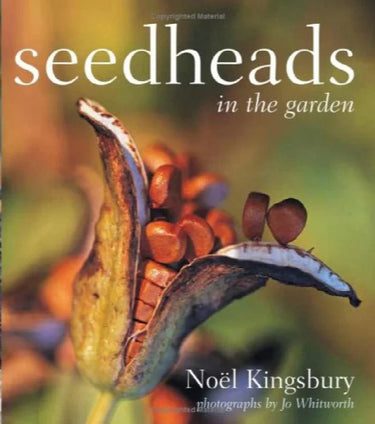
Seedheads in the Garden by Noël Kingsbury,Jo Whitworth
Seedheads bring impact to late summer borders and linger to provide interest well into autumn and winter. They look dramatic set against a backdrop of fading flowers, associate well with grasses and native plants, and are key components of the naturalistic garden in which every phase of a plant is enjoyed from first shoot to final decay. After providing historical context, Noël Kingsbury explains how plants reproduce and participate in the garden's wider ecology, and explores seedheads' role in diverse gardens worldwide. At the heart of the book is a plant directory in which Kingsbury's hand-picked selection describes the particular characteristics of each plant's seedheads and grades them according to their value and persistence. Jo Whitworth's compelling photographs capture the individual character of each seedhead and open our eyes to the intricate shapes, tempting textures and dense monochromes of seedheads. Editorial Reviews From Booklist Prolific writer and designer Kingsbury focuses on a key element of the naturalistic garden style with which he is associated: the fading allure of plants flaunting their showy seedheads. Winter gardens have been all the rage; now Kingsbury accords the autumn season equal attention in his discussion of the ornamental cycle of grasses, flowers, and herbaceous perennials. Lavishly illustrated with color photographs, Kingbury's richly descriptive writing draws readers into a fascinating botanical realm where pods, papery seedcases, awns, and burrs dance on the wind, find their way to terra firma, and ultimately germinate, continuing the circle of life. Designing with seedheads utilizes their visual impact up close and from a distance. Presenting a wealth of options, Kingsbury acts as an aesthetic guide to seeing beauty from a wilder perspective while also explaining how to integrate seedheads into formal settings. With tips on cultivation and a comprehensive plant directory, Kingbury's latest should prove exciting for gardeners open to new ideas. Alice Joyce Copyright © American Library Association. All rights reserved Review This beautiffuly photographed book showcases the unusual textures and striking silhouettes of plants past their prime. -- Seattle Times From the Publisher In this book, Noël Kingsbury explores the role of seedheads in diverse gardens worldwide. An analysis of seedheads' aesthetic merits is accompanied by cultivation advice and a plant directory. About the Author Noel Kingsbury is a well-known designer, commentator, and writer on plants, gardens, landscape, and the environment. His doctorate in horticultural ecology from the University of Sheffield focused on the selection and management of ornamental perennials and he is still engaged in active research in this field. Noel is interested in combining natives and non-natives in ecological planting schemes and a passionate advocate for sustainable plant combinations that require minimal intervention from the gardener. He trials plants and gardens at his home on the border between England and Wales and travels widely. Excerpt. ® Reprinted by permission. All rights reserved. A good way to start thinking about seedheads is to look at them in nature. Take a winter walk in an environment where you can find a wide variety of wildflowers: paths along the edges of woodland, grassland such as meadow or prairie, or even waste ground in areas of urban or industrial dereliction. See how many attractive or interesting-looking seedheads you can find. How many of them are worth picking to use in dried-flower arrangements back at home? How many might even be worth including in the garden, if you could be sure that they would take to cultivation? Take time to look for interesting shapes and forms, and notice how seedheads often make an impact because you see lots of them at once, and how they look in different kinds of light. Notice in particular how some are very dark, others very light; how some have hard, definite shapes and others are wispy and nebulous, and how these different characteristics can combine to form very attractive compositions. Our aim is to encourage gardeners, garden designers, and landscape architects to consider how they can use plants with interesting seedheads in their work. The emphasis is very much on herbaceous perennials, for it is these that form the largest group of plants with good seedheads among the ornamental hardy flora. Seedheads - like flowers - form a substantial part of their visual impact, whereas they are little more than extra ornamentation on those woody plants which have them. The seedheads of herbaceous plants can also make a substantial contribution to the overall visual impact of a garden or other planted space from mid-autumn to the end of winter - and as such should be regarded as a major source of material for the planting designer. Excerpt. ® Reprinted by permission. All rights reserved. A good way to start thinking about seedheads is to look at them in nature. Take a winter walk in an environment where you can find a wide variety of wildflowers: paths along the edges of woodland, grassland such as meadow or prairie, or even waste ground in areas of urban or industrial dereliction. See how many attractive or interesting-looking seedheads you can find. How many of them are worth picking to use in dried-flower arrangements back at home? How many might even be worth including in the garden, if you could be sure that they would take to cultivation? Take time to look for interesting shapes and forms, and notice how seedheads often make an impact because you see lots of them at once, and how they look in different kinds of light. Notice in particular how some are very dark, others very light; how some have hard, definite shapes and others are wispy and nebulous, and how these different characteristics can combine to form very attractive compositions. Our aim is to encourage gardeners, garden designers, and landscape architects to consider how they can use plants with interesting seedheads in their work. The emphasis is very much on herbaceous perennials, for it is these that form the largest group of plants with good seedheads among the ornamental hardy flora. Seedheads - like flowers - form a substantial part of their visual impact, whereas they are little more than extra ornamentation on those woody plants which have them. The seedheads of herbaceous plants can also make a substantial contribution to the overall visual impact of a garden or other planted space from mid-autumn to the end of winter - and as such should be regarded as a major source of material for the planting designer.
Publication Details
Title:
Author(s):
Illustrator:
Binding: Hardcover
Published by: Timber Press, Incorporated: , 2006
Edition:
ISBN: 9780881927962 | 0881927961
144 pages.
Book Condition: Very Good
products.product.pickup_availability.unavailable
Product information
New Zealand Delivery
Shipping Options
Shipping options are shown at checkout and will vary depending on the delivery address and weight of the books.
We endeavour to ship the following day after your order is made and to have pick up orders available the same day. We ship Monday-Friday. Any orders made on a Friday afternoon will be sent the following Monday. We are unable to deliver on Saturday and Sunday.
Pick Up is Available in NZ:
Warehouse Pick Up Hours
- Monday - Friday: 9am-5pm
- 35 Nathan Terrace, Shannon NZ
Please make sure we have confirmed your order is ready for pickup and bring your confirmation email with you.
Rates
-
New Zealand Standard Shipping - $6.00
- New Zealand Standard Rural Shipping - $10.00
- Free Nationwide Standard Shipping on all Orders $75+
Please allow up to 5 working days for your order to arrive within New Zealand before contacting us about a late delivery. We use NZ Post and the tracking details will be emailed to you as soon as they become available. There may be some courier delays that are out of our control.
International Delivery
We currently ship to Australia and a range of international locations including: Belgium, Canada, China, Switzerland, Czechia, Germany, Denmark, Spain, Finland, France, United Kingdom, United States, Hong Kong SAR, Thailand, Philippines, Ireland, Israel, Italy, Japan, South Korea, Malaysia, Netherlands, Norway, Poland, Portugal, Sweden & Singapore. If your country is not listed, we may not be able to ship to you, or may only offer a quoting shipping option, please contact us if you are unsure.
International orders normally arrive within 2-4 weeks of shipping. Please note that these orders need to pass through the customs office in your country before it will be released for final delivery, which can occasionally cause additional delays. Once an order leaves our warehouse, carrier shipping delays may occur due to factors outside our control. We, unfortunately, can’t control how quickly an order arrives once it has left our warehouse. Contacting the carrier is the best way to get more insight into your package’s location and estimated delivery date.
- Global Standard 1 Book Rate: $37 + $10 for every extra book up to 20kg
- Australia Standard 1 Book Rate: $14 + $4 for every extra book
Any parcels with a combined weight of over 20kg will not process automatically on the website and you will need to contact us for a quote.
Payment Options
On checkout you can either opt to pay by credit card (Visa, Mastercard or American Express), Google Pay, Apple Pay, Shop Pay & Union Pay. Paypal, Afterpay and Bank Deposit.
Transactions are processed immediately and in most cases your order will be shipped the next working day. We do not deliver weekends sorry.
If you do need to contact us about an order please do so here.
You can also check your order by logging in.
Contact Details
- Trade Name: Book Express Ltd
- Phone Number: (+64) 22 852 6879
- Email: sales@bookexpress.co.nz
- Address: 35 Nathan Terrace, Shannon, 4821, New Zealand.
- GST Number: 103320957 - We are registered for GST in New Zealand
- NZBN: 9429031911290
We have a 30-day return policy, which means you have 30 days after receiving your item to request a return.
To be eligible for a return, your item must be in the same condition that you received it, unworn or unread.
To start a return, you can contact us at sales@bookexpress.co.nz. Please note that returns will need to be sent to the following address: 35 Nathan Terrace, Shannon, New Zealand 4821.
If your return is for a quality or incorrect item, the cost of return will be on us, and will refund your cost. If it is for a change of mind, the return will be at your cost.
You can always contact us for any return question at sales@bookexpress.co.nz.
Damages and issues
Please inspect your order upon reception and contact us immediately if the item is defective, damaged or if you receive the wrong item, so that we can evaluate the issue and make it right.
Exceptions / non-returnable items
Certain types of items cannot be returned, like perishable goods (such as food, flowers, or plants), custom products (such as special orders or personalised items), and personal care goods (such as beauty products). Although we don't currently sell anything like this. Please get in touch if you have questions or concerns about your specific item.
Unfortunately, we cannot accept returns on gift cards.
Exchanges
The fastest way to ensure you get what you want is to return the item you have, and once the return is accepted, make a separate purchase for the new item.
European Union 14 day cooling off period
Notwithstanding the above, if the merchandise is being shipped into the European Union, you have the right to cancel or return your order within 14 days, for any reason and without a justification. As above, your item must be in the same condition that you received it, unworn or unused, with tags, and in its original packaging. You’ll also need the receipt or proof of purchase.
Refunds
We will notify you once we’ve received and inspected your return, and let you know if the refund was approved or not. If approved, you’ll be automatically refunded on your original payment method within 10 business days. Please remember it can take some time for your bank or credit card company to process and post the refund too.
If more than 15 business days have passed since we’ve approved your return, please contact us at sales@bookexpress.co.nz.