
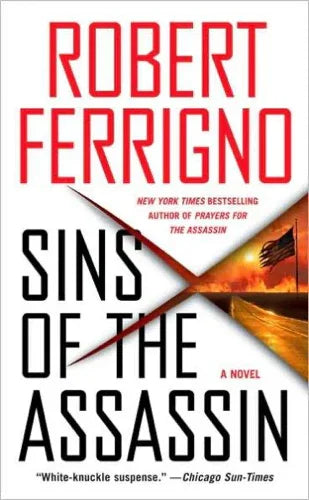
Sins of the Assassin: A Novel (2) (Assassin Trilogy) by Robert Ferrigno
Colossal in concept, dazzlingly plotted, filled with vivid, jaw-dropping violence, Sins of the Assassin confirms Robert Ferrigno as the modern master of the futuristic thriller. In the second book of Ferrigno's spectacular Assassin Trilogy, Rakkim Epps battles radical fundamentalist forces in a futuristic America, now a divided blood-soaked dystopia. Will he survive? Can America ever be unified again? The year is 2043. New York and Washington, D.C., have been leveled by nuclear bombs. New Orleans is submerged beneath fifty feet of water and treasure hunters scavenge its watery ruins. The United States no longer exists, and in its place two new nations maintain an uneasy coexistence. To the west stretches the Islamic Republic, seemingly governed by a moderate president but hollowed from within by the violent, repressive Black Robes, a shadowy fundamentalist group intent on crushing all those who do not follow Allah's path. In this frightening world, freedom is controlled by the state, and non-Muslims are either second-class citizens, hidden underground, exiled, or executed. To the east and south lies the Christian Bible Belt, itself torn by conflict from warring factions, each claiming to be more righteous than the others. Meanwhile the former United States is being nibbled away at the edges: South Florida, known as Nuevo Florida, is independent; the Aztln Empire, formerly Mexico, encroaches from the south; and Canada has laid claim to huge swaths of territory along the United States's former northern border. What stability exists between the warring empires is threatened when the president of the Islamic Republic discovers that a Bible Belt warlord, known simply as the Colonel, is searching for a superweapon hidden inside a remote mountain decades earlier by the old United States regime. Rakkim Epps, retired shadow warrior, is sent on a perilous mission to infiltrate the Belt and steal or destroy the weapon. Accompanying Rakkim is Leo, a naive nineteen-year-old whose technologically enhanced brain is crucial to their success.Together they sneak through the Belt, a lawless territory where a bloodthirsty, drug-addled militia prepares for the End-Times. When Rakkim and Leo finally reach the Colonel's mountain, Epps is forced to rely on his shadow warrior's ability to kill any and all who would halt his quest. Opposing him is the Colonel's enforcer, a sadistic, carbon-skinned killer named Gravenholtz, and the Colonel's wife, the alluring, sexually rapacious Baby, who wants -- and gets -- more of everything. Meanwhile, the Old One, the ancient and immensely rich Muslim fanatic who seeks to rule both American nations, plots his attack from the safety of his ocean liner. Rakkim Epps, he realizes, must be stopped, controlled, or killed. A terrific stand-alone read, Sins of the Assassin is a cinematic feast of action and plot, and verifies Robert Ferrigno's Assassin Trilogy as a monumental imaginative work of suspense. Editorial Reviews Review White-knuckle suspense. -- Chicago Sun-Times Provocative, unpredictable, and nuanced....Sins of the Assassin is terrific -- all killer, no filler. -- The Seattle Times About the Author Robert Ferrigno was born in South Florida, a tropical backwater rife with mosquitoes and flying cockroaches. After earning college degrees in philosophy, film-making, and creative writing, he returned to his first love, poker. He spent the next five years gambling full-time and living in a high-crime area populated by starving artists, alcoholics, thieves, and drug dealers, becoming friends with many people who would later populate his novels. Over the next several years he flew jets with the Blue Angels, drove Ferraris, and went for desert survival training with gun nuts. He ultimately gave up his day job to become a novelist, and his first book, The Horse Latitudes, was called the fiction debut of the season by Time. He lives in Washington with his family. Excerpt. Reprinted by permission. All rights reserved. Sins of the Assassin Chapter 1 Moseby needed to slow down. His haste stirred up a gray confetti of silt, disintegrating paper, and pulverized glass from the neon sign that once flashed OYSTER PO√¢€™ BOYS, TREAT YO MOUTH. The tiny halogen beams on either side of his face mask bounced back from the confetti, the light made useless by his excitement. Moseby drifted in the warm water of the Gulf, waiting. Plenty of time, no need to rush. He easily got four hours out of a three-hour tank. More if he stayed calm and clear. Mama√¢€™s Home Cookin√¢€™ lay crumbling on its foundation, roof gone, the concrete-block walls scoured clean by the tide. A couple of red leatherette stools still sat upright, the floor carpeted with gently waving sea grass. He thought of the crowd at the LSU homecoming game last month, Annabelle on her feet beside him, pom-poms shaking as she cheered louder than anyone. He smiled around his mouthpiece. The cash register was sprung open on the counter, soggy bills hanging out like fingers from the till. Old money. Worthless. Mama√¢€™s didn√¢€™t hold any treasure. The oyster shack was just a marker, an indicator that he was close to what he sought. Moseby floated in place, listening to the sound of his own steady breathing. Easy to get spooked fifty feet under, a swimmer alone with the dead. It took patience to survive in the drowned city. More than patience, it took faith. Moseby pulled at the chain around his neck, clasped the small gold crucifix between thumb and forefinger. He silently asked the blessing of Mary, mother of God. Asked her to intercede on behalf of all who had lost their lives in the city below. Asked the dead for their permission to take what they no longer needed. A man could never pray too much. Particularly a man like Moseby, who had much to atone for. He let go of the crucifix, drifted again, shivering in the warm water. Unlike Moseby, most scavengers used electric sleds in their explorations, racing around at full power, churning up debris. Greedy, frightened men chopping their way through the city, so eager to get back to the surface that they ruined most of what they brought up. Dangerous work under the best of circumstances. Rebreathers failed. Floors and ceilings gave way. Walls collapsed. Jagged metal sliced through wet suits, the rush of blood attracting the barracuda and morays that lurked in the mossy grottos of the French Quarter and the collapsed Superdome. More dangerous than anything else to the scavengers was the panic, men disoriented by the darkness, and the fractured geometry of wrecked buildings. Gulping air, swimming frantically, they got lost in the concrete maze, adding themselves to the long list of dead. The streets below were almost beyond the reach of sunlight, obscured further by thousands of automobiles leaking oil even after all these years. Murkier still in the houses and restaurants, the grand hotels where the easy spoils lay. Afraid of the deep, the scavengers used ever more powerful lights, blinding themselves, losing all perspective in the undersea tableau. Men had died for a crystal doorknob they mistook for a massive diamond, gotten trapped reaching for a sterling punch bowl far from their grasp. Frightened of the dark and the loneliness, frightened most of all by the ghosts. Commuters floating in their vehicles. Lovers in their hotel beds, honeymooners huddling in the lavish bathrooms where they had taken cover. Hard to pluck a gold Rolex off a bony wrist under those watching eye sockets. Hard not to hurry, to drop the goods and fumble to find them again. Easy to breathe too fast, to let the nitrogen build up in the bloodstream, to overestimate the air supply. This year alone sixty-seven men had died or disappeared. Most scavengers focused on the French Quarter√¢€the fancy stores and tourist emporiums had been picked over, but their familiarity offered some illusion of safety. Not Moseby. His crew worked the untouched areas, the mansions and banks and businesses outside the central core, places where the flood had been most ferocious, leaving behind a deadly jumble of concrete and steel and twisted rebar. They were the most successful crew working the city, bringing up gold coins and jewelry, carved stonework, vintage brandy, and Creole memorabilia. Steering wheels from classic cars had been particularly hot this year√¢€most of them sold to collectors in Asia and South America. Moseby trained his men himself, taught them as much as they could handle. The men were careful√¢€ but they still died. Not as often as the men working the supposedly safer parts of the city, but too often, for Moseby. That√¢€™s why he dove alone today. Men had the right to risk their lives to feed their families, but Moseby wasn√¢€™t seeking treasure today. At least none that would be sold or bartered. He switched off his light. Gave in to the darkness. Waiting. Moseby closed his eyes. Patient. When he opened them again, he could see. Not clearly, even his eyes weren√¢€™t that good, but he could see. Now that Mama√¢€™s had oriented him, the shapes and shadows seemed laid out before him, the messy grid on the city√¢€™s outskirts. St. Bernard√¢€™s Parish in the Ninth Ward, where the levee had failed first. The old government had raised the levees two times after Hurricane Katrina inundated the city. Built them higher and higher, trying to keep up with the rising sea level and the ever more powerful hurricanes spawned by the warming. September 23, 2013, thirty years ago, Hurricane James, a category 6 hurricane, predicted to miss the city, had suddenly veered west in the middle of the night and struck New Orleans at sunrise. The levees gave way as though made of tissue, the waters of the Gulf covering the city under fifty feet of water. Most of the estimated 300,000 dead were stuck in traffic trying to flee. Hurricane James was the most violent storm ever recorded. Until Hurricane Maria two years later. He glided over the road, his no-wake flippers almost living up to their name. Brightly colored fish ignored him, twisting and turning as they darted past him, weaving in and out the open windows of the barnaclecrusted vehicles strewn below. The houses in the immediate area were small and falling down, but the land rose slightly toward the north, where the homes were larger, many of them surrounded by iron fences and stone walls. This was where Sweeny would have lived. Annabelle couldn√¢€™t remember much from her visit to her eccentric uncle√¢€™s house√¢€she was barely five√¢€but there had been an ancient banyan tree in his backyard dripping with Spanish moss, and a swing set already rusted, squeaking loudly, one leg of the swing lifting off the ground as she had rhythmically pumped away. She remembered Sweeny taking her and her mother to a local po√¢€™boy joint, a hole-in-the-wall specializing in oysters drenched in fresh lime juice, bourbon, and Tabasco. Sweeny said he ate two po√¢€™boys for lunch every day, proudly watched as his niece devoured one of her own, smacking her lips with pleasure in spite of the blistering hot sauce. Moseby had spent months searching for New Orleans take-out joints specializing in the Cajun delicacy, months of scouring local guidebooks and newspaper articles. Last week he got lucky, ran into an old-timer√¢€ a regular at Mama√¢€™s in the old days. Moseby√¢€™s eyes adjusted even further to the dim light. Annabelle said if it had been him instead of Jonah swallowed by the whale, Moseby wouldn√¢€™t have needed divine intervention to find his way out of its innards. He checked his watch. Plenty of time. Plenty of air. He passed over a small backyard, a line of laundry drooping but still standing. Shirts and pants and dresses, their colors faded, eaten through with time, ragged pennants rippling in the current. Another yard√¢€ the screen door thrown open, torn half off its hinges, and Moseby wondered if the family inside the house had made it out alive, had clung to a boat, a skiff, an inflatable swimming pool; he wondered if they had gotten lucky, awakened from a nightmare before dawn, and raced ahead of the raging floodwaters. Annabelle said her uncle√¢€™s house had been large, with a high river-rock fence and white pillars; he had become a rich man down on his luck by then, his house the remnant of his fortune as the neighborhood sunk into squalor. She and her mother had never gone back after that first visit. Sweeny had taken offense at something her mother said√¢€ or maybe it was the other way around. Either way, her uncle and the house were a dim memory. The marble bust of the woman√¢€ that was a different story. Annabelle remembered it vividly. The stone queen, that√¢€™s what she had called the statue. A beautiful woman with a head full of tight curls, her expression distant and dreamy, as though she had seen something that no one else had ever seen, and the sight had changed her. The world would never be quite fine enough for the woman now. Annabelle said she thought the stone queen must have looked into heaven and couldn√¢€™t wait to go there. Moseby knew better. He and Annabelle had sifted through photos on the Net until she narrowed down what she remembered. If she was right, the statue was Greek, probably early classical, in the style of Aphrodite of Melos. Priceless. Moseby was going to surprise Annabelle with it for their anniversary tonight. For weeks he had been searching for it, not even telling his daughter, Leanne. A grove of trees had been flattened by the flood, thrown together in a tangle. Beyond the fallen trees, a huge banyan squatted in place, leaves long gone, its branches still sharp. A crumbling stone wall√¢€ Moseby angled lower, straining to see. The wall was made from smooth river rock. Spiky, brightly colored sea anemones festooned the stones, completely covering the south wall where the offshore flow brought the densest stream of nutrients. He jerked back as a sea snake poked out from a hole in the crumbling wall, the creature tracking him with its tiny eyes, working its fangs as it undulated toward him. Yellow with red stripes, four feet long√¢€ five feet, six feet at least as it wiggled out of the wall. Moseby drew his knife as he watched the snake, playing with it now, the flat of the blade making lazy rotations around his index finger. The spinning blade gathered the faint light, flashed in the darkness, and the snake inched closer, attracted. Moseby kept the blade moving, calling it closer. Sea snake venom was more deadly than a cobra√¢€™s, that√¢€™s what the old-timers said. All Moseby knew was that three divers had died last month from snakebites, died ugly, puffed up until their skin split. Fifty years ago there hadn√¢€™t been sea snakes in the Gulf, none like this anyway, but the water was warmer now, the snakes migrating toward rich pickings√¢€ just like Moseby. The snake stopped, faced off with him, and then slowly retreated back to its grotto in the stone wall. Moseby waited another minute, then slipped his knife back into its sheath, moved on to the house. He slipped gently through a picture window that had been blown out, scattering fish with his presence. The fish returned just as quickly. He switched his face mask lights to the lowest setting, bounced the beam off the ceiling. He saw well enough to navigate. Tables and chairs were jumbled below, the carpet thick with mud, tiny crabs scuttling through the saw grass. Paintings on the wall hung askew, their surfaces occluded by a dull blue-gray fungus, gilt frames eaten by woodworms. Fish nosed around him, but Moseby ignored them. He lightly wiped a gloved hand across the surface of the largest painting√¢€ the paint rolled off in tiny droplets, spun lazily around him as the fish gobbled them down. He kicked on through the house, limpets dotting the walls and ceiling. Stingrays burrowed into the debris, hiding themselves. He hovered in the doorway of the master bedroom. A huge bookcase had fallen, scattered volumes. Pages swollen, the books gaped on the carpet. The Greek bust lay among the books, toppled off its display stand. He moved inside, eager now; his movements stirred the top layer of mud, but he didn√¢€™t care. He wrenched the bust from the pile of books, sent the sodden pages fluttering around him, free of their rotten bindings. He cleared away the fine moss that covered the statue√¢€™s features, taking off his glove to feel the smooth marble, not satisfied until she was clean. Moseby looked into her face. She was everything that Annabelle had described: strong and beautiful, but most of all possessed of secrets that had cost her greatly. The wisdom of time. He ran a finger along her cheek. Even buoyed by the water, the bust was heavy, maybe a hundred pounds, but he tucked it under one arm, comforted by its heft. He swam for the window, his kicks powerful, leaving clouds of pages in his wake. All those lost words√¢€ His wrist tracker guided him back to where his boat was anchored 1.3 miles away. He could have tagged the bust and returned for it when he got to the boat. Would have been easier, but the idea of putting aside the sculpture even for a few minutes, after all this time searching for it√¢€ Moseby couldn√¢€™t do it. He swam on, shifting the sculpture from arm to arm, more excited than fatigued. By the time the bottom of the boat came into view, he just wanted to load up and be gone. He carefully placed the bust on the hydraulic shelf at the stern, the stone queen√¢€™s face gleaming in the sunlight after all those years underwater. Moseby tore himself away from her gaze, grabbed a handhold, and pulled himself quickly onto the boat. Pushed back his face mask. Trouble. He turned. √¢€œNice morning. A little hot maybe√¢€ √¢€ Moseby stared at the man in shorts and a bright Hawaiian shirt leaning against the command console, cleaning his fingernails with Moseby√¢€™s boning knife. A muscular bruiser, sweating in the heat. Tufts of short red hair blossomed across his skull. Small, cruel eyes, made worse by the intelligence within, and large, flat, uneven teeth. An albino ape raped by a wild boar would birth something like this man√¢€ and then abandon it in disgust. Moseby stood on the deck, dripping water. √¢€œWhat are you doing on my boat?√¢€ The man wandered over to check out the statue. Whistled. √¢€œYou carried that thing by yourself? You√¢€™re a lot stronger than you look.√¢€ He grinned with those crooked teeth, idly adjusted the machine pistol slung around one shoulder. √¢€œI best watch my manners.√¢€ √¢€œI asked you a question.√¢€ √¢€œYou know who I am?√¢€ the man said softly, working the curved tip of the boning knife deep under his thumbnail. Coarse red hairs on his knuckles waved in the breeze. √¢€œYeah.√¢€ The man flicked something from under his nail with the knife, looked up at Moseby. √¢€œThen you know I don√¢€™t need to give you any explanations.√¢€ Moseby had seen the man on video more than once, Gravenholtz√¢€ Lester Gravenholtz. He was usually standing behind the Colonel at news conferences, rarely acknowledged, but always there. The Colonel was a bona fide war hero, known as the savior of Knoxville for his tenacious defense of the city. √¢€œNo retreat, no surrender, no prisoners√¢€ was his motto. At the height of the battle he had personally executed nineteen deserters, live-broadcasting the slayings to his troops. A local warlord now√¢€plenty of those in the Bible Belt, where any central authority was always suspect√¢€but the Colonel was the most powerful, a law unto himself. Lester Gravenholtz had been a late edition to the Colonel√¢€™s forces, showed up about ten years ago and made himself at home. The Colonel√¢€™s imp, hostile preachers had called him√¢€ until they disappeared. Two years ago, the president himself had signed a federal arrest warrant for Gravenholtz, citing multiple examples of rape, murder, and the sacking of the government armory in Vicksburg. The Colonel had sent home the federal prosecutor who attempted to arrest Gravenholtz, said he√¢€™d rein in Gravenholtz himself. The thirty members of the prosecutor√¢€™s armed detail had defected and become part of the Colonel√¢€™s private army. √¢€œI don√¢€™t blame you for being scared,√¢€ said Gravenholtz. Moseby didn√¢€™t answer. In the distance, he saw a stealth helicopter just above the treeline, completely silent, props wafting the branches. He didn√¢€™t react, turned and watched the water. Not one man in a thousand would have noticed the chopper. Some kind of new silent-running model, probably tricked out with laser rail-guns and optics capable of counting the pores in Gravenholtz√¢€™s nose. So what was Gravenholtz and this fancy bird doing here? √¢€œIf you√¢€™re nice I√¢€™ll give you a ride,√¢€ said Gravenholtz. Moseby pretended not to understand, but realized he wasn√¢€™t the only one with good eyes. Gravenholtz tossed the knife, chunked it deep into the teak railing an inch from Moseby√¢€™s hip. √¢€œHeckfire, I√¢€™ll give you a ride even if you√¢€™re not nice.√¢€ Moseby bent down, lifted the stone queen off the shelf, and gently set it down on the deck. √¢€œNo thanks.√¢€ Gravenholtz spit on the deck, wiped his mouth with the back of his hand. √¢€œWhat makes you think it was a request?√¢€ Moseby plucked a strand of seaweed off the stone queen√¢€™s shoulder, kept his attention on her. He didn√¢€™t need to look at Gravenholtz to sense him closing in. √¢€œThe Colonel wants to see you. Now. I√¢€™ll round up your crew later.√¢€ √¢€œTonight√¢€™s my anniversary.√¢€ Moseby picked tiny bits of sand and moss off the stone queen√¢€™s marble surface. √¢€œThe Colonel will have to wait.√¢€ Gravenholtz laughed. √¢€œYou believe in God, Moseby?√¢€ Moseby kept working. √¢€œYes, I do.√¢€ Gravenholtz pointed the machine pistol at Moseby√¢€™s head. √¢€œBetter to believe in the Colonel, because God can√¢€™t help you now.√¢€ Moseby gently removed a bit of grit from the stone queen√¢€™s right eye. √¢€œYou didn√¢€™t come all the way here to shoot me.√¢€ He pulled tiny snails from the stone queen√¢€™s hair, the perfect spiral of their shells one of the infinite proofs of God. He flicked the snails over the side as he worked on the stone queen, his hands steady, unhurried. √¢€œYou√¢€™re here because the Colonel needs me for a project of some kind. Something special. Something he thinks only I can do. I wouldn√¢€™t want to be you if anything happened to me.√¢€ He looked up at Gravenholtz. √¢€œPick me up tomorrow morning after breakfast. If I like the Colonel√¢€™s business terms, I√¢€™ll send for my crew. If not√¢€√¢€ Gravenholtz ripped off a dozen rounds into the stone queen, her head shattering into a thousand pieces. √¢€œI know where you live. I√¢€™ll set my bird down in your backyard.√¢€ He beckoned and the chopper streaked toward them. Moseby stared at the shattered stone queen. Stood up. He pulled a shard of marble from under his eye, felt blood trickle toward his lip. Gravenholtz laughed again. Moseby promised himself that someday√¢€sooner rather than later√¢€he was going to drown Gravenholtz in the man√¢€™s own blood and send him to hell still dripping. Christ had commanded his followers to turn the other cheek, to love those that cursed them, but Moseby knew his own limitations.
Publication Details
Title:
Author(s):
Illustrator:
Binding: Paperback
Published by: Pocket Star: , 2009
Edition:
ISBN: 9781416537717 | 1416537716
480 pages.
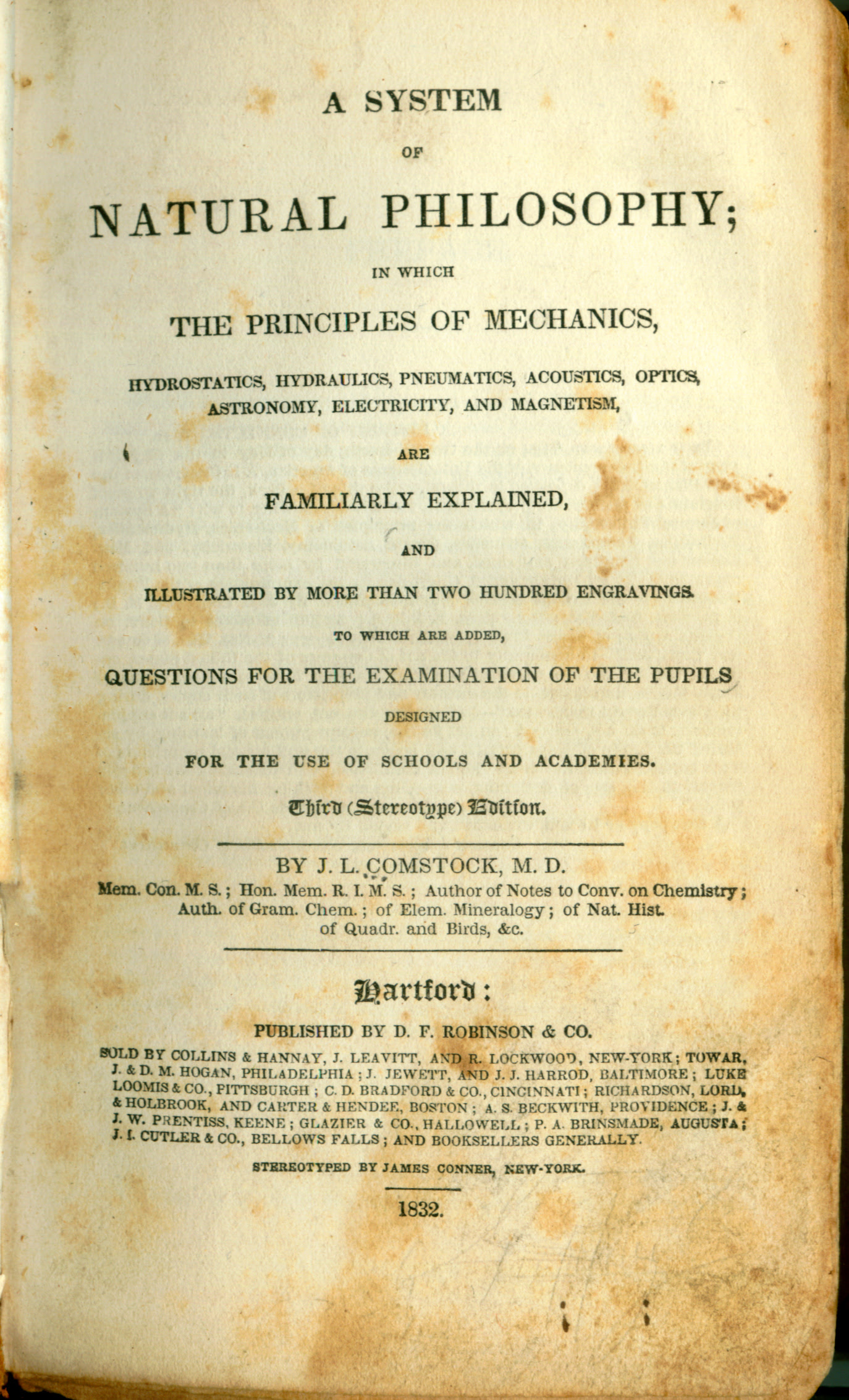
Book Condition: Very Good
products.product.pickup_availability.unavailable
Product information
New Zealand Delivery
Shipping Options
Shipping options are shown at checkout and will vary depending on the delivery address and weight of the books.
We endeavour to ship the following day after your order is made and to have pick up orders available the same day. We ship Monday-Friday. Any orders made on a Friday afternoon will be sent the following Monday. We are unable to deliver on Saturday and Sunday.
Pick Up is Available in NZ:
Warehouse Pick Up Hours
- Monday - Friday: 9am-5pm
- 35 Nathan Terrace, Shannon NZ
Please make sure we have confirmed your order is ready for pickup and bring your confirmation email with you.
Rates
-
New Zealand Standard Shipping - $6.00
- New Zealand Standard Rural Shipping - $10.00
- Free Nationwide Standard Shipping on all Orders $75+
Please allow up to 5 working days for your order to arrive within New Zealand before contacting us about a late delivery. We use NZ Post and the tracking details will be emailed to you as soon as they become available. There may be some courier delays that are out of our control.
International Delivery
We currently ship to Australia and a range of international locations including: Belgium, Canada, China, Switzerland, Czechia, Germany, Denmark, Spain, Finland, France, United Kingdom, United States, Hong Kong SAR, Thailand, Philippines, Ireland, Israel, Italy, Japan, South Korea, Malaysia, Netherlands, Norway, Poland, Portugal, Sweden & Singapore. If your country is not listed, we may not be able to ship to you, or may only offer a quoting shipping option, please contact us if you are unsure.
International orders normally arrive within 2-4 weeks of shipping. Please note that these orders need to pass through the customs office in your country before it will be released for final delivery, which can occasionally cause additional delays. Once an order leaves our warehouse, carrier shipping delays may occur due to factors outside our control. We, unfortunately, can’t control how quickly an order arrives once it has left our warehouse. Contacting the carrier is the best way to get more insight into your package’s location and estimated delivery date.
- Global Standard 1 Book Rate: $37 + $10 for every extra book up to 20kg
- Australia Standard 1 Book Rate: $14 + $4 for every extra book
Any parcels with a combined weight of over 20kg will not process automatically on the website and you will need to contact us for a quote.
Payment Options
On checkout you can either opt to pay by credit card (Visa, Mastercard or American Express), Google Pay, Apple Pay, Shop Pay & Union Pay. Paypal, Afterpay and Bank Deposit.
Transactions are processed immediately and in most cases your order will be shipped the next working day. We do not deliver weekends sorry.
If you do need to contact us about an order please do so here.
You can also check your order by logging in.
Contact Details
- Trade Name: Book Express Ltd
- Phone Number: (+64) 22 852 6879
- Email: sales@bookexpress.co.nz
- Address: 35 Nathan Terrace, Shannon, 4821, New Zealand.
- GST Number: 103320957 - We are registered for GST in New Zealand
- NZBN: 9429031911290
We have a 30-day return policy, which means you have 30 days after receiving your item to request a return.
To be eligible for a return, your item must be in the same condition that you received it, unworn or unread.
To start a return, you can contact us at sales@bookexpress.co.nz. Please note that returns will need to be sent to the following address: 35 Nathan Terrace, Shannon, New Zealand 4821.
If your return is for a quality or incorrect item, the cost of return will be on us, and will refund your cost. If it is for a change of mind, the return will be at your cost.
You can always contact us for any return question at sales@bookexpress.co.nz.
Damages and issues
Please inspect your order upon reception and contact us immediately if the item is defective, damaged or if you receive the wrong item, so that we can evaluate the issue and make it right.
Exceptions / non-returnable items
Certain types of items cannot be returned, like perishable goods (such as food, flowers, or plants), custom products (such as special orders or personalised items), and personal care goods (such as beauty products). Although we don't currently sell anything like this. Please get in touch if you have questions or concerns about your specific item.
Unfortunately, we cannot accept returns on gift cards.
Exchanges
The fastest way to ensure you get what you want is to return the item you have, and once the return is accepted, make a separate purchase for the new item.
European Union 14 day cooling off period
Notwithstanding the above, if the merchandise is being shipped into the European Union, you have the right to cancel or return your order within 14 days, for any reason and without a justification. As above, your item must be in the same condition that you received it, unworn or unused, with tags, and in its original packaging. You’ll also need the receipt or proof of purchase.
Refunds
We will notify you once we’ve received and inspected your return, and let you know if the refund was approved or not. If approved, you’ll be automatically refunded on your original payment method within 10 business days. Please remember it can take some time for your bank or credit card company to process and post the refund too.
If more than 15 business days have passed since we’ve approved your return, please contact us at sales@bookexpress.co.nz.