
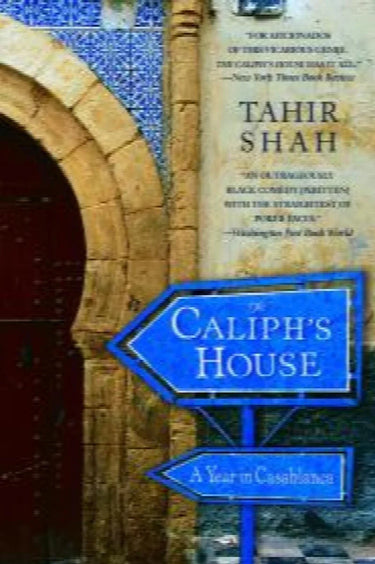
The Caliph's House: A Year in Casablanca by Tahir Shah
In the tradition of A Year in Provence and Under the Tuscan Sun, acclaimed English travel writer Tahir Shah shares a highly entertaining account of making an exotic dream come true. By turns hilarious and harrowing, here is the story of his family's move from the gray skies of London to the sun-drenched city of Casablanca, where Islamic tradition and African folklore converge-and nothing is as easy as it seems.... Inspired by the Moroccan vacations of his childhood, Tahir Shah dreamed of making a home in that astonishing country. At age thirty-six he got his chance. Investing what money he and his wife, Rachana, had, Tahir packed up his growing family and bought Dar Khalifa, a crumbling ruin of a mansion by the sea in Casablanca that once belonged to the city's caliph, or spiritual leader. With its lush grounds, cool, secluded courtyards, and relaxed pace, life at Dar Khalifa seems sure to fulfill Tahir's fantasy-until he discovers that in many ways he is farther from home than he imagined. For in Morocco an empty house is thought to attract jinns, invisible spirits unique to the Islamic world. The ardent belief in their presence greatly hampers sleep and renovation plans, but that is just the beginning. From elaborate exorcism rituals involving sacrificial goats to dealing with gangster neighbors intent on stealing their property, the Shahs must cope with a new culture and all that comes with it. Endlessly enthralling, The Caliph's House charts a year in the life of one family who takes a tremendous gamble. As we follow Tahir on his travels throughout the kingdom, from Tangier to Marrakech to the Sahara, we discover a world of fierce contrasts that any true adventurer would be thrilled to call home. Editorial Reviews Review Tahir Shah's highly readable account of moving his young family to Casablanca is.... an outrageously black comedy [written] with the straightest of poker faces.-The Washington Post Book Review A wonderfully entertaining book - Tahir Shah's talent is to make you laugh while you are admiring the insights given by his most original and lively view of life.-Doris Lessing Reminiscent of Peter Mayle's A Year in Provence.-Entertainment Weekly About the Author Tahir Shah was born into an Anglo-Afghan family with roots in the mountain stronghold of the Hindu Kush. His ten books have chronicled a series of fabulous journeys. He lives with his wife and two children in Casablanca. Excerpt. ® Reprinted by permission. All rights reserved. Chapter One Two reeds drink from the same stream. One is hollow, the other is sugarcane. -moroccan proverb There was a sdaness in the stillness of dusk. The cafe was packed with long-faced men in robes sipping black coffee, smoking dark tobacco. A waiter weaved between the tables, tray balanced on upturned fingertips, glass balanced on tray. In that moment, day became night. The sitters drew deep on their cigarettes, coughed, and stared out at the street. Some were worrying, others dreaming, or just sitting in silence. The same ritual is played out each evening across Morocco, the desert kingdom in Africa's northwest, nudged up against the Atlantic shore. As the last strains of sunlight dissipated, the chatter began again, the hum of calm voices breaking gently over the traffic. The backstreet cafe in Casablanca was for me a place of mystery, a place with a soul, a place with danger. There was a sense that the safety nets had been cut away, that each citizen walked upon the high wire of this, the real world. I longed not merely to travel through it, but to live in such a city. My wife, Rachana, who was pregnant, had reservations from the start. These were fueled all the more when I ranted on about the need for uncertainty and for danger. She said that our little daughter required a secure home, that her childhood could do without an exotic backdrop. I raised the stakes, promising a cook, a maid, an army of nannies, and sunshine--unending, glorious sunshine. Since moving from India eight years before, Rachana had hardly ever glimpsed the sun in the drab London sky. She had almost forgotten how it looked. I reminded her of what we were missing--the dazzle of yellow morning light breaking through bedroom curtains, the drone of bumblebees in honeysuckle, rich aromas wafting through narrow streets, where market stalls are a blaze of color, heaped with spices--paprika and turmeric, cinnamon, cumin and fenugreek. All this in a land where the family is still the core of life, where traditions die hard, and where children can grow up knowing the meaning of honor, pride, and respect. I was tired of our meager existence and the paltry size of our apartment, where the warring couple next door plagued us through paper-thin walls. I wanted to escape to a house of serious dimensions, a fantasy inspired by the pages of The Arabian Nights, with arches and colonnades, towering doors fashioned from aromatic cedar, courtyards with gardens hidden inside, stables and fountains, orchards of fruit trees, and dozens and dozens of rooms. ANYONE WHO HAS EVER tried to make a break from the damp English shores has needed a long list of reasons. I have often wondered how the pilgrims on the Mayflower ever managed to get away at all. Friends and family regard would-be escapees as crazed. Mine were no exception. At first they scoffed at my plan to move abroad, and when they realized I wasn't interested in the usual bolt-holes--southern France or Spain--they weighed in with fighting talk. They branded me as irresponsible, unfit to be a parent, a dreamer destined for failure. The pressure to abandon my dream mounted. It became so great that I did almost back down. Then, one dreary winter morning, I passed a crowd of people on a central London street. An elderly man at the middle of the group was being wrestled to the ground by two police officers. He was dressed in business attire--pressed white shirt, silk tie, and three-piece suit, with a plump red carnation pinned to his lapel. In a bizarre display of eccentricity, he had taken off his trousers and was wearing his underpants on his head. The police, who were not amused, were busy cuffing the man's hands behind his back. A young woman nearby was screaming, begging the authorities to lock the madman up. As the man was bundled into an armored police van, he turned and shouted: Don't waste your life following others! Be individual! Live your dreams! The steel doors slammed, the vehicle sped away, and the crowd dispersed--all except for me. I stood there thinking over what I had seen, and what the supposed madman had said. He was right. Ours was a society of followers, trapped by an island mentality. I made a promise to myself right then. I would not be subdued by others' expectations. I would risk everything and leave the island, dragging my family with me. Together we would search for freedom, and for a land where we could be ourselves. CASABLANCA'S EVENING RUSH OF traffic rivals any in its ferocity. But it has never been so wild as it was on the late spring day that I took possession of the Caliph's House. I had sat in the cafe all afternoon, waiting for the rendezvous with the lawyer. He had told me to come to his office at eight p.m. At seven fifty-five I pressed a coin to the tabletop, left the cafe, and crossed the street. I passed a glass-fronted hotel flanked by proud date palms. An empty tour bus stood outside it, a pair of donkey carts beside, each piled high with overripe fruit. A moment later I was climbing up the curved stairwell of a dilapidated Art Deco building. I rapped at an oak door on the third story. The lawyer opened it, greeted me stiffly, and led the way into his office. There was an official-looking Arabic document on the desk. The lawyer ordered me to read it through. I don't know Arabic, I said. Then you'd better just sign it, he replied, glancing at a gold Rolex on his wrist. He handed me a Mont Blanc. I signed the paper as instructed. The lawyer stood up and slid a hefty iron key across the desk. You are a very brave man, he said. I paused for a moment to look him in the eye. He didn't flinch. I lifted the key. As I did so, I was knocked to the floor by the force of a violent explosion. The windows blew inward, shattering with spectacular energy, sending a hailstorm of glass through the office. Deafened, covered in broken glass, and confused, I struggled to my feet. My legs were shaking so badly that I had trouble standing. The impeccably dressed legal man was crouched beneath his desk, as if he had previous experience of this kind. He rose silently, dusted the glass from his shoulders, straightened his silk tie, and opened the door for me to leave. Out on the street, people were screaming, running in all directions, fire alarms shrieking, police sirens wailing. There was blood, too. Lots of it, strewn across faces and over slashed clothing. I was too shaken to be of any use to the injured, who were now streaming from the glass-fronted hotel. As I observed them in slow motion, a small red taxi pulled up fast. The driver was calling desperately from the passenger window: Etranger! Monsieur etranger! he yelled. Come quickly, it's dangerous for the foreigners! I clambered in and he swung the wheel, hurling us into the slipstream of traffic. It's bombers, suicide bombers, he said, they're going off across Casablanca! The red Peugeot slalomed westward, out of the center of town. But my mind was not on the traffic, the bombs, or the blood. Rather, it was on my wife, at home in London. I could see the news flash tearing over the TV screen, and her clutching our toddler to her very pregnant belly. I felt sure she would now be in no mood to embrace a new culture and a dream. She had been fearful of Morocco's Islamic society, especially in light of Al Qaeda's September 11 attacks and the second Gulf conflict, which had toppled Saddam Hussein only days before. But it was too late to turn back. The money had been paid, the documents signed, stamped once, and stamped again. In my hands was the key: a symbol of the future or, perhaps, of a deranged purchase. I stared down at it, taking in the ancient iron notches, cursing myself for having courted danger so openly. At that moment, the driver slammed on the brakes. We have arrived! he exclaimed. MY REASONS FOR MOROCCO were many. They were endless, and began a long time ago. Throughout my own childhood, my father, who was an Afghan, had wanted to take us to his homeland. But the nation's enduring wars prevented us from ever venturing to the lofty mountain strongholds of Afghanistan. So, from the time we could walk, my sisters and I were frequently bustled into the family station wagon, vinyl cases laden high on the roof. Our gardener would drive us from the dull, serene lanes of the English countryside, through France and Spain, and up into Morocco's High Atlas Mountains. For my father it was a chance to reveal to his children fragments of his own homeland. We found a tapestry of mountain passes and steep-sided valleys, of deserts and oases and imperial fortress cities, a culture bound by the tribal codes of honor and respect. For my mother, it was an opportunity to snap up all manner of bargains, from caftans to candlesticks, and to order the delirious heaps of hippies home to their own mothers far away. We would spend weeks at a time trundling through the mountains, and driving down to the soaring dunes of the Sahara, where the blue men traipsed in from the desert, their dark skin dyed by indigo robes. There would be regular breaks to throw up in the bushes, to gorge ourselves on cactus fruit, and to trade our pocket money for chips of amethyst at the quarries in the hills. My earliest memories are of the great walled city of Fes. Cobbled lanes no wider than a barrel's length, dimly lit and bewitching, where street-side stalls sold anything you could ever wish to buy. There were mountains of spices and fresh-cut herbs--saffron, aniseed, paprika--pickled lemons and mounds of gleaming olives; small cedar boxes inset with camel bone; fragrant leather sandals and terracotta pots; rough Berber rugs, golden caftans, amulets and talismans. By far my favorite corner of the souq was where the black magicians would go to buy ingredients for their spells. The walls of those shops were hung with cages. In them were live chameleons, cobras, salamanders, and forlorn-looking eagles. There were cabinets, too, made from battered Burma teak, their drawers brimming with dried whale skin, the hair of dead men, and other such things, so my father said. Morocco had brought color to my sanitized English childhood, which was more usually cloaked in itchy gray flannel shirts and corduroy shorts, acted out beneath an overcast sky. The kingdom had always been a place of escape, a place of astonishing intensity, but, beyond all else, a place with a soul. With a young family of my own, I regarded it as my duty, my responsibility, to pass on the same gift to my children--a gift of cultural color. It would have been far easier to have given in and not to have made the great escape from the island's shores. But something deep inside me goaded me on: a sense that if I did not seize the moment, I would regret it for the rest of my life. There was another strong reason for Morocco--my father's father. He spent the last years of his life in a small villa near the seafront in Tangier. When his beloved wife died at just fifty-nine, he was broken. Unable to bear the memories, he moved to Morocco because they had never traveled there together. One morning while walking the usual route down the hill, from Cafe France back to his home, he was struck by a reversing Coca-Cola truck. Unconscious and bleeding, he was rushed to the hospital, where he died hours later. I was too small then to even remember him, but I felt a sadness all the same. WE SEARCHED MOROCCO FOR months, desperate to find a house where my delusions of grandeur could run wild. Our starting point was Fes, undoubtedly Morocco's greatest jewel. It is the only medieval Arab city that remains entirely intact. Walking through the labyrinth of streets that make up the vast medina is like stepping into The Thousand and One Nights. The smells, sights, and sounds bombard the senses. A stroll of a few feet can be an overwhelming experience. For centuries, Fes was a place of impressive wealth, a center of scholarship and trade. Its houses reflect a confidence in Arab architecture almost never seen elsewhere, their decor profiting from a line of apprentices unbroken for a thousand years. We found the alleyways of the old city teeming with workshops where the traditional skills of metalwork and leather tanning, of mosaic design, weaving, ceramics, and marquetry, were still transferred from father to son. By chance we were taken to a large merchant's house on the northern edge of the old city. It had been constructed in the grand Fasi style and dated back at least four hundred years. Six cavernous salons were clustered around a central courtyard, each one adorned with mosaic friezes, the floors laid with slabs of marble hewn from the Middle Atlas Mountains. Around the courtyard, columns towered up to the sky, and at its center stood a lotus-shaped fountain crafted from the finest alabaster. High on an adjacent wall was a modest glassless window, veiled by a wooden filigree screen, a lookout point from what once would have been the harem. The man showing off the building was a kebab seller with contacts. He said it had been empty for just a handful of years. I balked at the remark--the place was in need of desperate repair. It looked to me as if it had been abandoned for at least half a century. In Morocco, said the kebab seller with a smile, an empty house invites the wicked. You mean thieves? The man shook his head violently. Not wicked people, he said, wicked forces. At the time, I had no idea what the agent meant. Brushing his comment aside, I began at once negotiating for the house. The problem was that it was owned by seven brothers, each one more avaricious than the last. Unlike the West, where a property is either for sale or it is not, in Morocco, it can be in the twilight zone of realty--possibly for sale, possibly not. Before even getting to the price, you must first coax the owners to sell. This coaxing phase is an Oriental feature, no doubt brought to the region by the Arabs as they swept across North Africa fourteen centuries ago. As you sit over glasses of sweet mint tea, cajoling madly, the vendors look you up and down, inspecting the craftsmanship of your clothing and the stitching of your shoes. The better the quality of your attire, the higher the price is likely to be. I must have been too well dressed on the morning of my meeting with the seven ghoulish brothers who owned the merchant's house. After four hours of coaxing, cajoling, and quaffing gallons of mint tea, they agreed in principle to a sale. Then they spat out a fantasy price and narrowed their eyes greedily. My bargaining skills were undeveloped. I should have stayed, sucked down more tea, and bargained through the afternoon and into the night. But instead I leapt up and ran out into the labyrinth, cursing. In doing so, I had broken the first rule of the Arab world--never lose your cool.
Publication Details
Title:
Author(s):
Illustrator:
Binding: Paperback
Published by: Bantam: , 2006
Edition:
ISBN: 9780553383102 | 0553383108
368 pages.
Book Condition: Very Good
products.product.pickup_availability.unavailable
Product information
New Zealand Delivery
Shipping Options
Shipping options are shown at checkout and will vary depending on the delivery address and weight of the books.
We endeavour to ship the following day after your order is made and to have pick up orders available the same day. We ship Monday-Friday. Any orders made on a Friday afternoon will be sent the following Monday. We are unable to deliver on Saturday and Sunday.
Pick Up is Available in NZ:
Warehouse Pick Up Hours
- Monday - Friday: 9am-5pm
- 35 Nathan Terrace, Shannon NZ
Please make sure we have confirmed your order is ready for pickup and bring your confirmation email with you.
Rates
-
New Zealand Standard Shipping - $6.00
- New Zealand Standard Rural Shipping - $10.00
- Free Nationwide Standard Shipping on all Orders $75+
Please allow up to 5 working days for your order to arrive within New Zealand before contacting us about a late delivery. We use NZ Post and the tracking details will be emailed to you as soon as they become available. There may be some courier delays that are out of our control.
International Delivery
We currently ship to Australia and a range of international locations including: Belgium, Canada, China, Switzerland, Czechia, Germany, Denmark, Spain, Finland, France, United Kingdom, United States, Hong Kong SAR, Thailand, Philippines, Ireland, Israel, Italy, Japan, South Korea, Malaysia, Netherlands, Norway, Poland, Portugal, Sweden & Singapore. If your country is not listed, we may not be able to ship to you, or may only offer a quoting shipping option, please contact us if you are unsure.
International orders normally arrive within 2-4 weeks of shipping. Please note that these orders need to pass through the customs office in your country before it will be released for final delivery, which can occasionally cause additional delays. Once an order leaves our warehouse, carrier shipping delays may occur due to factors outside our control. We, unfortunately, can’t control how quickly an order arrives once it has left our warehouse. Contacting the carrier is the best way to get more insight into your package’s location and estimated delivery date.
- Global Standard 1 Book Rate: $37 + $10 for every extra book up to 20kg
- Australia Standard 1 Book Rate: $14 + $4 for every extra book
Any parcels with a combined weight of over 20kg will not process automatically on the website and you will need to contact us for a quote.
Payment Options
On checkout you can either opt to pay by credit card (Visa, Mastercard or American Express), Google Pay, Apple Pay, Shop Pay & Union Pay. Paypal, Afterpay and Bank Deposit.
Transactions are processed immediately and in most cases your order will be shipped the next working day. We do not deliver weekends sorry.
If you do need to contact us about an order please do so here.
You can also check your order by logging in.
Contact Details
- Trade Name: Book Express Ltd
- Phone Number: (+64) 22 852 6879
- Email: sales@bookexpress.co.nz
- Address: 35 Nathan Terrace, Shannon, 4821, New Zealand.
- GST Number: 103320957 - We are registered for GST in New Zealand
- NZBN: 9429031911290
We have a 30-day return policy, which means you have 30 days after receiving your item to request a return.
To be eligible for a return, your item must be in the same condition that you received it, unworn or unread.
To start a return, you can contact us at sales@bookexpress.co.nz. Please note that returns will need to be sent to the following address: 35 Nathan Terrace, Shannon, New Zealand 4821.
If your return is for a quality or incorrect item, the cost of return will be on us, and will refund your cost. If it is for a change of mind, the return will be at your cost.
You can always contact us for any return question at sales@bookexpress.co.nz.
Damages and issues
Please inspect your order upon reception and contact us immediately if the item is defective, damaged or if you receive the wrong item, so that we can evaluate the issue and make it right.
Exceptions / non-returnable items
Certain types of items cannot be returned, like perishable goods (such as food, flowers, or plants), custom products (such as special orders or personalised items), and personal care goods (such as beauty products). Although we don't currently sell anything like this. Please get in touch if you have questions or concerns about your specific item.
Unfortunately, we cannot accept returns on gift cards.
Exchanges
The fastest way to ensure you get what you want is to return the item you have, and once the return is accepted, make a separate purchase for the new item.
European Union 14 day cooling off period
Notwithstanding the above, if the merchandise is being shipped into the European Union, you have the right to cancel or return your order within 14 days, for any reason and without a justification. As above, your item must be in the same condition that you received it, unworn or unused, with tags, and in its original packaging. You’ll also need the receipt or proof of purchase.
Refunds
We will notify you once we’ve received and inspected your return, and let you know if the refund was approved or not. If approved, you’ll be automatically refunded on your original payment method within 10 business days. Please remember it can take some time for your bank or credit card company to process and post the refund too.
If more than 15 business days have passed since we’ve approved your return, please contact us at sales@bookexpress.co.nz.