
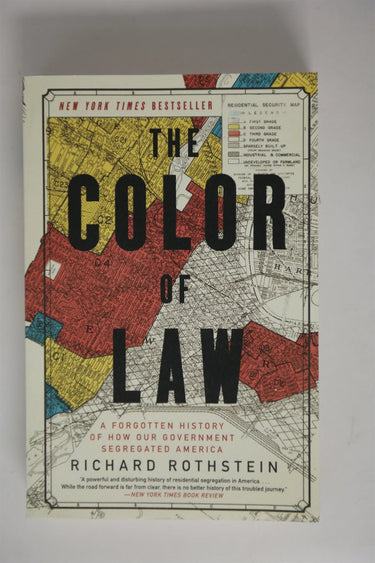
The Color of Law: A Forgotten History of How Our Government Segregated America by Richard Rothstein
Notes From Your Bookseller An essential history of America focusing on the overt urban policies that fortified widespread segregation. This is an exacting and damning indictment of the American government that is essential reading for all. New York Times Bestseller • Notable Book of the Year • Editors' Choice Selection One of Bill Gates' Amazing Books of the Year One of Publishers Weekly's 10 Best Books of the Year Longlisted for the National Book Award for Nonfiction An NPR Best Book of the Year Winner of the Hillman Prize for Nonfiction Gold Winner • California Book Award (Nonfiction) Finalist • Los Angeles Times Book Prize (History) Finalist • Brooklyn Public Library Literary Prize This powerful and disturbing history exposes how American governments deliberately imposed racial segregation on metropolitan areas nationwide (New York Times Book Review). Widely heralded as a masterful (Washington Post) and essential (Slate) history of the modern American metropolis, Richard Rothstein's The Color of Law offers the most forceful argument ever published on how federal, state, and local governments gave rise to and reinforced neighborhood segregation (William Julius Wilson). Exploding the myth of de facto segregation arising from private prejudice or the unintended consequences of economic forces, Rothstein describes how the American government systematically imposed residential segregation: with undisguised racial zoning; public housing that purposefully segregated previously mixed communities; subsidies for builders to create whites-only suburbs; tax exemptions for institutions that enforced segregation; and support for violent resistance to African Americans in white neighborhoods. A groundbreaking, virtually indispensable study that has already transformed our understanding of twentieth-century urban history (Chicago Daily Observer), The Color of Law forces us to face the obligation to remedy our unconstitutional past. Editorial Reviews There's a really important book that came out... called The Color of Law. It explains how a lot of the racial segregation taking place in our neighborhoods that we maybe treat today as de facto actually happened as the result of very specific and very racist policy choices, going back at least to the F.D.R. Administration. You would think it would make sense if resources went into creating that racial inequity that resources would go into reversing it. - Pete Buttigieg Virtually indispensable... I can only implore anyone interested in understanding the depth of the problem to read this necessary book. - Don Rose Essential... Rothstein persuasively debunks many contemporary myths about racial discrimination.... Only when Americans learn a common-and accurate-history of our nation's racial divisions, he contends, will we then be able to consider steps to fulfill our legal and moral obligations. For the rest of us, still trying to work past 40 years of misinformation, there might not be a better place to start than Rothstein's book. - Rachel M. Cohen Masterful... The Rothstein book gathers meticulous research showing how governments at all levels long employed racially discriminatory policies to deny blacks the opportunity to live in neighborhoods with jobs, good schools and upward mobility. - Jared Bernstein Rothstein's work should make everyone, all across the political spectrum, reconsider what it is we allow those in power to do in the name of 'social harmony' and 'progress' with more skepticism... The Color of Law shows what happens when Americans lose their natural rights of life, liberty, and the pursuit of happiness, or in the case of African-Americans, when there are those still waiting to receive them in full. - Carl Paulus A powerful and disturbing history of residential segregation in America.... One of the great strengths of Rothstein's account is the sheer weight of evidence he marshals.... While the road forward is far from clear, there is no better history of this troubled journey than The Color of Law. - David Oshinsky ...a powerful and disturbing history of residential segregation in America...One of the great strengths of Rothstein's account is the sheer weight of evidence he marshals...he quite simply demolishes the notion that government played a minor role in creating the racial ghettos that plague our suburbs and inner cities. Going back to the late 19th century, he uncovers a policy of de jure segregation in virtually every presidential administration, including those we normally describe as liberal on domestic issues...Rothstein writes that America has a constitutional obligation to remedy de jure segregation in housing, and that its story must be told. While the road forward is far from clear, there is no better history of this troubled journey than The Color of Law. - The New York Times Book Review - David Oshinsky *02/20/2017 Rothstein's comprehensive and engrossing book reveals just how the U.S. arrived at the systematic racial segregation we find in metropolitan areas today, focusing in particular on the role of government. While remaining cognizant of recent changes in legislation and implementation, Rothstein is keenly alert to the continuing effects of past practices. He leads the reader through Jim Crow laws, sundown towns, restrictive covenants, blockbusting, law enforcement complicity, and subprime loans. The book touches on the Federal Housing Administration and the creation of public housing projects, explaining how these were transformed into a warehousing system for the poor. Rothstein also notes the impact of Woodrow Wilson's racist hiring policies, the New Deal-era Fair Labor Standards that excluded industries in which African Americans predominated, like agriculture, and the exclusion of African-American workers from the construction trades, making clear how directly government contributed to segregation in labor. And Rothstein shows exactly why a simplistic North/South polarization lacks substance, using copious examples from both regions. This compassionate and scholarly diagnosis of past policies and prescription for our current racial maladies shines a bright light on some shadowy spaces. 13 illus. (May) - Publishers Weekly This wonderful, important book could not be more timely...With its clarity and breadth, the book is literally a page-turner. - Florence Roisman Original and insightful...The central premise of [Rothstein's] argument...is that the Supreme Court has failed for decades to understand the extent to which residential racial segregation in our nation is not the result of private decisions by private individuals, but is the direct product of unconstitutional government action. The implications of his analysis are revolutionary. - Geoffrey R. Stone One of those rare books that will be discussed and debated for many decades. Based on careful analyses of multiple historical documents, Rothstein has presented what I consider to be the most forceful argument ever published on how federal, state, and local governments gave rise to and reinforced neighborhood segregation. - Wiliam Julius Wilson Rothstein's work should make everyone, all across the political spectrum, reconsider what it is we allow those in power to do in the name of 'social harmony' and 'progress' with more skepticism...The Color of Law shows what happens when Americans lose their natural rights of life, liberty, and the pursuit of happiness, or in the case of African-Americans, when there are those still waiting to receive them in full. - Carl Paulusn Conservative The Color of Law should be required reading for every American student... What an amazing accomplishment and what a contribution to restorative justice. Truly a tour de force, and exceptionally moving. - Jeffrey D. Sachs At once analytical and passionate, The Color of Law discloses why segregation has persisted, even deepened, in the post-civil rights era, and thoughtfully proposes how remedies might be pursued. A must-read. - Ira Katznelson Masterful...Rothstein documents the deep historical roots and the continuing practices in law and social custom that maintain a profoundly un-American system holding down the nation's most disadvantaged citizens. - Thomas B. Edsall Through meticulous research and powerful human stories, Rothstein reveals a history of racism hiding in plain sight and compels us to confront the consequences of the intentional, decades-long governmental policies that created a segregated America. - Sherrilyn A. Ifill *04/01/2017 Conventional narratives about segregation in 21st-century America hold that persistent racial disparities are a product of de facto segregation--the summation of individual preferences--rather than de jure segregation enforced (unconstitutionally) by law. Legal scholar Rothstein (NAACP Legal Defense Fund; Univ. of Calif., Berkeley) disabuses us of this too-comfortable notion that the state has not incentivised, and in some cases explicitly required, discrimination against African Americans. Rather than being an accident of privately held prejudice, Rothstein's work argues that segregation across the long 20th century was a product of federal, state, and local housing and land-use policies that directly and intentionally led to the suppression of black family wealth and well-being. To support his argument, he draws on extensive historical research that documents government efforts to create and enforce segregation. Each chapter focuses on a particular tactic such as public housing, racial covenants, or state-sanctioned violence. The final section calls on citizens to accept collective responsibility and remedy state wrongs through public policy. VERDICT This indictment of government-sponsored segregation is a timely work that will find broad readership among those asking How did we arrive here? and What next?--Anna J. Clutterbuck-Cook, Massachusetts Historical Soc. - Library Journal 2017-02-20 How government policies have perpetuated the caste system of slavery.Rothstein (Grading Education: Getting Accountability Right, 2008, etc.), a research associate at the Economic Policy Institute and a fellow at the Thurgood Marshall Institute of the NAACP Legal Defense Fund, mounts a hard-hitting argument condemning federal, state, and local governments for devising laws that enforce segregation. Underserved, blighted African-American communities, he argues persuasively, are not the result only of personal prejudice or market forces but of unconstitutional racially explicit government policies to segregate our metropolitan areas. The author cites cases and decisions regarding public housing, racial zoning, mortgage lending, the enforcement of housing covenants, fearmongering to incite white flight, planning for highways and roads, IRS tax-exemption status for institutions that promote segregation, state-sanctioned violence, and the effects of segregation on schools and income disparity. Although he sometimes refers to particular individuals, his main focus is on law and public policy affecting neighborhoods. In 1949, for example, when a proposed integration amendment to a public housing law threatened to be defeated by Southern Democrats, liberals caved, voting for a program that stipulated segregation rather than giving up the possibility of much-needed public housing. State supreme courts consistently upheld restrictive real estate covenants that forbade sales of homes to African-Americans, claiming that such private agreements did not violate the Constitution. Even after the U.S. Supreme Court ruled that restrictive covenants did, indeed, violate the 14th Amendment, the Federal Housing Administration continued to deny mortgage insurance to homes in integrated neighborhoods. After World War II, the GI Bill denied African-Americans mortgage subsidies and opportunities for education and training that were available to whites. Rothstein considers the insidious effects of housing segregation on economic mobility, infrastructure, and politics. Racial polarization, he asserts, bolsters leaders who appeal to white voters' sense of racial entitlement and who foster intolerance. An informed, important expos of the nation's institutionalized racism that would have been even more reader-friendly with the inclusion of more individual case histories. - Kirkus Reviews
Publication Details
Title:
Author(s):
Illustrator:
Binding: Paperback
Published by: Liveright Publishing Corporation: , 2018
Edition:
ISBN: 9781631494536 | 1631494538
368 pages.
Book Condition: Very Good
products.product.pickup_availability.unavailable
Product information
New Zealand Delivery
Shipping Options
Shipping options are shown at checkout and will vary depending on the delivery address and weight of the books.
We endeavour to ship the following day after your order is made and to have pick up orders available the same day. We ship Monday-Friday. Any orders made on a Friday afternoon will be sent the following Monday. We are unable to deliver on Saturday and Sunday.
Pick Up is Available in NZ:
Warehouse Pick Up Hours
- Monday - Friday: 9am-5pm
- 35 Nathan Terrace, Shannon NZ
Please make sure we have confirmed your order is ready for pickup and bring your confirmation email with you.
Rates
-
New Zealand Standard Shipping - $6.00
- New Zealand Standard Rural Shipping - $10.00
- Free Nationwide Standard Shipping on all Orders $75+
Please allow up to 5 working days for your order to arrive within New Zealand before contacting us about a late delivery. We use NZ Post and the tracking details will be emailed to you as soon as they become available. There may be some courier delays that are out of our control.
International Delivery
We currently ship to Australia and a range of international locations including: Belgium, Canada, China, Switzerland, Czechia, Germany, Denmark, Spain, Finland, France, United Kingdom, United States, Hong Kong SAR, Thailand, Philippines, Ireland, Israel, Italy, Japan, South Korea, Malaysia, Netherlands, Norway, Poland, Portugal, Sweden & Singapore. If your country is not listed, we may not be able to ship to you, or may only offer a quoting shipping option, please contact us if you are unsure.
International orders normally arrive within 2-4 weeks of shipping. Please note that these orders need to pass through the customs office in your country before it will be released for final delivery, which can occasionally cause additional delays. Once an order leaves our warehouse, carrier shipping delays may occur due to factors outside our control. We, unfortunately, can’t control how quickly an order arrives once it has left our warehouse. Contacting the carrier is the best way to get more insight into your package’s location and estimated delivery date.
- Global Standard 1 Book Rate: $37 + $10 for every extra book up to 20kg
- Australia Standard 1 Book Rate: $14 + $4 for every extra book
Any parcels with a combined weight of over 20kg will not process automatically on the website and you will need to contact us for a quote.
Payment Options
On checkout you can either opt to pay by credit card (Visa, Mastercard or American Express), Google Pay, Apple Pay, Shop Pay & Union Pay. Paypal, Afterpay and Bank Deposit.
Transactions are processed immediately and in most cases your order will be shipped the next working day. We do not deliver weekends sorry.
If you do need to contact us about an order please do so here.
You can also check your order by logging in.
Contact Details
- Trade Name: Book Express Ltd
- Phone Number: (+64) 22 852 6879
- Email: sales@bookexpress.co.nz
- Address: 35 Nathan Terrace, Shannon, 4821, New Zealand.
- GST Number: 103320957 - We are registered for GST in New Zealand
- NZBN: 9429031911290
We have a 30-day return policy, which means you have 30 days after receiving your item to request a return.
To be eligible for a return, your item must be in the same condition that you received it, unworn or unread.
To start a return, you can contact us at sales@bookexpress.co.nz. Please note that returns will need to be sent to the following address: 35 Nathan Terrace, Shannon, New Zealand 4821.
If your return is for a quality or incorrect item, the cost of return will be on us, and will refund your cost. If it is for a change of mind, the return will be at your cost.
You can always contact us for any return question at sales@bookexpress.co.nz.
Damages and issues
Please inspect your order upon reception and contact us immediately if the item is defective, damaged or if you receive the wrong item, so that we can evaluate the issue and make it right.
Exceptions / non-returnable items
Certain types of items cannot be returned, like perishable goods (such as food, flowers, or plants), custom products (such as special orders or personalised items), and personal care goods (such as beauty products). Although we don't currently sell anything like this. Please get in touch if you have questions or concerns about your specific item.
Unfortunately, we cannot accept returns on gift cards.
Exchanges
The fastest way to ensure you get what you want is to return the item you have, and once the return is accepted, make a separate purchase for the new item.
European Union 14 day cooling off period
Notwithstanding the above, if the merchandise is being shipped into the European Union, you have the right to cancel or return your order within 14 days, for any reason and without a justification. As above, your item must be in the same condition that you received it, unworn or unused, with tags, and in its original packaging. You’ll also need the receipt or proof of purchase.
Refunds
We will notify you once we’ve received and inspected your return, and let you know if the refund was approved or not. If approved, you’ll be automatically refunded on your original payment method within 10 business days. Please remember it can take some time for your bank or credit card company to process and post the refund too.
If more than 15 business days have passed since we’ve approved your return, please contact us at sales@bookexpress.co.nz.