
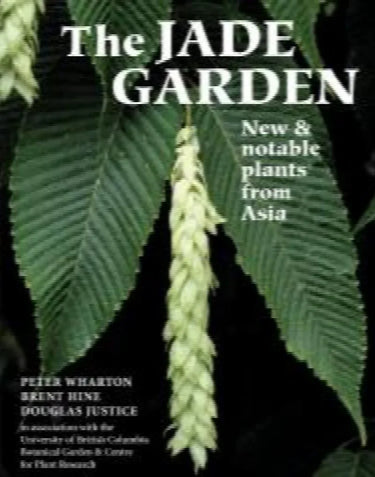
The Jade Garden: New and Notable Plants from Asia by Peter Wharton,Brent Hine,Douglas Justice
The Jade Garden is an authoritative guide to 130 of the most fascinating yet little-known ornamental trees, shrubs, and perennials from the green mantle of Asia. Based on detailed research and observation at one of the largest and oldest collections of Asian plants in North America, the subjects of this book were chosen for their superior garden qualities, their rarity in everyday horticulture, and their commercial availability. From an extraordinary, nearly black geranium with reflexed petals, to a ground-creeping honeysuckle with bicolored flowers and blue berries, gardeners are sure to find something new and exciting in these pages. Although plants included are from the cutting edge of plant exploration and discovery, the authors have included only those selections that have undergone thorough evaluation at the University of British Columbia Botanical Garden for hardiness and garden appeal. In addition, the authors have taken special care to exclude potentially invasive plants, allowing readers to be confident that any selection from the book will be an environmentally responsible one. With many of its plants appearing in a garden book for the first time, The Jade Garden is certain to be a groundbreaking horticultural event. Editorial Reviews From Booklist Wharton and company share an affiliation with the University of British Columbia Botanical Garden and Centre for Plant Research, a wondrous place known for its magnificent plant collections. Calling upon their vast knowledge of Asian perennials, shrubs, and trees, the authors have compiled an encyclopedic guide to a bevy of gardenworthy specimens, especially little-known selections. A botanical perspective informs an introductory overview of the breathtakingly varied geography of China and its adjacent neighbors, thus setting the stage for the plant entries. Written in an engaging style, each plant listing contains a description of native habitat, growing habit, and hardiness, along with cultivation and propagation advice. Observations document how plants perform at the botanical garden, and suggest what one might expect in a cooler or warmer region. This valuable resource on cutting-edge Asian species includes photographs of plants in the wild as well as detailed shots of alluring characteristics. Alice Joyce Copyright © American Library Association. All rights reserved Review Calling upon their vast knowledge of Asian perennials, shrubs and trees, the authors have compiled an encyclopedic guide to a bevy of garden-worthy specimens. This valuable resource on cutting-edge Asian species includes photographs of plants in the wild as well as detailed shots of alluring characteristics. --Booklist An authoritative, groundbreaking work that will delight horticulture connoisseurs and those interested in Asian flora and natural history. --Library Journal A clever and highly recommended book for garden enthusiasts wishing to increase their knowledge of Asian vegetation. --Garden Compass An authoritative guide to 150 of the most fascinating yet little-known ornamental trees, shrubs and perennials from 'the green mantle' of Asia. --The Professional Gardener A jewel box of suggestions. --Cleveland Plain Dealer The Jade Garden will appeal not only to gardeners with dirt under their fingernails and a hankering for the exotic in the backyard, but also to the armchair gardener and traveler. --Asian Reporter The very informative descriptions often cover a variety of subjects, including details on where the plant was found, its unique morphological characteristics, its growth over time in the botanical garden and taxonomic considerations where controversies exist. --Plant Science Bulletin A treat for the serious gardener. --Salem Statesman Journal Book Description The Jade Garden is an authoritative guide to 150 of the most fascinating yet little-known ornamental trees, shrubs, and perennials from the green mantle of Asia. Based on detailed research and observation at one of the largest and oldest collections of Asian plants in North America, the subjects of this book were chosen for their superior garden qualities, their rarity in everyday horticulture, and their commercial availability. From an extraordinary, nearly black geranium with reflexed petals, to a ground-creeping honeysuckle with bicolored flowers and blue berries, gardeners are sure to find something new and exciting in these pages. Although plants included are from the cutting edge of plant exploration and discovery, the authors have included only those selections that have undergone thorough evaluation at the University of British Columbia Botanical Garden for hardiness and garden appeal. In addition, the authors have taken special care to exclude potentially invasive plants, allowing readers to be confident that any selection from the book will be an environmentally responsible one. With many of its plants appearing in a garden book for the first time, The Jade Garden is certain to be a groundbreaking horticultural event. From the Author Douglas Justice is associate director and curator of collections at the UBC Botanical Garden and Centre for Plant Research. From the Back Cover The Jade Garden is an authoritative guide to 130 of the most fascinating yet little-known ornamental trees, shrubs, and perennials from the green mantle of Asia. Based on detailed research and observation at one of the largest and oldest collections of Asian plants in North America, the subjects of this book were chosen for their superior garden qualities, their rarity in everyday horticulture, and their commercial availability. From an extraordinary, nearly black geranium with reflexed petals, to a ground-creeping honeysuckle with bicolored flowers and blue berries, gardeners are sure to find something new and exciting in these pages.Although plants included are from the cutting edge of plant exploration and discovery, the authors have included only those selections that have undergone thorough evaluation at the University of British Columbia Botanical Garden for hardiness and garden appeal. In addition, the authors have taken special care to exclude potentially invasive plants, allowing readers to be confident that any selection from the book will be an environmentally responsible one.Every plant has a story; the authors provide many colorful histories and enthusiastic accounts--often of their own firsthand encounters with the plants in their wild Asian habitats. For the scientifically minded, introductory essays provide a useful background on Asian geography and floristics. With many of its plants appearing in a garden book for the first time, The Jade Garden is certain to be a groundbreaking horticultural event. About the Author Peter Wharton has been curator, since 1975, of the David C. Lam Asian Garden, a component of the University of British Columbia (UBC) Botanical Garden and Centre for Plant Research. Peter's professional career has been centered on the development of this unique forest garden in concert with extensive plant exploration in China. Brent Hine has been curator of the E. H. Lohbrunner Alpine Garden at the UBC Botanical Garden and Centre for Plant Research since 1997. Away from the garden setting, the natural sciences-from the microscopic to the very macroscopic-have alwyas held his fundamental fascination. Douglas Justice is associate director and curator of collections at the UBC Botanical Garden and Centre for Plant Research. A teacher and writer with an abiding interest in all things green, he considers the knowledge of trees to be way up there. Excerpt. ® Reprinted by permission. All rights reserved. The main scope of this book covers China, and to a lesser degree bordering countries such as Korea, Japan, Vietnam, and Myanmar. The volcanic geological province of the Japanese archipelago is a significant part of the Pacific Ring of Fire that continues south through the Ryukyu Islands and Taiwan to the Philippines. These islands frame the eastern edge of our region of focus. All have generally mountainous spines and restricted coastal plains. The altitudinal range, varied geology, geographical isolation, and maritime climate have led to great biotic diversity, but the islands share many common elements with their larger mainland neighbour to the west. The first three of the Four Great Steps of China and bordering regions can be further divided into a total of seven separate subregions for our purposes in this book. The First Step, the Tibetan (Qinghai-Xizang) Plateau, is the first subregion. The Second Step is comprised of the Xinjiang, the Inner Mongolia uplands, and Qin Ling Shan; the Red Basin and central uplands; and the Yunnan-Guizhou Plateau and Western Mountains. The Third Step includes the eastern highlands, the Shandong Peninsula, and the northeast coastal region; the northeastern and eastern lowlands; and finally, the southern uplands, basins, and coastal plains. I encourage the reader to use the fine Atlas of China by Liu (1996), particularly the topographic section, and also the popular Nelles Maps, to navigate the formidable array of names and locations mentioned here. The most challenging aspect of writing this account has been to describe the complex regional mountain geography of this vast area. These mountains often form provincial boundaries or overlap them, sometimes in a bewildering manner. The Tibetan (Qjnghai-Xizang) Plateau This immense plateau covers an area the size of Alaska and Maine combined. Sven Hedin, the resolute central Asian Swedish explorer, rightly describes this region as the most stupendous upheaval to be found on the face of the planet (Hopkirk 1980). Comprised of high, cold desert, montane grasslands, and rich alpine vegetation, the general elevation in the north ranges from the Kunlun Shan at 5000 metres and rises toward its southern rim, the Himalayas, to peaks of between 7000 and 8000 metres. The greatest single tectonic event that shaped this vast region was the titanic uplift of the Tibetan Plateau and the Himalayas starting in the Miocene, 8 million years ago. It is important for us to have a basic understanding of this seminal event. Landforms throughout much of western and central China have been hugely impacted by this past and continuing activity. This massive uplift is the direct result of the Indian subcontinent colliding with the continental margin of Asia. Before this collision, 150 million years ago, the Tethys formed a seaway that extended from Europe to eastern Asia; it gradually narrowed and then was obliterated by this intercontinental collision. The denser, colder oceanic plate was subducted beneath the Tibetan Plateau, while the lighter geosynclinal sediments were compressed and thrust upward into the Himalayas of today. A ghostly trace of the Tethys Sea is preserved in the east-west depression, or suture, that the present-day Yarlung Tsangpo River follows from its origin 1550 kilometres west of the Tsangpo Gorge. The eastern termination of the Himalayas is marked by a stunning 180-degree bend in the Yarlung Tsangpo River at this gorge. Here, erosion has kept pace with the astonishing 6- to 14-centimetre-a-year uplift of the Himalayas. The Tsangpo Gorge acts like a fulcrum for a profound alteration to the alignment of the Himalayas and Hengduan Shan Ranges. The mountains that arch over the Tsangpo Gorge to the immediate north of the Yarlung Tsangpo River, the Nyainqentanglha Shan, form a link with the massive Hengduan Shan Ranges to the southeast. West of the Tsangpo Gorge, the mountains have a generally west-east orientation, while to the east of the Tsangpo Gorge, the mountains curve to a more north-south axis in western Yunnan before fanning out into Indochina. This change in the mountain alignment was a result of compressional geological forces changing from south to north to west to east as we move eastward from the Tsangpo Gorge, and a direct result of the counterclockwise rotation of the Indian subcontinent starting in the west and moving east as it plowed into Asia, starting in the Eocene and continuing to the present. The collision has also resulted in huge movements eastward and southeastward, creating massive intracontinental strike-slip faulting that has, significantly, reactivated ancient mountain ranges throughout much of eastern China and into Vietnam. The vertical cliffs of the Tsangpo Gorge ascend to two stupendous peaks, Namcha Barwa (7757 metres) and Gyala Pen (7238 metres), marking the eastern extremity of the Himalayan Range. These peaks overshadow the stygian chasm described so well by the plant explorer Frank Kingdon Ward. The intense tectonic activity of this region makes it prone to earthquake activity; an example was the Assam Earthquake of 15 August 1950, which did immense damage. The Yarlung Tsangpo River itself has rent an immense breach into the Himalayan ramparts that stretches unbroken to this point from the Indus River of Pakistan. The gap is highly significant because it permits what is called the Southwest Monsoon to penetrate into the interior of the southeastern Tibetan Plateau. The combination of moisture and the high protective mountains of this area has resulted in a vegetational anomaly - the penetration of valley bottom tropical rain forests to its highest latitude in the Northern Hemisphere at nearly latitude 30° north in the Medog region. The diversity and primeval nature of the Tsangpo Gorge forests are a wonder in themselves, yet it is here where another strange natural event can occur. Huge icefalls from the surrounding massive towering peaks can be dislodged, often by earth movements, then cascade headlong through the steaming tropical forests below, before plunging into the furious Yarlung Tsangpo River. Praiseworthy indeed is the establishment of the Yarlung Tsangpo Great Canyon National Park in 1999, covering 9168 square kilometres, and the Cibagou Nature Reserve in southeast Tibet, both in this unique area. The region is home to the Bengal or Indian tiger, now well protected in a series of reserves in northern India. Perhaps 30 to 35 tigers range through southeast Tibet into western Yunnan. To the south, the turbulent Yarlung Tsangpo River turns south and then southwest, to become the Brahmaputra of India. It flows through a wide plain, which funnels the Southwest Monsoon into the Mishimishi Mountains to the north and then southwestward over the northeast- to southwest-trending Patkai Range, part of the Indoburmese Mountains bordering Assam, Nagaland, and Manipur. These incredibly wet mountains (with 5,000 to 10,000 millimetres annual rainfall) separate India from Myanmar eastward into the remarkably biodiverse Northern Triangle Forests that extend north to the Three Corners where the borders of Myanmar, Tibet (Xizang), and India meet. Here the fioras of Assam/India, the Eastern Himalayas, Indo-Malaya, and China mingle. This region of challenging geography and diverse flora is associated with the indomitable Frank Kingdon Ward's explorations of 1921, 1930, and 1952; he described it as perhaps the most uncompromising mountain terrain in the world (Cox 1945). Subsequently, Alan Rabinowitz, director of the Wildlife Conservation Society, has done inspiring work in the region; he was instrumental in the establishment in the Northern Triangle Forests of the Hkakabo Razi National Park in 1998, and the Hukawng Wildlife Sanctuary in 2001, both in Myanmar's Kachin State (Rabinowitz 2004). The Hukawng sanctuary is the size of Vermont and has a population of 80 to 100 tigers. Two more protected areas connecting these two impressive reserves, including the Hponkhan Razi National Park, have been added to a contiguous area of over 31,077 square kilometres of primary forest. Dr. Rabinowitz is a world leader in the conservation of the world's large cats. Here, the Indochinese tiger and the Asian elephant are the flagship animal species of this region's rich subtropical evergreen forests. These encouraging developments must be balanced against the stark realities of general forest degradation in Myanmar. Global Witness, a British organization, has published (2003) a formidable and disturbing account concerning the uncertain future of Myanmar's forests, which should be compulsory reading for anyone who has a passion for untouched forests. This glorious intractable wilderness continues in an arc south through Kachin State to the borders of Yunnan, along the Gaoligong Shan. To the west, where the Brahmaputra debouches onto the Assamese lowlands, the southern slopes of the Himalayas stretch through Bhutan and Nepal, a region celebrated for its rich flora and soaring mountains. Xinjiang, Inner Mongolia Uplands, and Qin Ling Shan The vast arid wilderness of Xinjiang forms the western bastion of this region, north of the Tibetan Plateau. It is defined geographically on the south by the Kunlun Shan and Altun Shan and on the west by the Pamir Knot. The mountainous border regions of Kazakstan, notably the Tian Shan, merge through mountainous country with Altay Shan in the north, demarcating the Mongolian border before entering the Gobi Desert on the borders of Gansu, Xinjiang, and Mongolia. The imposing Tarim Basin, to the far west, receives the drainage of the surrounding mountains before the moisture ends up in the dried-up salt lake of Lop Nur. The Tarim, or in Uygur the converging of the waters, is surrounded on three sides by imposing mountains that form the furnace walls of the infamous sand-choked Taklamakan Desert, which in Turkic means appropriately the region where you go in and you will not come out. On the fourth side, the vast stony Gobi Desert stretches eastward to the horizon. Through the shimmering heat, the surrounding mountains are home to fine alpine country with a treasure trove of herbaceous plants. At the southwest edge of the Tian Shan, the small, isolated Turfan Basin is in sharp contrast to the vast steppe grasslands of the Junggar Basin stretching northwest to the Altay Shan on the Kazak border. The Gobi Desert is a region of endless aridity, caused by the enormous rain shadow of the Tibetan Plateau that extends east to the borders of Gansu Province, where the Republic of Mongolia and Xinjiang meet. This region of yellow earth stretches across northern China (T. Liu 1985). These windblown, yellow silt (bess) deposits have deeply buried the landscape in this region since the beginning of the Pleistocene. The Tengger, Alishan, and Ordos Deserts of Inner Mongolia and bordering provinces form an austere region dominated by shifting sand dunes and numerous desiccated low mountain ranges. An extensive forest covered Nei Mongol (Inner Mongolia) in historical times, but was burned in a vast inferno during the tenth century. Subsequent fires have further increased the aridity that is creeping eastward toward the borders of Heilongjiang Province. The Ordos Desert is encircled by the great north bend of the Huang He (Yellow River). Out of this land of great aridity rise two mountain massifs that are noted for remnant montane coniferous forest vegetation, and they have fortunately received recent protection. The Helan Shan to the west of the Huang He, near Yinchuan, and the Lang Shan and Yin Shan at the northern apex of the great northern loop of the Huang He are notable for their isolated forest fragments. The eastern Gobi Desert continues in all its severity along the border of Mongolia, gradually merging with the arid steppe south of the river Herlen Gol. The Kunlun Shan-Altun Shan merges eastward with the Qilian Shan mountain complex within the Gansu's Hexi Corridor, ultimately connecting with the Qin Ling Shan in southern Shaanxi. This region on the northeast margin of the Tibetan Plateau contains several botanically interesting mountain areas including the Qilian Shan, Nan Shan, and Daba Shan. In this arid region, fragmented remnant Picea asperata forests are scattered along the northern slopes of these mountains, but trees are often completely absent on the arid southern aspects. The extreme southeast portion of the Qin Ling Shan, in southern Shaanxi, and the connecting south- to north-trending Luliang Shan, in western Shanxi, extend north to the eastern Gobi Desert on the Mongolian frontier, thus forming the eastern margin of this enormous physiographic region. The Qin Ling Shan is a broad transitional zone that divides the realms of the Huang He and Yangtze River Basins, marking climatically the northern limit of the summer monsoon and vegetationally the northern limit of the important complex mixed mesophytic forest formations of central China. The western end merges with the high arid mountains of the Hexi Corridor, gradually becoming moister and more forested in southwest Gansu (Tianshui County) toward the Mm Shan. The Qin Ling Shan includes the sacred Taibai Shan with its outstanding nature reserve. These mountains overlook the Weihe Plain, the birthplace of Chinese civilization, then north over arid dissected bess uplands to the distant Ordos Desert. These mountains are covered by extensive rich and varied forests, well known to botanical explorers such as Frank N. Meyer (1875-1918), the indefatigable USDA plant hunter. The drier northern parts of the range are mantled in deciduous broad-leaf forests with oaks predominating, while the southern parts are dominated by mixed mesophytic forest elements. Here, the famous Foping National Nature Reserve protects significant forests and important habitat for the giant panda. Crossing the Wei He to the north, the Luliang Shan in Shanxi forms a transition area of steppe and desert characterized by basins of bess and exposed rocky uplands. These mountains of over 2000 metres were once covered in mixed deciduous broad-leaf forests, particularly to the north and east. The forests are now heavily degraded and fragmented, yet a few areas have intact conifer and mixed temperate forests such as the Pangquangou Nature Reserve in the north and Luya Shan in the south. The southeast extension of the Qin Ling Shan reaches into the Funiu Shan in western Henan. The Funiu Shan is noted for rich and diverse forests now protected in a comprehensive network of conservation areas, including the Baotianman, Laojieling, Longchiman, Laojun Shan, and Shiren Shan Reserves.
Publication Details
Title:
Author(s):
Illustrator:
Binding: Hardcover
Published by: Timber Press: , 2005
Edition:
ISBN: 9780881927054 | 0881927058
300 pages.
Book Condition: As New
products.product.pickup_availability.unavailable
Product information

New Zealand Delivery
Shipping Options
Shipping options are shown at checkout and will vary depending on the delivery address and weight of the books.
We endeavour to ship the following day after your order is made and to have pick up orders available the same day. We ship Monday-Friday. Any orders made on a Friday afternoon will be sent the following Monday. We are unable to deliver on Saturday and Sunday.
Pick Up is Available in NZ:
Warehouse Pick Up Hours
- Monday - Friday: 9am-5pm
- 35 Nathan Terrace, Shannon NZ
Please make sure we have confirmed your order is ready for pickup and bring your confirmation email with you.
Rates
-
New Zealand Standard Shipping - $6.00
- New Zealand Standard Rural Shipping - $10.00
- Free Nationwide Standard Shipping on all Orders $75+
Please allow up to 5 working days for your order to arrive within New Zealand before contacting us about a late delivery. We use NZ Post and the tracking details will be emailed to you as soon as they become available. There may be some courier delays that are out of our control.
International Delivery
We currently ship to Australia and a range of international locations including: Belgium, Canada, China, Switzerland, Czechia, Germany, Denmark, Spain, Finland, France, United Kingdom, United States, Hong Kong SAR, Thailand, Philippines, Ireland, Israel, Italy, Japan, South Korea, Malaysia, Netherlands, Norway, Poland, Portugal, Sweden & Singapore. If your country is not listed, we may not be able to ship to you, or may only offer a quoting shipping option, please contact us if you are unsure.
International orders normally arrive within 2-4 weeks of shipping. Please note that these orders need to pass through the customs office in your country before it will be released for final delivery, which can occasionally cause additional delays. Once an order leaves our warehouse, carrier shipping delays may occur due to factors outside our control. We, unfortunately, can’t control how quickly an order arrives once it has left our warehouse. Contacting the carrier is the best way to get more insight into your package’s location and estimated delivery date.
- Global Standard 1 Book Rate: $37 + $10 for every extra book up to 20kg
- Australia Standard 1 Book Rate: $14 + $4 for every extra book
Any parcels with a combined weight of over 20kg will not process automatically on the website and you will need to contact us for a quote.
Payment Options
On checkout you can either opt to pay by credit card (Visa, Mastercard or American Express), Google Pay, Apple Pay, Shop Pay & Union Pay. Paypal, Afterpay and Bank Deposit.
Transactions are processed immediately and in most cases your order will be shipped the next working day. We do not deliver weekends sorry.
If you do need to contact us about an order please do so here.
You can also check your order by logging in.
Contact Details
- Trade Name: Book Express Ltd
- Phone Number: (+64) 22 852 6879
- Email: sales@bookexpress.co.nz
- Address: 35 Nathan Terrace, Shannon, 4821, New Zealand.
- GST Number: 103320957 - We are registered for GST in New Zealand
- NZBN: 9429031911290
We have a 30-day return policy, which means you have 30 days after receiving your item to request a return.
To be eligible for a return, your item must be in the same condition that you received it, unworn or unread.
To start a return, you can contact us at sales@bookexpress.co.nz. Please note that returns will need to be sent to the following address: 35 Nathan Terrace, Shannon, New Zealand 4821.
If your return is for a quality or incorrect item, the cost of return will be on us, and will refund your cost. If it is for a change of mind, the return will be at your cost.
You can always contact us for any return question at sales@bookexpress.co.nz.
Damages and issues
Please inspect your order upon reception and contact us immediately if the item is defective, damaged or if you receive the wrong item, so that we can evaluate the issue and make it right.
Exceptions / non-returnable items
Certain types of items cannot be returned, like perishable goods (such as food, flowers, or plants), custom products (such as special orders or personalised items), and personal care goods (such as beauty products). Although we don't currently sell anything like this. Please get in touch if you have questions or concerns about your specific item.
Unfortunately, we cannot accept returns on gift cards.
Exchanges
The fastest way to ensure you get what you want is to return the item you have, and once the return is accepted, make a separate purchase for the new item.
European Union 14 day cooling off period
Notwithstanding the above, if the merchandise is being shipped into the European Union, you have the right to cancel or return your order within 14 days, for any reason and without a justification. As above, your item must be in the same condition that you received it, unworn or unused, with tags, and in its original packaging. You’ll also need the receipt or proof of purchase.
Refunds
We will notify you once we’ve received and inspected your return, and let you know if the refund was approved or not. If approved, you’ll be automatically refunded on your original payment method within 10 business days. Please remember it can take some time for your bank or credit card company to process and post the refund too.
If more than 15 business days have passed since we’ve approved your return, please contact us at sales@bookexpress.co.nz.